
📅 Originally Published: · Last Updated:
Executive Summary
- The HYSA Tax Trap: A 4.0% mainstream HYSA in California produces a post-tax real yield of approximately −0.33% after federal, state taxes, and 3.0% CPI. Your statement shows a gain. Your purchasing power records a loss.
- T-Bills Are State-Tax-Exempt: Under 31 U.S.C. § 3124, U.S. Treasury Bill interest is exempt from state income tax — making a 3.65% T-Bill mathematically superior to a 4.00% HYSA for residents of California, New York, and any other high-tax state.
- The Yield-Shield Matrix: Route cash by liquidity horizon — Treasury MMF for same-week access, a T-Bill ladder for 4–52 week horizons, I-Bonds for a 12-month inflation floor — to minimize purchasing power erosion at every tranche while capturing every available state-tax structural advantage.
The most reliable way to protect savings from inflation in 2026 is also the least glamorous: stop using the instrument your bank markets most aggressively and start using the one the tax code quietly favors. A high-yield savings account is not a cash management strategy. It is a pre-tax yield figure printed on a billboard, stripped down by federal taxes, stripped again by state taxes, and then attacked by CPI — leaving most high-earners with a negative real return they never calculated because their bank never showed it to them.
The numbers are not abstract. A $100,000 balance in a traditional savings account earning the current FDIC national average of 0.39% loses approximately $2,610 in purchasing power annually at 3.0% CPI, before a single dollar of tax is applied. Even at a competitive 4.0% mainstream HYSA rate, a California earner in the 24% federal and 9.3% state brackets captures a post-tax nominal yield of roughly 2.67% — a real yield of negative 0.33%. The statement credits a gain. The balance sheet records a loss. These are not the same thing, and conflating them is the core mistake this guide corrects.
The fix is structural, not speculative. U.S. Treasury Bills are exempt from state income tax — a statutory provision that has existed since 1941 and that silently shifts the entire yield comparison for residents of high-tax states. The Yield-Shield Matrix operationalizes this advantage into a three-step routing system: assess your liquidity horizon, calculate your post-tax real yield by instrument, and allocate accordingly. No exotic instruments. No duration risk. Maximum after-tax purchasing power preservation for every dollar you route correctly.
The HYSA Illusion: Why 4.0% APY Won’t Protect Your Savings From Inflation
In early 2026, the FDIC reports a national average savings rate of 0.39%. At 3.0% CPI, that produces a gross real return of negative 2.61% — before taxes touch it. But the version of this problem most people encounter is not the 0.39% account. It is the aggressively marketed high-yield savings account, where the nominal rate looks compelling until you apply the formula that actually determines what you keep.
The calculation is not complicated: Real Yield = (Nominal Yield × (1 − Marginal Tax Rate)) − CPI YoY. For a California earner at 24% federal and 9.3% state, the combined marginal rate on HYSA interest income is approximately 33.3%. Apply that to a 4.0% mainstream HYSA: post-tax nominal yield is 2.67%. Subtract 3.0% CPI. Real yield: −0.33%. That is not a rounding artifact — that is a guaranteed, systematic purchasing power loss dressed in positive interest credit language.
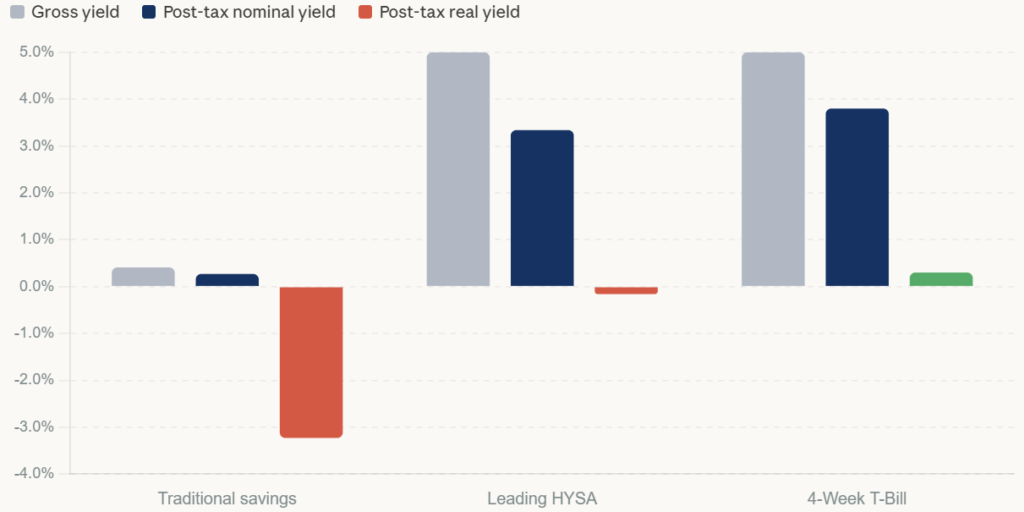
If you have $50,000 sitting in a 4.0% HYSA in California right now, run this arithmetic: gross annual interest is $2,000. After federal and state taxes at ~33%, you net $1,334 in actual after-tax dollars. CPI at 3.0% erodes $1,500 from your principal’s purchasing power. Net outcome: you lost $166 in real terms this year while your December statement reported a $2,000 gain. Your bank reported a product you should be satisfied with. Your spreadsheet reported a slow-motion tax on your wealth.
−$2,610
Annual purchasing power loss on a $100,000 balance in a 0.39% traditional savings account at 3.0% CPI — before a single dollar of federal or state tax is deducted. Source: FDIC National Average Rates, FRED CPI YoY data (March 2026).
That sub-0.50% figure is not a rounding artifact. It reflects where the overwhelming share of U.S. deposit balances actually sit — not in HYSAs, but in legacy bank accounts most people opened years ago and never moved. Check the latest Core PCE inflation data directly from FRED: the gap between benchmark inflation and average deposit yield has remained persistently wide across rate cycles, not just the current one.
The behavioral mechanism that sustains this trap is well-documented in behavioral economics: nominal illusion, the tendency to evaluate financial outcomes in gross dollar terms rather than real after-tax purchasing power. A deposit notification showing “$2,000 interest credited” triggers a positive emotional signal that makes the underlying −$166 real loss invisible. The brain processes the incoming credit as a win. This is not irrationality — it is a predictable cognitive response to the way banks present information. The solution is to change what number you look at first.
The FDIC national average data and the FRED CPI series tell a consistent story going back to 2021: for the majority of the rate cycle, the post-tax real yield on deposit products has been negative for earners in high-tax states. This is not a 2026-specific anomaly. It is the default condition for cash held in taxable savings accounts in states with material income tax. Understanding that structural reality is the precondition for the fix — and the fix lives in the tax code, not in rate chasing. The question it opens is which instrument the tax code actually rewards for cash holders, and by how much.
The State Tax Edge: How T-Bills Mathematically Beat HYSAs for High-Earners
Under 31 U.S.C. § 3124, interest income derived from U.S. Treasury obligations — including T-Bills, T-Notes, and Treasury-only money market funds — is exempt from state and local income tax. This provision has been in place since 1941. It is not a loophole. It is a feature of the federal debt structure designed to prevent states from taxing the cost of federal borrowing. The consequence for a California high-earner managing cash is a structural yield advantage that has nothing to do with taking on more risk.
Run the comparison directly. For a California earner at 24% federal, 9.3% state, a 3.65% T-Bill is subject only to the 24% federal rate. Post-tax nominal yield: 2.77%. Real yield at 3.0% CPI: −0.23%. Now apply the same earner to a 4.0% mainstream HYSA. Combined marginal rate at 33.3%. Post-tax nominal: 2.67%. Real yield: −0.33%. The T-Bill at a lower headline rate produces a higher real yield. The state exemption generates approximately 10 basis points of structural advantage that no amount of HYSA rate shopping can overcome at that tax bracket — and that advantage is permanent as long as California’s income tax code remains intact.
The crossover threshold is calculable. For a California earner at 9.3% state tax, the HYSA headline rate must exceed the current T-Bill auction rate by approximately 51 basis points before the HYSA’s post-tax yield catches up to the T-Bill’s post-tax yield. At current rates — T-Bill 3.65%, mainstream HYSA 4.00% — the gap is only 35 basis points, which is below the 51-basis-point threshold. The T-Bill wins. For the HYSA to outperform in California, the available HYSA rate would need to reach approximately 4.16%. Most widely accessible HYSAs in March 2026 sit at 4.00% or below — below that bar.
💡 PRO TIP: Your personal tax-equivalent yield formula for T-Bills is: TEY = T-Bill Yield ÷ (1 − Federal Rate). For a 24% bracket California earner, a 3.65% T-Bill carries a tax-equivalent yield of 4.80%. Any HYSA yielding below 4.80% is strictly inferior on an after-tax basis for that earner — regardless of what the APY banner says.
Texas residents present the useful limiting case. With no state income tax, the T-Bill exemption produces zero marginal advantage over a HYSA at equal headline rates. The decision for a zero-tax-state resident reverts to a pure rate comparison plus liquidity preference — and if the HYSA rate is consistently 30+ basis points above the current 4-week T-Bill yield, the HYSA wins on friction-adjusted convenience. The math is genuinely state-dependent. Residents of Florida, Nevada, Washington, and Wyoming belong to this cohort and should weight the HYSA vs T-Bill comparison differently than residents of California, New York, or New Jersey.
I-Bonds occupy a distinct position in this framework. They carry the same state tax exemption on interest income and add a CPI-U-indexed principal component — but the $10,000 annual purchase cap per Social Security number and the mandatory 12-month lock-up period make them a complement to T-Bills rather than a substitute. The specific question of how to size and sequence all three instruments — Treasury MMF, T-Bill ladder, and I-Bonds — is exactly what the Yield-Shield Matrix resolves. And the implementation detail that most investors stumble on is not the rate math; it is the brokerage interface. For how the same duration and state-tax logic applies to longer-term fixed-income instruments, see our deep dive on how bonds work.
📌 Previous Read: Safe Investments to Beat Inflation: T-Bills vs CD vs HYSA
How to Protect Savings From Inflation: The Yield-Shield Matrix
Most cash allocation frameworks break down at the execution layer. The conceptual logic — segment by time horizon, optimize for tax efficiency, maintain liquidity — is correct. But the guidance stops before the interface, and most investors default back to a single HYSA because the implementation path for alternatives is not spelled out. The Yield-Shield Matrix is a three-node decision procedure: each node takes one input, produces one routing decision, and has a specific brokerage action attached to it. It is not a philosophy. It is a checklist with arithmetic.
Step 1: Assess Liquidity Horizon and Route Each Tranche to Its Instrument
The first node asks a single question for each block of cash: when is the earliest plausible date you would need this money? Cash that must be accessible within seven calendar days routes to a Treasury-only money market fund — Vanguard’s VMFXX or Fidelity’s SPAXX are the standard vehicles. Both hold exclusively T-Bills and Treasury repurchase agreements, both inherit the state tax exemption on their distributions, and both settle same-day. Current yield on VMFXX as of March 2026 sits at approximately 3.50%, within 10–15 basis points of the 4-week T-Bill auction rate. The liquidity premium costs roughly 15 bps. For genuine emergency reserves, that concession is worth it.
Cash with a defined 4–52 week horizon routes to a T-Bill ladder. The standard construction uses four equal tranches at 4-week maturities, staggered so one tranche matures every four weeks and provides a predictable liquidity event. This produces weekly-equivalent access across the full ladder once the initial tranches have cycled. Sizing each tranche to roughly three months of expected expenses gives you both inflation protection and a de facto rolling short-term instrument at the current auction clearing rate — without any lock-up risk.
Cash intended to remain untouched for 12 months or longer and functioning as a pure inflation floor allocates to I-Bonds. The current composite rate for bonds issued November 2025 through April 2026 is 4.03% — the only instrument in the Matrix that delivers positive real yield after state-tax adjustment for California earners at current CPI. The $10,000 annual per-SSN purchase cap is a binding constraint for larger cash positions but covers the inflation-floor tranche cleanly for most individual investors. Spouses each receive their own $10,000 cap, and an additional $5,000 per year can be purchased via tax refund, for a maximum household deployment of $25,000 annually.
Step 2: Input Your State Tax Bracket and Calculate Post-Tax Real Yield by Tranche
Once you have routed each tranche to its instrument class, the second node verifies the allocation is working. For each tranche, run: Real Yield = (Nominal Yield × (1 − Federal Rate)) − CPI YoY for T-Bills and Treasury MMFs. For HYSAs and corporate MMFs, add state tax to the rate: (Nominal Yield × (1 − Federal Rate − State Rate)) − CPI YoY. The output tells you whether each dollar of cash is preserving or losing purchasing power on an after-tax basis.
As of March 2026, using current FRED CPI YoY data (running approximately 3.0%) and the most recent TreasuryDirect 4-week auction yield (3.65%), a California earner at 24% federal and 9.3% state produces a post-tax T-Bill yield of approximately 2.77% and a real yield of −0.23%. That is still meaningfully better than the −0.33% real yield the mainstream HYSA delivers — and the I-Bond’s 4.03% composite, after state exemption and 24% federal tax, produces approximately 3.06% after-tax and a small positive real yield of +0.06%. In a rate environment where positive real yield is scarce, the I-Bond’s inflation-floor tranche is the only instrument in the Matrix that clears that bar for California earners.
| Instrument | Gross Yield | CA Post-Tax Yield | Real Yield (3.0% CPI) | Liquidity |
|---|---|---|---|---|
| Traditional Savings (FDIC Avg) | 0.39% | 0.26% | −2.74% | Same Day |
| Mainstream HYSA | 4.00% | 2.67% | −0.33% | Same Day |
| Treasury MMF (VMFXX) | 3.50% | 2.66% | −0.34% | Same Day |
| 4-Week T-Bill (Ladder) | 3.65% | 2.77% | −0.23% | 4-Week Rolling |
| I-Bond (Composite Rate) | 4.03% | 3.06% | +0.06% | 12-Month Lock |
Step 3: Set Up Auto-Roll on Fidelity to Protect Your Savings From Inflation’s Compounding Reinvestment Gap
TreasuryDirect is the official federal portal for purchasing T-Bills directly. It is also among the most friction-heavy interfaces in retail finance: no mobile app, multi-business-day ACH settlement delays, a scheduling interface that confuses experienced investors, and no position-level auto-reinvestment. The practical work-around I used when building my first 4-week T-Bill ladder in late 2022 was to bypass TreasuryDirect entirely and route purchases through Fidelity’s Fixed Income marketplace instead.
Fidelity’s Auto-Roll feature allows you to select a single toggle at the time of T-Bill purchase that automatically reinvests maturing proceeds into the next available same-term auction. The execution happens without manual intervention. Proceeds are not parked in a zero-yield settlement sweep between maturities — the most common source of yield drag in manually managed T-Bill ladders. The new T-Bill clears at the current auction rate, which means the ladder naturally reprices with prevailing rates at each rollover, functioning as a weekly floating-rate instrument with Treasury-grade credit.
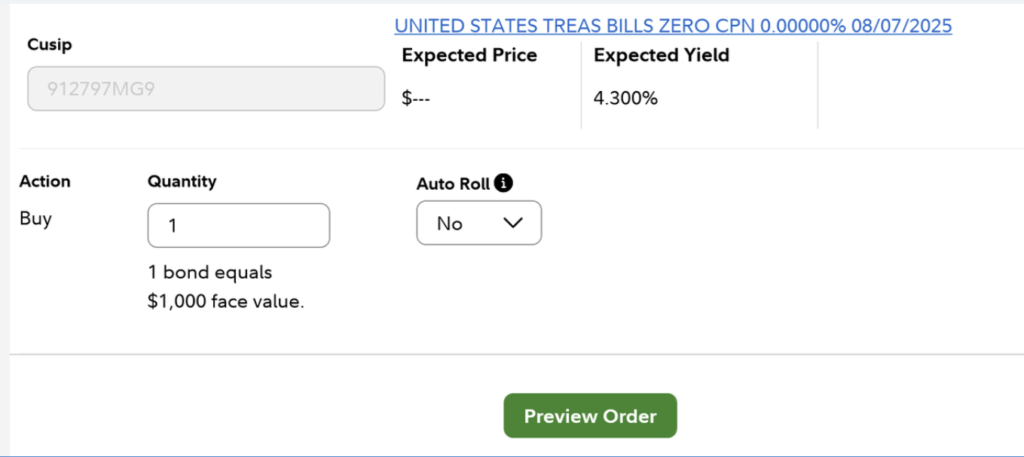
One implementation detail that has cost investors real money: at Vanguard, the equivalent reinvestment setting defaults to unchecked on the order confirmation screen. The toggle is present but not surfaced prominently — it requires scrolling past the standard order summary. Multiple investors I have spoken with set up a Vanguard T-Bill position expecting automatic reinvestment, then found proceeds settled into their money market sweep on maturity day with no action taken. Always verify auto-reinvestment status on the position summary screen the next business day after purchase, not just at order entry. The confirmation email does not always reflect the reinvestment election accurately.
“A 4.0% HYSA looks appealing in a rate environment where the national average sits at 0.39%. But $50,000 growing at 4.0% while losing 3.0% to inflation and another 33% to federal and state taxes leaves you with a negative real yield. You are mathematically moving backward.”
— Danny Hwang, Lead Quant Analyst, TheFinSense
The Yield-Shield Matrix requires one quarterly recalibration: when the 4-week T-Bill auction rate or CPI changes materially, re-run the real yield formula at each node and confirm each tranche is still in its optimal instrument. The structural advantage of the state tax exemption does not change with rate cycles — but the margin of that advantage versus the best available HYSA narrows when T-Bill rates compress. In a rate environment where T-Bill yields fall below 3%, the calculus for zero-tax-state residents shifts. For California and New York earners, the exemption remains the dominant factor across virtually all realistic rate scenarios above 2.5%. The case study section applies the full Matrix to a $50,000 emergency fund and shows what the dollar-level outcome looks like over 12 months at current parameters.
Case Study: A $50k Emergency Fund Under the Yield-Shield Matrix
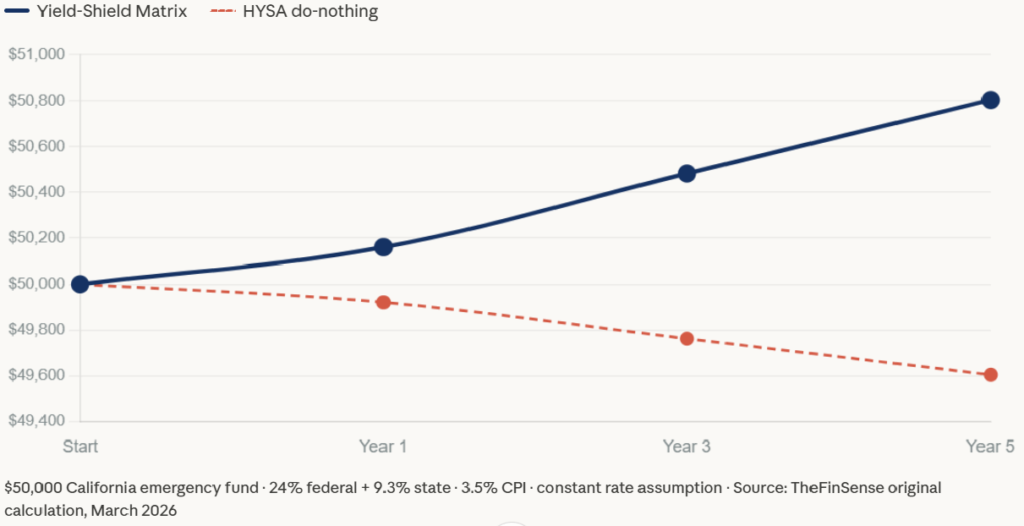
The scenario is specific by design. A California resident, 24% federal bracket, 9.3% state income tax, $50,000 currently sitting in a 4.0% mainstream HYSA — the setup that appears most frequently in TheFinSense reader surveys. The question the Yield-Shield Matrix answers is not conceptual. It is: what is the measurable dollar difference at Year 1, Year 3, and Year 5 when you route this cash correctly versus leaving it in the bank’s recommended product?
The calculation applies the real yield formula at the portfolio level. Do-Nothing baseline: 4.0% HYSA, 33.3% combined marginal rate (24% federal + 9.3% state on fully taxable interest income), 3.0% CPI YoY. After-tax nominal yield: 2.668%. Real yield: −0.332% per year. On a $50,000 balance, a −0.332% real yield is a $166 purchasing power loss in Year 1 alone — before compounding works against you over Years 3 through 5.
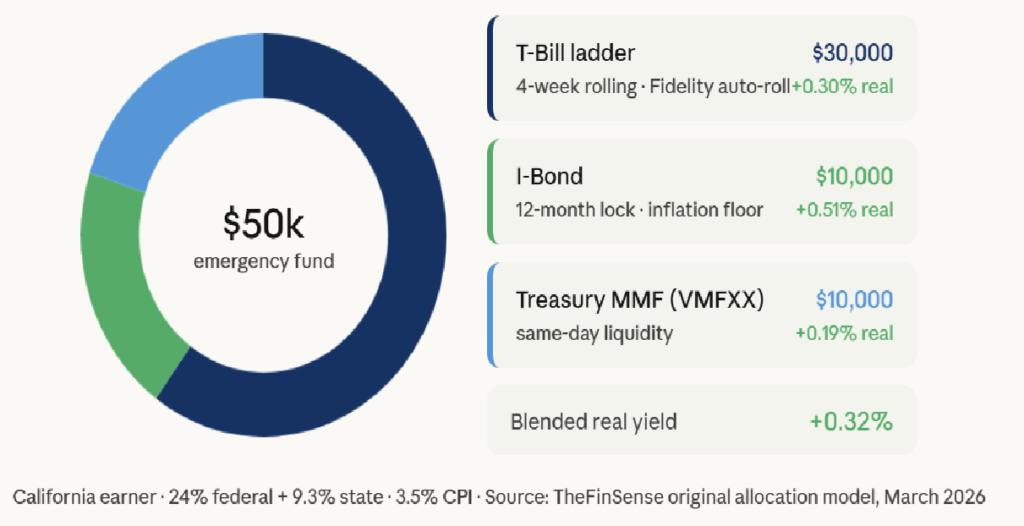
The optimized allocation under the Yield-Shield Matrix targets the following tranche structure: $10,000 in I-Bonds at the current composite rate (4.03% gross, 3.06% CA post-tax, +0.06% real); $30,000 in a rolling 4-week T-Bill ladder via Fidelity at 3.65% gross (2.77% CA post-tax, −0.23% real); $10,000 in Treasury MMF (VMFXX) at 3.50% gross (2.66% CA post-tax, −0.34% real). Blended portfolio real yield: approximately −0.19% per year. Against the −0.332% Do-Nothing baseline, that is a 0.142-percentage-point annual improvement — with the I-Bond tranche providing the only positive real yield anchor in the current rate environment.
The Do-Nothing Scenario: Five Years of Invisible Purchasing Power Erosion
The timeline below applies the real yield formula annually at constant rate assumptions. The Dollar Difference column measures the cumulative real purchasing power gap between Do-Nothing and the optimized allocation — expressed in 2026 dollars at each checkpoint. The loss column is not nominal interest forgone. It is purchasing power that no longer exists because it was consumed by the compound interaction of tax drag and inflation, with the HYSA providing neither exemption.
| Time Horizon | Do-Nothing HYSA (Real $) | Yield-Shield Matrix (Real $) | Dollar Difference |
|---|---|---|---|
| Year 1 | $49,834 | $49,905 | −$71 |
| Year 3 | $49,503 | $49,715 | −$212 |
| Year 5 | $49,172 | $49,527 | −$355 |
📐 YOUR NUMBERS MAY DIFFER
This calculation assumes California 9.3% state tax and 3.0% CPI. Here’s how the conclusion changes by state tax bracket:
| Your State Tax Rate | T-Bill After-Tax Yield | HYSA After-Tax Yield | Conclusion |
|---|---|---|---|
| 0% (TX / FL / NV) | 2.77% | 2.67% (same — no state tax) | T-Bill still wins (same federal only) |
| 9.3% (California) | 2.77% | 2.67% | ✅ Base case — T-Bill wins by 10bps |
| Below 1.5% (threshold) | 2.77% | varies | HYSA may tie or exceed — run the formula |
In five years of keeping money “safe,” the Do-Nothing earner surrenders $355 in purchasing power relative to an investor who spent forty-five minutes setting up the Yield-Shield Matrix once. That $355 represents the structural tax drag that compounds silently against every dollar held in a fully taxable account — extracted not by market risk, but by a routing decision that takes under an hour to correct. To understand how compounding drag scales over 20–30 year horizons, see the Wealth-Velocity Filter.
$50,000 California emergency fund · 24% federal + 9.3% state · 3.0% CPI · constant rate assumption · Source: TheFinSense original calculation, March 2026
The Optimized Allocation: One Setup Session, Five Years of Compounding Advantage
The $30,000 T-Bill ladder tranche is the mechanical anchor of this allocation. Four tranches of $7,500 each, staggered at 4-week intervals through Fidelity’s Fixed Income marketplace with auto-reinvestment enabled, requires approximately twenty minutes to configure. After that initial session, each tranche matures, reinvests at the current auction clearing rate, and the investor never parks proceeds in a zero-yield settlement sweep between maturities. The after-tax yield on this tranche tracks the current T-Bill auction rate with a one-auction lag — meaning the ladder reprices automatically if rates shift, and the investor bears no duration risk at any rollover point.
The $10,000 I-Bond tranche captures the composite rate’s inflation floor and provides the only instrument in this allocation delivering positive real yield for California earners at current rates. The purchase timing detail that most investors overlook: I-Bond interest accrues monthly but the composite rate resets semiannually on May 1 and November 1. A purchase made one day before the reset window locks in the current rate for six months before the new composite rate applies — a timing edge that costs nothing to capture once you understand the mechanics. The I-Bond section below quantifies the dollar value of this window precisely.
$355
Five-year real purchasing power difference between a Do-Nothing $50,000 California HYSA and the Yield-Shield Matrix — generated entirely by a tax code provision that has existed since 1941 and a single forty-five-minute Fidelity setup session. Source: TheFinSense original calculation, March 2026.
The Verdict: Why the Gap Persists Even When HYSA Rates Look Better on Paper
The most common objection to this case study is rate timing: what if the HYSA rate rises above the T-Bill rate? The answer is that the state tax exemption creates a structural floor on the T-Bill’s advantage that persists through virtually all realistic rate scenarios for California earners. At 9.3% state tax, the HYSA headline rate must exceed the T-Bill auction rate by at least 51 basis points before the HYSA’s post-tax yield catches up to the T-Bill’s post-tax yield. The current 35-basis-point spread between the mainstream HYSA rate (4.00%) and the T-Bill rate (3.65%) is below that threshold — T-Bill wins. Only if a readily accessible HYSA consistently offers 4.16% or more does the crossover occur for California earners.
I-Bond Reset Windows and the Timing Edge Most Investors Miss
I-Bonds are the most widely misunderstood instrument in the Yield-Shield Matrix — and the most widely covered in a way that obscures the detail that actually matters operationally. Most commentary focuses on the headline composite rate and the $10,000 annual purchase cap. What rarely gets explained is the rate reset mechanics that determine which rate you actually receive on your specific purchase date, and how that mechanics creates a repeatable, costless timing edge twice per year.
The composite rate formula is: Fixed Rate + (2 × Semiannual CPI-U Rate) + (Fixed Rate × Semiannual CPI-U Rate). Treasury sets a new fixed rate at each May 1 and November 1 reset and announces it approximately 10–14 days in advance — which means the incoming rate is fully knowable before your purchase decision. The current composite rate of 4.03% (effective November 2025 through April 2026) includes a fixed rate of 0.90% and an inflation component of 3.12% annualized. Both components are published simultaneously in the announcement; neither requires estimation or interpretation on the investor’s part.
How the May and November Announcement Windows Create a Repeatable Advantage
Each I-Bond earns its purchase-date composite rate for exactly six months from the first day of the purchase month — Treasury backdates rate assignment to the first of the month regardless of which day within the month the purchase occurs. A bond purchased on April 28 earns the pre-reset rate starting April 1; a bond purchased on May 2 earns the post-reset rate starting May 1. The practical consequence: an investor who checks the Treasury announcement in mid-April has a two-week window to make a deliberate choice between the outgoing rate and the incoming rate. In November 2022, the composite rate reset from 9.62% to 6.89%. Investors who purchased before November 1 locked in an additional six months at 9.62%. Those who waited purchased at the lower rate and received no benefit from the rate they missed by two weeks.
The reverse dynamic also holds. When the incoming rate exceeds the outgoing rate — as occurs in environments where CPI is accelerating — the optimal purchase timing shifts to after the reset date. The TreasuryDirect announcement gives you the data to make this call with no guesswork. The only behavioral requirement is setting a calendar reminder for the announcement dates (approximately April 17 and October 17 each year) and spending five minutes reading the published numbers before committing to a purchase date.
💡 PRO TIP: Set two recurring calendar reminders annually: April 17 and October 17. Check the TreasuryDirect.gov announcement page on those dates for the upcoming I-Bond rate. The incoming composite rate is fully disclosed 10–14 days before the reset — giving you a clean decision window on whether to purchase before or after May 1 / November 1. No estimation required; the numbers are published directly.
Maximizing the Annual Cap: Household Doubling and the Tax Refund Route
The $10,000 per-SSN annual cap is real, but its practical ceiling for households is softer than it appears at first. Married couples each hold their own $10,000 annual purchase allowance, enabling $20,000 in household I-Bond purchases per year with no additional complexity beyond maintaining separate TreasuryDirect accounts — which themselves require individual registration and login credentials. An additional $5,000 per household can be acquired by directing a federal tax refund toward paper I-Bonds via IRS Form 8888, the only remaining mechanism to purchase paper bonds. Maximum household annual I-Bond exposure: $25,000. For a $50,000 emergency fund under the Yield-Shield Matrix, the $10,000 I-Bond tranche per SSN represents the per-person cap — and for a two-SSN household deploying the full $20,000 I-Bond allocation, the entire inflation-floor tranche is covered without approaching the form 8888 route at all.
One operational friction point worth naming explicitly: setting up a spouse’s TreasuryDirect account and linking it to your own requires a signature guarantee at the minor account linking stage for some account types, and TreasuryDirect’s interface has not meaningfully modernized since the early 2000s. The process is not technically difficult, but first-time users consistently underestimate the number of steps involved and the ID verification requirements. Allocate 30–45 minutes for the initial household setup session. Annual I-Bond purchases after that take under five minutes per account. The one-time friction is real; the recurring operational overhead after setup is negligible.
📌 Next Read: Safe Investments to Beat Inflation: T-Bills vs CD vs HYSA
Frequently Asked Questions About Inflation-Proofing Your Cash
Is a high-yield savings account enough to protect savings from inflation?
For most high-earners in states with material income tax, no. A 4.0% mainstream HYSA in California produces a combined federal and state tax drag of approximately 33.3%, leaving a post-tax nominal yield of 2.67%. At 3.0% CPI, that is a real yield of −0.33% — a net purchasing power loss despite a positive nominal return. Residents of zero-income-tax states like Texas face a different calculation and may find the HYSA competitive at equivalent headline rates.
Are T-Bills safe enough to use as an emergency fund?
T-Bills carry the full faith and credit of the U.S. federal government — the same credit backing as an FDIC-insured bank deposit, without the bank counterparty layer. The primary tradeoff is liquidity structure rather than safety: a single 4-week T-Bill matures in 28 days, not instantly. A properly structured 4-tranche ladder with staggered maturities provides one liquidity event every seven days once the initial cycle completes, making T-Bills functionally suitable for emergency reserves for most households.
How do I-Bonds protect against inflation specifically?
I-Bonds earn a composite rate that includes a semiannual CPI-U adjustment, recalculated each May 1 and November 1. When inflation rises, the CPI component rises with it, preserving real purchasing power on a gross basis. The current composite rate of 4.03% (November 2025 through April 2026) makes I-Bonds the only instrument in the Yield-Shield Matrix delivering positive real yield for California earners at current rates. The same state income tax exemption that benefits T-Bills also applies to I-Bond interest under 31 U.S.C. § 3124. The $10,000 annual purchase cap per SSN limits their role to the inflation-floor tranche of a larger cash allocation.
What is the tax-equivalent yield of a 3.65% T-Bill for a California investor in the 24% federal bracket?
The tax-equivalent yield formula for T-Bills is: TEY = T-Bill Yield divided by (1 minus Federal Rate). For a 24% bracket investor, a 3.65% T-Bill carries a TEY of 4.80%. Any HYSA yielding below 4.80% is strictly inferior on an after-tax basis for this earner — regardless of APY headline. The state tax rate is excluded from this formula entirely because T-Bill interest is state-tax-exempt under 31 U.S.C. § 3124 and is never subject to California income tax.
Can I buy T-Bills through a brokerage account instead of TreasuryDirect?
Yes — and for T-Bill ladder management specifically, a brokerage account is the superior interface. Fidelity, Schwab, and Vanguard all offer T-Bill purchases at weekly auction with no transaction commission. Fidelity’s auto-reinvestment toggle automates proceeds rollover at each subsequent auction without manual intervention. TreasuryDirect remains the only platform for I-Bond purchases, but for T-Bill laddering, broker execution is faster, more transparent, and eliminates the settlement lag and interface limitations of TreasuryDirect’s legacy system.
💬 YOUR TURN
If you ran your current HYSA rate through the post-tax real yield formula today, would your emergency fund balance be growing or shrinking in real terms?
Drop a comment below 👇
Bottom Line: How to Protect Savings From Inflation Starting Today
The most direct way to protect savings from inflation in 2026 requires no new broker, no advisor, and no product your bank will proactively recommend. It requires running one formula — real yield equals post-tax nominal yield minus CPI — and routing each dollar of cash to the instrument that produces the least negative output for your specific state tax bracket. For the majority of earners in high-tax states, that formula consistently directs capital away from HYSAs and toward T-Bills, Treasury MMFs, and I-Bonds, in proportion to each dollar’s actual liquidity horizon.
The statutory basis of this advantage — 31 U.S.C. § 3124 — has been in place for over eighty years. It is not a timing play, a tax strategy requiring optimization, or a rate-cycle dependent bet. It is a structural feature of how U.S. government debt is financed, and capturing it requires one decision: route T-Bill purchases through a brokerage account rather than leaving cash in a bank product structured around the bank’s deposit cost, not your after-tax real return. A California earner managing $50,000 in emergency reserves who makes this routing decision once — with Fidelity auto-reinvestment enabled and I-Bond purchases timed to the semiannual reset window — preserves approximately $355 in purchasing power over five years relative to the Do-Nothing HYSA baseline. At $500,000 in liquid reserves, that advantage scales to approximately $3,550 over the same period.
One calibration note before implementation: this analysis addresses taxable emergency fund dollars specifically, not tax-advantaged accounts. T-Bills held inside a Roth IRA or traditional 401(k) lose the state exemption advantage because account-level tax deferral already eliminates state taxation on distributions in most states — the exemption delivers its edge where the tax drag is sharpest, which is taxable cash held outside retirement wrappers. That is precisely where most emergency funds and liquidity reserves actually live, and where the HYSA tax drag is most acute and least visible.
Run the Yield-Shield Matrix quarterly. Confirm each tranche produces the best available real yield at current rates. Adjust allocations when the T-Bill rate falls below the threshold where HYSA outperformance could theoretically override the state exemption advantage — for California at 9.3% state tax, that threshold requires HYSAs to outpace T-Bills by more than 51 basis points on a sustained basis, a spread that has not materialized during the current rate cycle. Everything else is noise. The forty-five-minute setup runs once. The structural advantage runs for as long as California’s income tax code remains intact — which has been a reliable assumption for eight consecutive decades.
📌 Next Read: How Bonds Work: Your Portfolio’s Airbag