📅 Originally Published: · Last Updated:
Every paycheck, the HSA balance rises by another deposit. The tap stays open. The water sits still.
The Bottom Line, Up Front
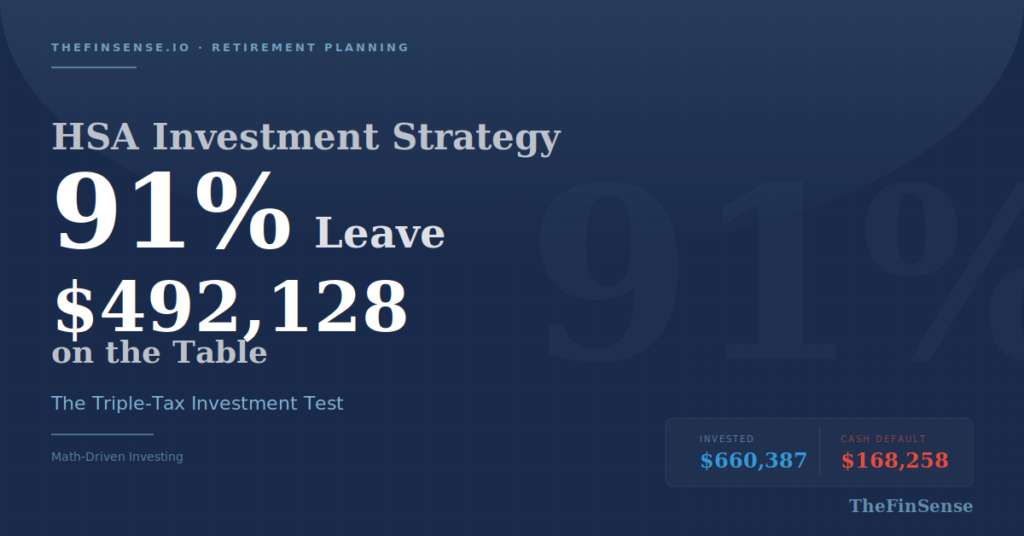
An HSA investment strategy separates the 9% who build six-figure tax-free balances from the 91% who leave every dollar in a cash sweep earning 0.5%. The gap on $4,400 in annual contributions over 35 years: $492,128. The Triple-Tax Investment Test takes 32 minutes and one index fund selection.
What does an HSA investment strategy require beyond the annual contribution? Does the tax deduction and rising balance mean the account is working? The Devenir 2024 Year-End HSA Research Report measured 39 million accounts and found that 91% contain zero invested assets.
Investors hold $22,032 on average. Non-investors hold roughly $2,500. The rising number is real, but the question is whether it measures the right step.
Why 91% of HSA Holders Never Take the Second Step
Keeping cash available for the annual deductible is rational when out-of-pocket costs are high. The 20% who account for 80% of healthcare spending need liquidity. Selling investments during a downturn to cover a medical bill destroys the compounding advantage.
The question is whether the remaining 80% of holders face the same constraint. One Bogleheads thread captures the default assumption: “I too am feeling it would be safer to hold HSA funds without investing.” The thread consensus reached the opposite conclusion: treat the HSA as a Roth extension, allocate 100% equities, pay medical expenses out of pocket.
What separates the forum consensus from the 91% who keep cash?
Not income, not risk tolerance. The system design itself.
Optum Financial requires a $2,000 cash floor before the investment tab activates. The default dashboard displays only the cash balance.
The holder with $5,000 in HSA cash sees the balance growing and assumes the account is working. The high earner maximizing a 401(k) and Roth IRA may not realize the HSA outperforms both on a tax-equivalent basis. The parent covering $3,000 in annual prescriptions needs cash on hand.
The portion above the deductible earns more invested than in the custodian sweep.
The tax deduction arrives on the first contribution. The investment option is buried behind a threshold the custodian sets.
Contributing to an HSA and investing in an HSA are separate actions. The IRS Revenue Procedure 2025-19 sets the 2026 individual limit at $4,400. Jon Robb, Senior Vice President of Research and Technology at Devenir, tracked the data across 39 million accounts.
Only 9% have crossed from contributing to investing. An HSA investment strategy requires both steps. How much does the gap between them actually cost?
The 9:1 Balance Gap Across 39 Million HSA Accounts
The gap shows up in one number: investors hold nine times the balance of non-investors across 39 million accounts.
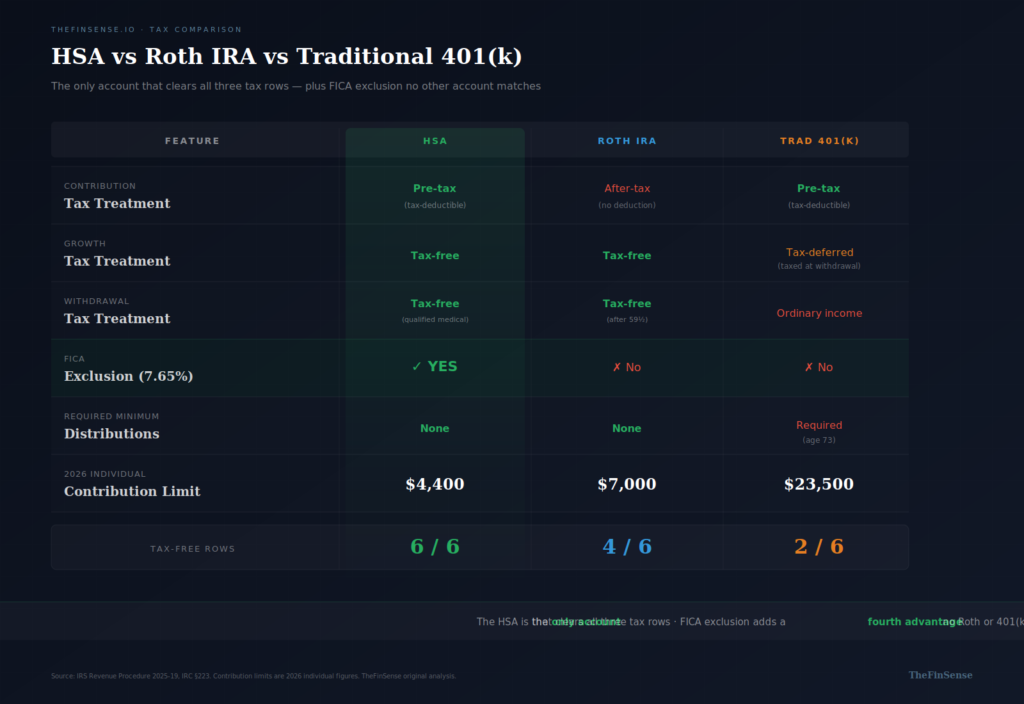
Where does the gap originate? The tax code treats these three accounts differently.
| Feature | HSA | Roth IRA | Traditional 401(k) |
|---|---|---|---|
| Contribution Tax | Pre-tax (tax-deductible) | After-tax | Pre-tax |
| Growth Tax | Tax-free | Tax-free | Tax-deferred |
| Withdrawal Tax | Tax-free (qualified medical) | Tax-free (after 59½) | Ordinary income |
| FICA Exclusion | Yes (payroll deduction) | No | No |
| RMDs | None | None | Required at 73 |
| 2026 Individual Limit | $4,400 | $7,000 | $23,500 |
The HSA is the only account that clears all three tax rows. Readers already weighing a Roth vs Traditional IRA contribution face a parallel calculation. The FICA row reveals the advantage no Roth can replicate: 7.65% excluded before the deposit reaches the account.
▶ HSA Triple-Tax Advantage by The Retirement Nerds.
Why do 91% of holders leave the account in cash if the tax structure is this favorable? Paul Fronstin, Director of Health Benefits Research at the Employee Benefit Research Institute (EBRI), identified the barrier. The gap is informational, not financial.
“Most HSA holders do not know the investment option exists. The behavioral pattern improves with account tenure, but the default remains cash.”
— Paul Fronstin, Director of Health Benefits Research, Employee Benefit Research Institute (EBRI)
The spend-through data confirms the pattern. Devenir tracked $56 billion contributed to HSA accounts in 2024 and $42 billion withdrawn during the same period. The 75% spend-through rate reveals the majority treat the HSA as a medical checking account.
HSA holders who invest carry nine times the balance of those who leave funds in cash.
The HSA investment strategy gap is not about income. It is about information.
The calculation that follows applies at every balance level, starting from the first dollar above the annual deductible.
The balance rises with each deposit, but the cash sweep adds $14,258 in growth over 35 years while the market adds $506,387. What is the formula behind the gap?
How the HSA Investment Strategy Formula Produces $660,387
The formula takes one variable: the annual return rate on $4,400 in contributions over 35 years.
The HSA Investment Strategy Annuity Formula
Fronstin (EBRI) asked a harder question in 2014: what happens when the HSA holder invests the balance over an entire career? His accumulation model set the ceiling at $1.1 million over 40 years at a 7.5% return with zero withdrawals. What does the annuity formula produce at the current HSA contribution limit?
The inputs: $366.67 per month ($4,400 ÷ 12), a 7% annual return, and 35 years.
FV = PMT × [((1 + r/12)^(t×12) − 1) / (r/12)]
$366.67 × [((1.005833)^420 − 1) / 0.005833] = $660,387.
What does the same deposit produce at the default cash sweep rate of 0.5%? $366.67 × [((1.000417)^420 − 1) / 0.000417] = $168,258. The gap: $492,128 on identical contributions.
The transfer requires a separate enrollment, fund selection, and a manual sweep. Most holders abandon the process at the threshold step.
Triple-Tax Advantage vs Roth IRA and 401(k)
The HSA clears three tax gates that no single competitor matches. Contributions bypass FICA at 7.65% through payroll deduction. Growth compounds tax-free, and qualified medical withdrawals pay zero federal or state income tax.
After age 65, the account shifts.
Non-medical withdrawals are taxed as ordinary income with no penalty. The HSA becomes functionally a Traditional IRA that also provides tax-free medical access.
Readers verifying their 401k employer match vesting schedule should note the distinction. The 401(k) defers tax on contributions but collects it on every withdrawal. The HSA eliminates tax on qualified medical withdrawals entirely.
Before Fronstin (2014), the field treated HSAs as transactional spending accounts attached to high-deductible plans. His accumulation model revealed a $1.1 million ceiling that reframed the HSA as the most tax-efficient retirement vehicle in the tax code. Devenir (2024) measured the distance between the ceiling and reality: 91% of 39 million accounts contain zero invested assets.
Why Even Conservative Returns Beat the Cash Default
Does the HSA investment strategy gap disappear at lower return assumptions?
At 3% invested return, the annuity formula produces $271,907. The cash sweep at 0.5% still produces $168,258, narrowing the gap to $103,649 without closing it.
Does the gap disappear at shorter time horizons? At 10 years, the invested path produces $63,464 versus $45,109 in cash. The $18,355 gap at the decade mark already exceeds two years of contributions.
Jacob Berman of the Office of Tax Analysis, U.S. Department of the Treasury, tracked HSA contribution patterns. Sita Slavov, Professor of Public Policy at George Mason University and NBER Research Associate, co-designed the study. Berman, Bloomfield, and Slavov (2025) found a 6.66% catch-up surge at age 55 with no retirement savings crowd-out.
The name says savings. The math says the most powerful retirement vehicle in the tax code. What does this HSA investment strategy produce for someone at my income level?
Morgan’s $4,400 Per Year: 35 Years in Cash vs Invested
Morgan opened the HSA at 30, contributed $4,400 each year, and left every dollar in the cash sweep alongside the other 91%.
The parameters: individual HDHP coverage, $366.67 per month deposited automatically, medical expenses paid out of pocket, receipts archived. Morgan followed every instruction the employer materials provided.
What does 35 years of contributions produce at the default cash sweep rate versus a total stock market index fund? The table separates the two paths.
| Year (Age) | Invested at 7% | Cash at 0.5% | Gap |
|---|---|---|---|
| Year 5 (35) | $26,251 | $22,273 | $3,978 |
| Year 10 (40) | $63,464 | $45,109 | $18,355 |
| Year 15 (45) | $116,220 | $68,523 | $47,696 |
| Year 20 (50) | $191,006 | $92,530 | $98,476 |
| Year 25 (55) | $297,026 | $117,145 | $179,882 |
| Year 30 (60) | $447,323 | $142,382 | $304,941 |
| Year 35 (65) | $660,387 | $168,258 | $492,128 |
How the HSA Investment Strategy Gap Reaches $492,128 Over 35 Years
Morgan, age 30, $4,400/year contributions, 7% invested vs 0.5% cash sweep
The chart traces two paths from the same paycheck. The lines overlap for the first five years. By year 15 the gap reaches $47,696.
By year 25 the invested balance doubles the cash balance. The final five years alone add $163,064 to the gap.
Morgan did not pick stocks, time the market, or make a single trade after the initial setup. The contributions were identical. The only variable was one enrollment step.
$154,000 contributed. $14,258 earned in cash. $660,387 possible if invested. The gap: $492,128. All tax-free.
The $492,128 represents 49 years of annual vacations at the national average. Morgan contributed for 35 years and the cash default returned $14,258 in growth on $154,000 in deposits.
The numbers pooled for 35 years without moving.
📐 YOUR NUMBERS MAY DIFFER
This calculation assumes a 7% annual return on the invested path. Here is how the gap changes at different rates:
| Annual Return | Invested FV | Gap vs Cash | Conclusion |
|---|---|---|---|
| 6% | $522,394 | $354,135 | Gap exceeds 2x contributions |
| 7% | $660,387 | $492,128 | Base case |
| 8% | $841,090 | $672,832 | Gap exceeds 4x contributions |
Time horizon shifts the result further. At 25 years the gap reaches $179,882. Extending to 40 years produces a $767,642 gap.
Even at 10 years the invested path leads by $18,355, more than two full years of contributions.
$154,000 deposited. $492,128 left on the table. The gap exceeds the contributions by a factor of three.
What do I do first?
The Triple-Tax Investment Test: 5 Steps in 32 Minutes
The fix starts with one check: does the current custodian charge a threshold to invest?
Step 1: Check Your Custodian’s Investment Threshold (2 Minutes)
Log into the HSA custodian portal and locate the investment tab. Some custodians display it on the main dashboard. Others bury it under a secondary menu labeled “Manage Investments” or “Transfer to Investments.”
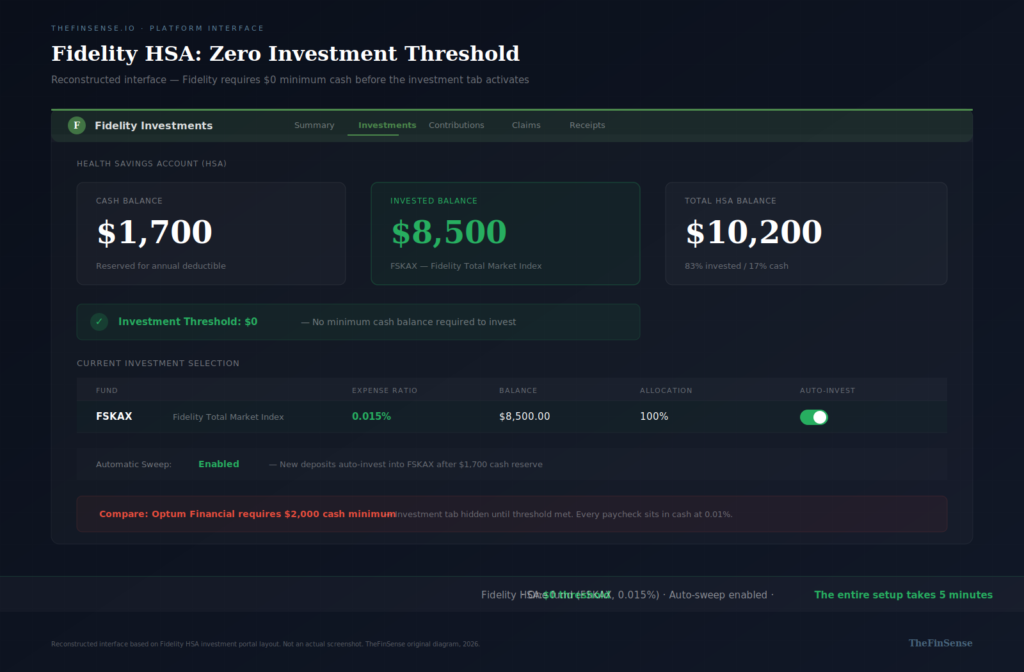
The threshold is the minimum cash balance the custodian requires before the investment option activates. Fidelity and Schwab set this at $0. Optum Financial sets it at $2,000.
HealthEquity sets it at $1,000.
If the threshold is $0, skip to Step 3. If the threshold exceeds $1,000, the next step matters more than the fund selection.
Step 2: Transfer to Fidelity or Schwab If Threshold Exceeds $1,000 (15 Minutes)
A custodian-to-custodian transfer moves the full HSA balance without triggering a taxable event. The IRS permits one rollover per 12-month period. The receiving custodian initiates the transfer.
Open a Fidelity or Schwab HSA online. The application takes 10 minutes. Request the transfer from the new custodian’s portal by entering the outgoing custodian’s name and account number.
Keep the employer-linked HSA open for payroll deposits.
Set a quarterly calendar reminder to sweep the balance from the employer custodian to the investment custodian.
Step 3: Select a Total Stock Market Index Fund (5 Minutes)
One fund covers the entire U.S. equity market. Fidelity offers FSKAX (total market, 0.015% expense ratio). Schwab offers SWTSX (total market, 0.03%).
Both provide broad diversification with near-zero cost.
Readers approaching retirement who want lower volatility can allocate a portion to a bond index fund. Understanding how bonds work helps calibrate the split between equities and fixed income inside the HSA.
Berman, Slavov, and Bloomfield (2025) found no evidence that HSA investment crowds out retirement savings.
Step 4: Set Up Automatic Sweeps and Archive Receipts (10 Minutes)
Configure automatic investment so new deposits move from cash sweep to the selected fund without manual intervention. Most custodians offer this as a toggle in the investment settings.
Pay current medical expenses out of pocket. Save every receipt. The IRS has no deadline for HSA reimbursement.
A $500 medical bill paid today can be reimbursed tax-free in 20 years after the balance has compounded.
This receipt archive converts the HSA into a dual-purpose vehicle: tax-free compounding now, tax-free withdrawal later, on a timeline the holder controls.
The HSA Investment Strategy Triple-Tax Investment Test Workflow
5-step process: 32 minutes from threshold check to receipt archive
TheFinSense’s Triple-Tax Investment Test distills this into five criteria: threshold check, custodian transfer, one index fund selection, automatic sweep, and receipt archive.
W-2 employees with after-tax 401(k) access can extend tax-free growth even further: the mega backdoor Roth adds $42,100 in annual Roth capacity on top of the HSA’s triple-tax advantage.
The entire process takes 32 minutes. The fund selection does not need to change after the initial setup.Every paycheck, the first $2,000 sits in cash earning 0.01% while the investment account waits.
The fix requires one fund selection and one automatic sweep. The risk of inaction costs $492,128.
If you also hold a leftover college savings balance, The 529 Penalty Break-Even Test uses the same 15-year compounding logic to determine whether keeping the account beats withdrawing to avoid the penalty.
How we calculated this: TheFinSense Methodology
When This Analysis Does Not Apply
This analysis holds for approximately 80% of HSA holders. Fronstin (EBRI) identified that 20% of the insured population accounts for 80% of healthcare spending in any given year. If annual out-of-pocket costs exceed $3,000: keep the deductible in cash, invest only the surplus, and reassess annually.
Fronstin’s finding draws from nationally representative expenditure data (EBRI/Inspira Financial 2024).
Hold cash equal to the annual HDHP deductible ($1,700 individual in 2026). Invest every dollar above that floor. If medical costs drop in a future year, sweep the excess cash into investments.
HSA Investment Strategy FAQ: 5 Questions Before You Invest
Does investing my HSA mean I cannot use it for medical expenses
No. Invested HSA funds remain available for qualified medical expenses at any time. Selling investments to cover a medical bill takes one to three business days at most custodians. The difference is that uninvested cash earns 0.5% while invested funds target 7% annual growth. Holders who pay medical costs out of pocket and reimburse themselves later preserve both the compounding and the tax-free withdrawal. The IRS imposes no deadline on HSA reimbursement.
How does the HSA triple-tax advantage compare to a Roth IRA after age 65
Before 65, the HSA withdraws tax-free only for qualified medical expenses. After 65, non-medical HSA withdrawals are taxed as ordinary income with no penalty, matching the Traditional IRA tax treatment. Medical withdrawals remain tax-free at any age. The Roth IRA withdraws tax-free for any purpose after 59½ but contributions are post-tax and subject to FICA. The HSA skips FICA at 7.65% through payroll deduction, an advantage the Roth cannot replicate.
Can I invest my HSA if my employer chose the custodian
Yes. Most employer-selected custodians offer an investment option, though the threshold and fund selection vary. If the employer custodian charges a high threshold or offers limited funds, open a second HSA at Fidelity or Schwab with zero threshold. Keep the employer HSA open for payroll deposits. Set a quarterly reminder to transfer the balance from the employer custodian to the investment custodian. The IRS allows one trustee-to-trustee transfer per rolling 12-month period.
What if my HSA custodian requires a $1,000 or $2,000 minimum before I can invest
Transfer to a custodian with zero investment threshold. Fidelity and Schwab both allow HSA investment starting from the first dollar. Keep the employer-linked HSA open to receive payroll contributions and the FICA exclusion. Every quarter, initiate a trustee-to-trustee transfer from the employer custodian to the investment custodian. This workaround preserves the payroll tax advantage while eliminating the cash threshold that delays compounding.
Does the OBBBA 2025 change who qualifies for an HSA
Yes. The One Big Beautiful Bill Act, signed July 2025, reclassifies Bronze and Catastrophic ACA Marketplace plans as HSA-compatible starting January 1, 2026. This expansion makes approximately 7.3 million additional Americans eligible to open and contribute to an HSA. The law also permanently allows telehealth services before the deductible without losing HSA eligibility. Existing HDHP holders see no change to contribution limits or the HSA investment strategy framework described above.
The HSA Investment Strategy That Starts After the Contribution
The 91% who contribute without investing follow the same path Morgan followed for 35 years.
The account’s mathematical superiority requires one behavioral step. An HSA investment strategy works because the annuity formula compounds tax-free on identical contributions. The 91% who skip the investment enrollment forfeit $492,128 on $154,000 in deposits.
The $492,128 is the investment gap. The real cost includes the FICA advantage abandoned, the receipt strategy forfeited, and the only RMD-free retirement account treated as disposable cash.
The account built to compound tax-free sits stagnant in 91% of cases.
The HSA investment strategy does not reward contribution alone. It rewards the second step that 91% of holders have not yet taken.
The annual contribution just became the starting line, not the finish.
The next account hiding a second step.
📌 Next Read: Roth vs Traditional IRA
The current runs from here.
YOUR TURN
What is your HSA custodian’s investment threshold, and have you checked whether a transfer could eliminate it?