

A 401(k) vesting schedule tells you how much employer money you actually keep if you leave a job. Before you look at the total 401(k) balance, separate your own salary deferrals from employer contributions. Your own deferrals are already 100% yours; the vesting schedule determines how much of each employer contribution source you keep.
What vesting can actually take away
A 401(k) statement can show one big balance even though the money inside it does not all follow the same ownership rule. The dollars you defer from your own paycheck are always 100% vested. Employer money, such as a match or profit-sharing contribution, may be immediately vested or may become yours over time.
That means leaving a job does not put your entire 401(k) at risk. The question is narrower: which employer contribution sources are not fully vested yet? The IRS vesting guidance draws the same line between employee deferrals and employer contributions.
If your benefits statement shows a “vested balance,” use it as a starting point, not a substitute for the plan rules. A plan can track more than one employer contribution source, and those sources can follow different vesting rules.
Cliff vs. graded vesting: the same service date can produce a very different result
On a cliff schedule, ownership can jump from 0% to 100% at one service milestone. There is no middle step. On a graded schedule, ownership rises in stages as the plan credits more service.
Federal minimum-vesting rules set the slowest schedules that generally apply to covered employer contributions: a 3-year cliff or a 6-year graded schedule. A plan can always vest you faster. So the table below is a reference point, not a promise about your employer’s plan.
| Credited service | 3-year cliff | 6-year graded |
|---|---|---|
| 1 year | 0% | 0% |
| 2 years | 0% | 20% |
| 3 years | 100% | 40% |
| 4 years | 100% | 60% |
| 5 years | 100% | 80% |
| 6 years | 100% | 100% |
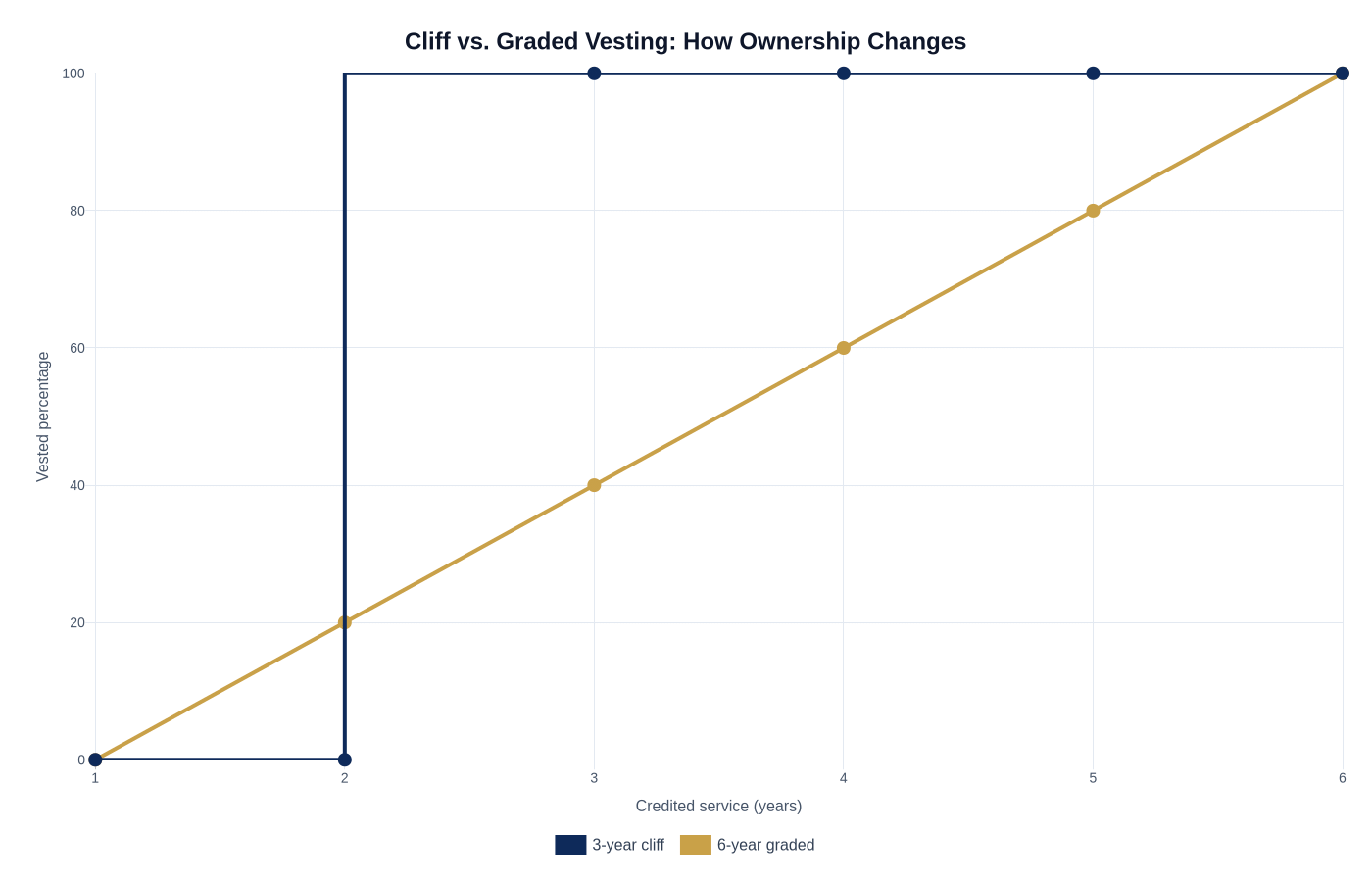
The contrast is sharp at two credited years: the federal cliff reference is still 0%, while the graded reference is 20%. At three credited years, the cliff reaches 100% while the graded reference reaches 40%. The useful question is not “Which schedule is better?” It is “Which schedule is attached to my employer contribution source?”
The employer-source label matters more than the words “safe harbor”
This is where a simple vesting chart can become misleading. “Safe harbor” does not automatically tell you the vesting rule for every employer dollar in the account.
- Traditional non-QACA safe-harbor contributions used to satisfy the safe harbor are fully vested.
- QACA (qualified automatic contribution arrangement) safe-harbor contributions may require up to two years of vesting service before they are 100% vested.
- Additional employer matching contributions can, in some circumstances, use another permissible vesting schedule.
The IRS explains these distinctions in its vesting snapshot for matching contributions. You do not need to memorize ADP, ACP, QACA, or the tax-code sections. You need the exact contribution label in your Summary Plan Description or benefits statement and the vesting rule attached to that label.
If your statement separates “safe harbor match,” “additional match,” “profit sharing,” or another employer source, keep those lines separate. Applying one vesting percentage to all employer money is an easy way to get the wrong answer.
The date that matters may not be your work anniversary
“I’ve worked here for three years” sounds like enough information. For vesting, it may not be. Plans can use different methods to credit service, and the IRS specifically notes that employers can choose different service-counting methods.
Some plans credit a year after a required number of hours; others use an elapsed-time method or another permitted approach. That is why a hire-date anniversary by itself does not prove that the next vesting step has been earned.
Before you time a resignation around a vesting milestone, check your Summary Plan Description (SPD) and your latest benefits statement. The U.S. Department of Labor also identifies the SPD as the document that explains how long it takes to become vested. If the date is close, ask the plan administrator to confirm your credited service and the date the next percentage becomes effective.
This is the part worth verifying twice. Being “almost at three years” on the calendar is not the same thing as having three credited years under the plan.
Sometimes the normal vesting schedule stops mattering
Before treating an unvested percentage as final, check whether a rule makes the affected balance fully vested. Federal rules require full vesting by the plan’s normal retirement age. A full plan termination also triggers full vesting for affected benefits, and a qualifying partial plan termination can fully vest affected participants.
If your employer is terminating the plan, or a major layoff or restructuring raises a partial-termination question, do not try to decide that from a generic vesting table. The IRS plan-termination guidance explains the rule, but whether a partial termination occurred depends on the facts and circumstances. Ask the plan administrator how the event affects your account.
For most ordinary job changes, no override will apply. When none does, go back to the plan’s source-specific schedule and credited-service record.
Put your plan on one page before you do the math
You do not need a longer explanation at this point. You need the right inputs. For each employer contribution source, copy the following fields from the SPD, benefits statement, or plan administrator. If you only have time to verify three things, start with the source label, current vested percentage, and next vesting milestone.
| Plan-record field | What to copy | Why it matters |
|---|---|---|
| Contribution source | Exact employer-source label | Different sources can follow different vesting rules. |
| Current source balance | Balance for that employer source | This is the dollar base for the calculation. |
| Vesting schedule | Immediate, cliff, graded, or the plan’s exact wording | Shows the ownership path for that source. |
| Credited service | The plan’s official service credit | Your calendar tenure may not be the same number. |
| Vested now | Current official percentage | Shows what you already own. |
| Next milestone | Next percentage and effective date | Shows what changes if you stay until that point. |
| Full-vesting rule | Any applicable termination, retirement-age, or plan-specific acceleration rule | An override can make the normal schedule irrelevant. |
Do not fill a blank with the federal reference table and call it your plan result. The federal schedules are limits on how slowly covered contributions can vest; your plan record supplies the participant-specific answer.
Now turn the percentage into dollars
Once the plan inputs are settled, the arithmetic is short. For each employer source, use the first formula below; the second shows what the next milestone adds on today’s balance.
Amount not vested now = employer-source balance × (1 − current vested percentage). Additional ownership at next milestone = employer-source balance × (next vested percentage − current vested percentage).
Example: Suppose your statement shows two employer sources. The first is a traditional non-QACA safe-harbor match with a $3,000 balance that is already 100% vested. The second is a $12,000 additional match. Your plan records show two credited years of service for that second source, with 20% vested now and 40% after the next credited year.
The first source has $0 at risk: $3,000 × (1 − 1.00) = $0. The second has $9,600 not vested now: $12,000 × (1 − 0.20) = $9,600. Reaching the next 40% milestone would add $2,400 of ownership on today’s $12,000 balance: $12,000 × (0.40 − 0.20) = $2,400.
If the same statement also shows $8,000 of your own elective deferrals, leave that $8,000 out of the forfeiture calculation. It is already yours. The example assumes no full-vesting override applies and uses illustrative plan labels and percentages; your plan records control your result.
That is the real payoff of reading the schedule correctly: you stop treating the 401(k) as one balance and can see exactly which employer dollars are already yours, which are still conditional, and what the next milestone changes.
Before you resign, verify these four numbers
- The balance of each employer contribution source.
- The vested percentage for each source today.
- The service date or service credit that triggers the next percentage.
- The dollar amount that becomes yours at that next milestone.
A vesting date should not decide a career move by itself. But if a job change is close to a milestone, knowing the actual amount at stake gives you something concrete to compare with the new offer instead of guessing from the total account balance.
Keep reading
If you already verified the worksheet and want to compare the unvested amount with a new job offer, future value, and the cost of waiting, continue with 401(k) Employer Match Vesting: What Leaving Early Can Cost.
Before acting, save a copy of the benefits statement you used and ask the plan administrator to confirm any milestone that is close to your planned departure date.
Sources, method, and evidence: This article was checked against current IRS guidance on vesting, the IRS matching-contribution vesting snapshot, IRS plan-termination guidance, and U.S. Department of Labor guidance on retirement-plan disclosures. Federal rules provide the framework; your Summary Plan Description and official plan records determine your plan-specific schedule, credited service, and vested percentage.
Update history
-
v1.1
2026-09-28
UPDATERechecked federal vesting schedules, safe-harbor/QACA distinctions, service-credit guidance, and full-vesting events; simplified the article around the job-change decision and added a cliff-vs.-graded vesting chart based on the same IRS reference schedule.
-
v1.0
2026-09-26
PUBLISHOriginal publication.
Published: · Updated: