
📅 Updated:
SIPC vs FDIC coverage depends on what failed and where the asset is actually held, not the account wrapper. SIPC can protect missing customer cash or securities when a SIPC-member broker fails, while FDIC insures eligible deposits when an insured bank fails. This matters most for brokerage cash sweeps because money shown on one brokerage screen can sit at a program bank, remain broker cash, or be invested in a money market fund. Identify the failed institution, legal holder, and asset form before applying any limit.
Browse the full guide
What decides whether SIPC or FDIC applies?
The test is what failed, who holds the asset, and what kind of asset it is.
FDIC deals with eligible deposits when an insured bank fails. SIPC deals with missing customer cash or securities when the failed broker is a SIPC member. SIPC excludes a normal drop in market value.
Start with two checks: what failed, and who holds the asset? Then name the asset. An insured-bank deposit, broker cash, and a money-market mutual fund can all look cash-like on one screen but follow different rules.
After that, use your brokerage account settings to check how idle cash is routed. Compare rates only after you know the rule that applies.
How do cash-like holdings map to SIPC or FDIC?
Cash-like holdings are easier to sort when you place each one beside its real holder. Match that holder to the event that caused the loss.
SIPA means the Securities Investor Protection Act.
| Holding | Failure event | Actual holder or location | Protection path | Limit or condition | Not covered |
|---|---|---|---|---|---|
| Bank deposit | Insured bank fails | FDIC-insured bank | FDIC | $250,000 standard maximum per depositor, per insured bank, per ownership category, subject to the rules | Nondeposit investments and market losses |
| Brokerage free-credit cash | SIPC-member broker fails and customer property is missing | Broker-dealer | SIPC | Up to $500,000 per separate customer capacity at the failed member broker, including a $250,000 cash sublimit, subject to SIPA | Ordinary investment-value losses |
| Bank-sweep deposit | Program bank fails | Program bank after the sweep | FDIC | FDIC rules apply at the receiving bank, including ownership, records, and same-bank aggregation | The broker wrapper creates no additional FDIC coverage |
| Money market mutual fund | SIPC-member broker fails and the security is missing | Brokerage securities account | SIPC as a security | Falls within the SIPC customer-property framework, subject to the total limit and SIPA | FDIC insurance and market-value declines |
| Other securities | SIPC-member broker fails and protected securities are missing | Broker-dealer custody | SIPC | Up to the applicable SIPC customer limit, subject to SIPA | Market losses or a bad investment |
SIPC groups accounts by separate capacity at the same member broker. Accounts held in the same capacity are combined; opening another account at that broker does not automatically add another $500,000 of protection.
At Fidelity, $4 million divided by the $250,000 SIPC cash sublimit equals 16. Those figures belong to different failure contexts.
That scale comparison is only a check. It cannot make one rule sixteen times safer or turn one limit into the other.
In both systems, the headline limit can depend on other facts. Check those facts before you use the number.
How can a brokerage cash sweep become FDIC-insured?
A cash sweep can move idle cash from the broker to one or more program banks. The screen may look the same, but the bank now holds the deposit.
The same broker can send idle cash to program banks while a money-market fund stays in the securities account. The two balances may sit side by side but follow different rules.
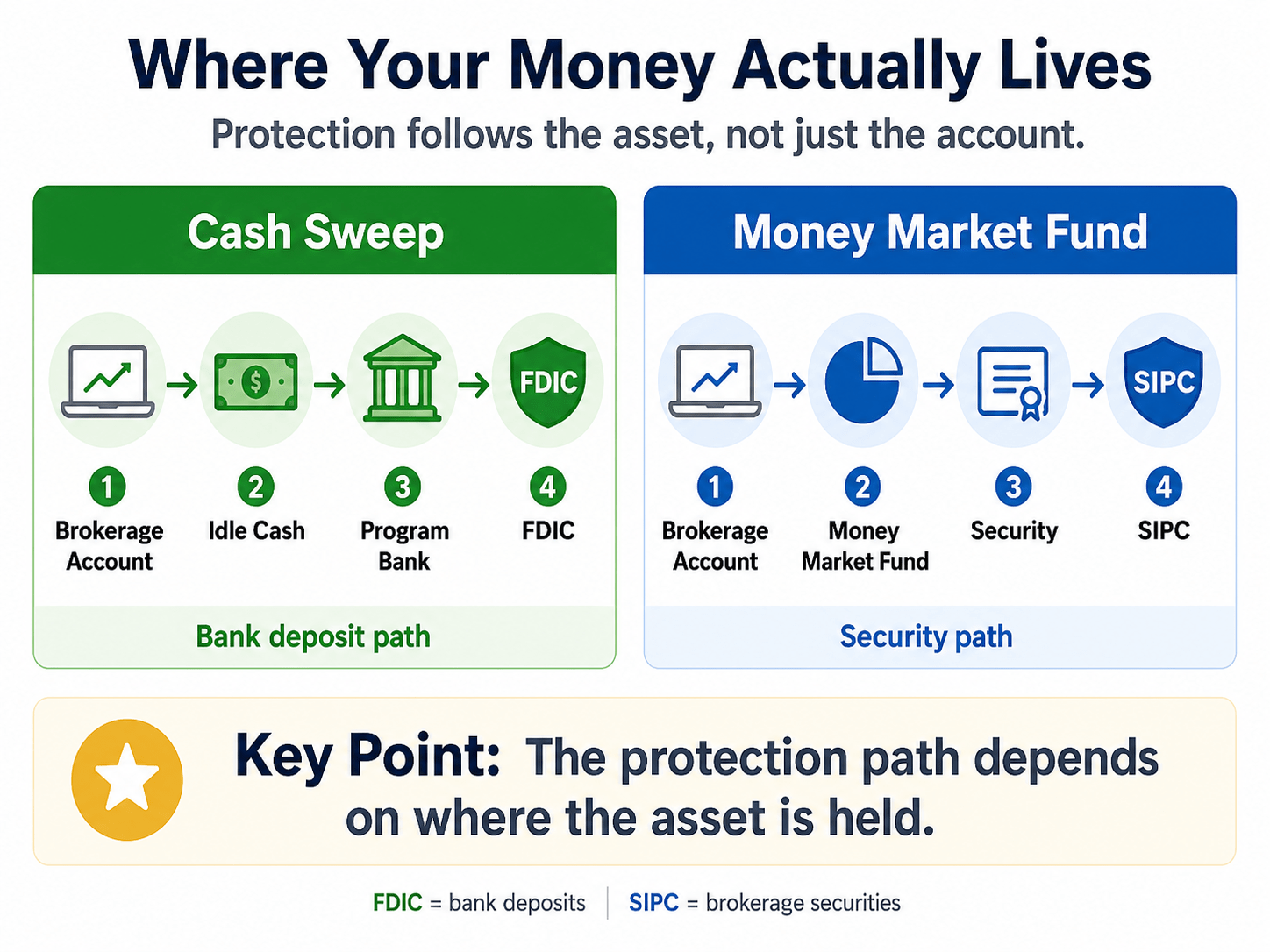
As checked on October 17, 2026, Fidelity’s account-safeguard disclosure says some eligible Cash Management and IRA sweep cash can get FDIC coverage up to $4 million when program banks have capacity and the program rules are met. Excess cash can enter a money market overflow fund; that portion is not an FDIC-insured deposit. The 16x comparison comes from that figure and SIPC’s $250,000 cash sublimit. It is not a general promise.
A SIPC cash limit is not the rule for a deposit that has already moved to a program bank. Once you know the path, compare brokerage sweep account rates as a separate choice.
What does SIPC actually do when a broker fails?
A broker failure is not the same event as a bank failure. SIPC is built around missing customer cash and securities at a failed member broker, not a normal fall in market price. Its cash protection applies to cash held in connection with buying or selling securities; a cash label alone does not establish coverage.
If you classify cash by the brokerage screen alone, headline cash limits can look interchangeable. They may protect different failure events.
SIPC’s history page says at least 99% of eligible people get their investments back with its help. It also says $3.6 billion advanced since 1970 helped recover $143.8 billion in assets. Those are past totals, not a promise for the next failed broker.
Use your brokerage cash-routing settings to identify which cash vehicle the account is actually using. Then compare sweep rates after coverage checks, not before them.
Broker custody rules require firms to safeguard customer cash and securities. Those duties are separate from a promise to reimburse market losses.
Why does $250,000 mean different things under SIPC and FDIC?
A limit is useful only after you know who holds the asset and which rule applies. For a bank sweep, records and other deposits at the same bank can also matter.
Use four checks before you rely on a number:
- Find the holder. Is the asset at the broker, at a program bank, or in a mutual fund?
- Check the rule. Confirm FDIC status for the bank or SIPC membership for the broker.
- Check the records. A broker-run deposit may need the right agency or fiduciary records for pass-through treatment.
- Add same-bank deposits. Deposits for the same owner at the same insured bank and in the same ownership category may be grouped for FDIC purposes.
The shortcut can work when the account label and legal holder already match, such as a plain deposit held directly at one insured bank. When the holder is ambiguous, use the broker’s sweep disclosure and program-bank list instead of guessing from the account name.
Classify the failure and asset first. Then use the right limit and same-bank rules. Recheck the official rules when the cash vehicle, banks, or ownership setup changes.
When the simple account-label shortcut can work
A simple account label can work when the facts all point the same way. The label, holder, asset, and rule must align.
A plain deposit held at one insured bank is the easy case. The bank holds a deposit, so FDIC rules are the right place to start. A broker case can also be clear when a failed broker with SIPC membership is missing customer cash or securities and the claim fits the customer-property rules.
SIPC protects the broker’s custody function. Customer status and eligible customer property still matter; a brokerage account is not a guarantee against every kind of loss.
The shortcut is useful only when the facts line up. If there is a sweep, a money-market fund, an unclear holder, or cash at the same bank through more than one path, stop and check the details.
SIPC vs FDIC coverage: questions readers still ask
These questions apply the same failure-event and asset checks to common account setups.
Does SIPC cover cash in a brokerage account?
SIPC can cover broker-held cash when a SIPC-member broker fails, customer cash is missing, and the claim fits SIPA rules. The limit is up to $500,000 for each separate customer capacity at the failed member broker, with a $250,000 cash sublimit. Accounts held in the same capacity at that broker are combined. But a cash label on the screen is not proof that SIPC applies. A bank sweep may move cash to a bank, while a money market mutual fund stays a security. Check who holds the cash and what the asset is before you use the SIPC number for your account.
Is a Fidelity cash sweep FDIC-insured?
A Fidelity cash sweep can get FDIC insurance when eligible cash is sent to program banks and the FDIC rules are met. The Fidelity disclosure checked on October 17, 2026 says some eligible Cash Management and IRA sweep cash can get coverage up to $4 million when program banks have capacity. That amount is tied to Fidelity’s program and can change. Check the latest sweep notice and bank list. Also count deposits you already have at the same bank, because those balances can affect how much of the cash is insured.
Does SIPC cover money market mutual funds?
SIPC can cover that fund as a security when customer property is missing after a member broker fails. The fund remains a security rather than becoming an FDIC deposit just because it is used like cash in a brokerage account. Mutual funds lack FDIC insurance, and SIPC excludes a normal drop in the fund’s market value. Look at the legal form of the asset. An insured deposit and a money market fund can sit on one screen but follow different rules.
What happens if a broker fails but my investments are still there?
If a broker fails but your investments are still there as customer property, the case is different from a market loss. Broker rules focus on how customer cash and securities are kept, and SIPA liquidation focuses on getting customer property back and filling some covered shortfalls. SIPC says most eligible customers have received their investments back with its help, but that history is not a promise. First ask whether any customer property is missing. Do not treat a fall in price as the same event.
How do I check whether my cash is under SIPC or FDIC?
Start with what failed: the bank or the broker. Then check who legally holds the cash or security and what the asset is. Confirm that the bank has FDIC insurance or the broker is a SIPC member before you use a dollar limit. For a bank sweep, read the current sweep notice and bank list, then check other deposits you have at the same bank and the ownership category. For broker-held property, remember that SIPC excludes normal market losses. That money market fund is a security, not an FDIC deposit.
The rule to remember when the wrapper changes
$250,000 changes meaning when the holder changes.
Open your broker’s cash settings and name the holder and the asset. Use those two facts before you trust any coverage number on the screen.
The wrapper is an interface. Protection follows the failed institution, legal holder, and asset form.
After that check, compare sweep rates and cash options.
When the broker changes its cash choices, run the holder-and-asset check again. Do that before you compare yield across the broker’s available cash choices.
YOUR TURN
Which line in your brokerage cash settings tells you who legally holds the balance today?
- SIPC
- 12 CFR 330.1
- 12 CFR 330.3
- Fidelity Cash Management Account
- Fidelity account safeguards
- FINRA customer asset protection
- SIPC history
- 12 CFR 330.5
- 12 CFR 330.7
- FDIC coverage guidance
- Columbia Business Law Review
The protection matrix separates bank failure, broker custody shortfalls, asset form and applicable limits. The $4 million Fidelity ceiling is conditional and was checked on October 17, 2026; dividing it by the $250,000 SIPC cash sublimit gives 16, not a relative-safety score. The Columbia paper is retained as further legal reading.
Update history
- Date correction 2026-10-31 CORRECTION
Corrected the original publication date to August 9, 2026 to match the publishing record, and updated the author title. No analysis, figure, or source changed.
- Independent verification clarification October 17, 2026 CLARIFICATION
Clarified SIPC separate-capacity limits and aggregation of accounts held in the same capacity at the failed member broker. Headline limits and the Fidelity program comparison are unchanged.
- Article clarificationOctober 17, 2026CLARIFICATION
Rechecked SIPC limits, FDIC ownership and recordkeeping rules, Fidelity sweep capacity and SIPC history figures. Added the securities-purpose cash condition and the overflow-fund distinction, trimmed repeated explanations and consolidated seven source strips. The matrix, sweep illustration and research links are preserved.
- v1.0 2026-08-09 PUBLISH
Original publication.