📅 Originally Published: · Last Updated:
Every two weeks, the 401(k) dashboard adds another row. Part of that balance has a lock on it.
Executive Summary
- 401k employer match vesting hides conditional ownership: 67% of participants cannot correctly identify their vesting status, per Vanguard’s 2025 research.
- Forfeiture probability is structural: 30% of job separations trigger forfeiture, claiming 40% of the affected worker’s balance.
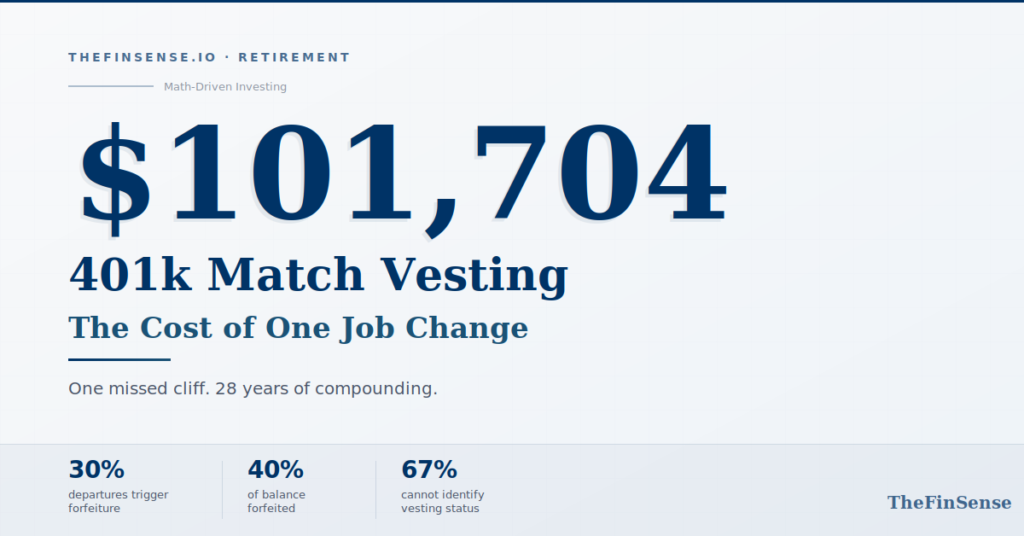
- One missed cliff costs six figures: A single $7,053 forfeiture compounds to $101,704 over a standard career horizon at 10% annual return.
Your 401k employer match vesting schedule splits your balance into two categories of ownership. The 40% forfeiture share that Vanguard’s research identified sits in the same dashboard column as the money that belongs to you. The number does not distinguish between the two.
Among Vanguard-surveyed participants, only 33% can correctly state their vesting status. The remaining 67% read a balance that overstates what they actually own. That gap between perceived and actual ownership is invisible until the day it disappears.
Your 401(k) Balance Includes Money That Isn’t Yours
Employers who vest their match can afford a more generous contribution rate. The 2.5% forfeiture recoupment subsidizes auto-enrollment and immediate eligibility for every participant.
The design has a cost. Aaron Goodman, Lead Author at Vanguard Strategic Retirement Consulting, tracked it across 4.7 million job separations. Fiona Greig, Global Head of Investor Research and Policy at Vanguard, co-authored the analysis.
Their finding: 30% of departures trigger forfeiture. The affected workers lose 40% of their final balance.
The loss follows the same trajectory as compounding fee drag. Invisible in year one. Six figures by retirement.
A worker earning $80,000 at year two of a three-year cliff vest has $7,053 conditionally parked on their dashboard. A 25-year-old in their first corporate job may not recognize the word ‘vesting’ on the plan document they signed during orientation. A tenured employee who cleared the cliff carries zero forfeiture risk today. The 30% of separations that trigger forfeiture fall disproportionately on lower-income workers who change jobs most frequently.
Vanguard’s participant dashboard displays a single Total Balance that blends vested funds with unvested employer match. Seeing what you actually own requires a second click into Balances & Holdings.
The same platforms that vest your employer match over three years route your idle cash to a 0.01% default sweep — check your brokerage sweep account rates to see if the pattern applies to your cash position.
One Bogleheads forum thread captures the pattern. A participant assumed the unvested match remaining after departure was theirs. The custodian did not break out vested from non-vested splits.
The number looked whole. Nothing on the screen flagged the distinction.
| Years of Service | Cliff Vesting (%) | Graded Vesting (%) | Forfeiture Risk If You Leave |
|---|---|---|---|
| Immediate | 100% | 100% | None |
| 1 year | 0% | 0% | 100% of match (both) |
| 2 years | 0% | 20% | 100% of match (cliff) / 80% of match (graded) |
| 3 years | 100% | 40% | None (cliff) / 60% of match (graded) |
| 4 years | 100% | 60% | None (cliff) / 40% of match (graded) |
| 5 years | 100% | 80% | None (cliff) / 20% of match (graded) |
| 6 years | 100% | 100% | None |
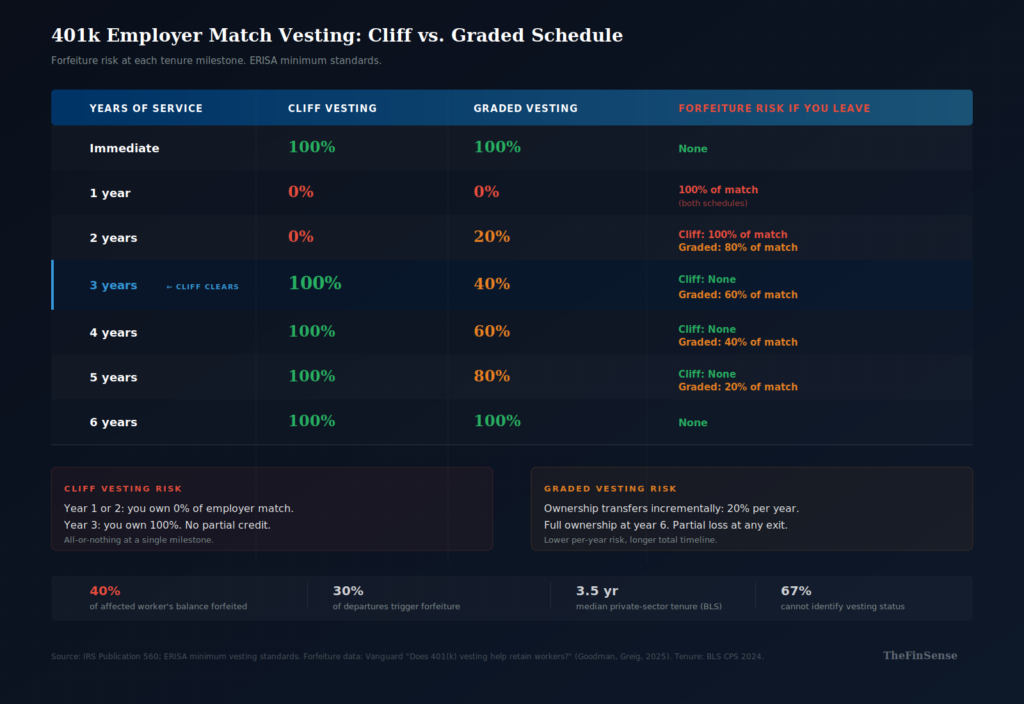
The total balance on the dashboard includes funds the employer can reclaim. Two out of three participants do not know their plan distinguishes between the two.
How many of your dollars are actually at risk right now?
Why Half of Workers Miss the Vesting Cliff
The dollar amount depends on salary, match rate, and one overlooked variable: how long the average worker actually stays.
▶ Video: 401k Vesting and Career Moves by FIRE Psy Chat — explains how vesting cliffs turn routine job changes into forfeiture events.
Goodman (Vanguard) found forfeitures recoup 2.5% of total employer contributions system-wide. That 2.5% represents billions annually within the $200+ billion DC employer contribution pipeline.
Bureau of Labor Statistics tenure data exposes the overlap. Median tenure in the private sector: 3.5 years overall. For workers aged 25 to 34: 2.7 years.
Most 401k employer match vesting cliffs require three years. The matched dollars often land in funds tracking the dow vs nasdaq vs sp500. No fund prospectus distinguishes vested from unvested.
Two out of three 401(k) participants do not know whether their plan has a vesting schedule that could erase 40% of their balance.
The math applies regardless of which segment describes you: the forfeiture compounds at the same rate as the contribution.
The probability is not a personal failing. Median private-sector tenure sits at 3.5 years. The most common cliff vesting schedule requires three, so half of private-sector workers leave before it clears.
What does the forfeiture actually cost when compounding enters the equation?
The 401k Employer Match Vesting Formula: What $7,053 Becomes
Vanguard tracked 4.7 million job separations and isolated the forfeiture rate, the balance share lost, and the compound trajectory.
The 401k Employer Match Vesting Schedule: Cliff vs. Graded
ERISA permits two 401k employer match vesting structures. Cliff vesting transfers 100% ownership at a single milestone. Most plans set that milestone at three years.
Graded vesting transfers ownership incrementally over six years. A cliff participant at year two owns 0% of the employer match. A graded participant at the same point owns 20%.
Goodman (Vanguard) tracked both structures across 1,500 plans. The forfeiture rate held at 30% regardless of schedule type. Tenure, not schedule complexity, determines the outcome.
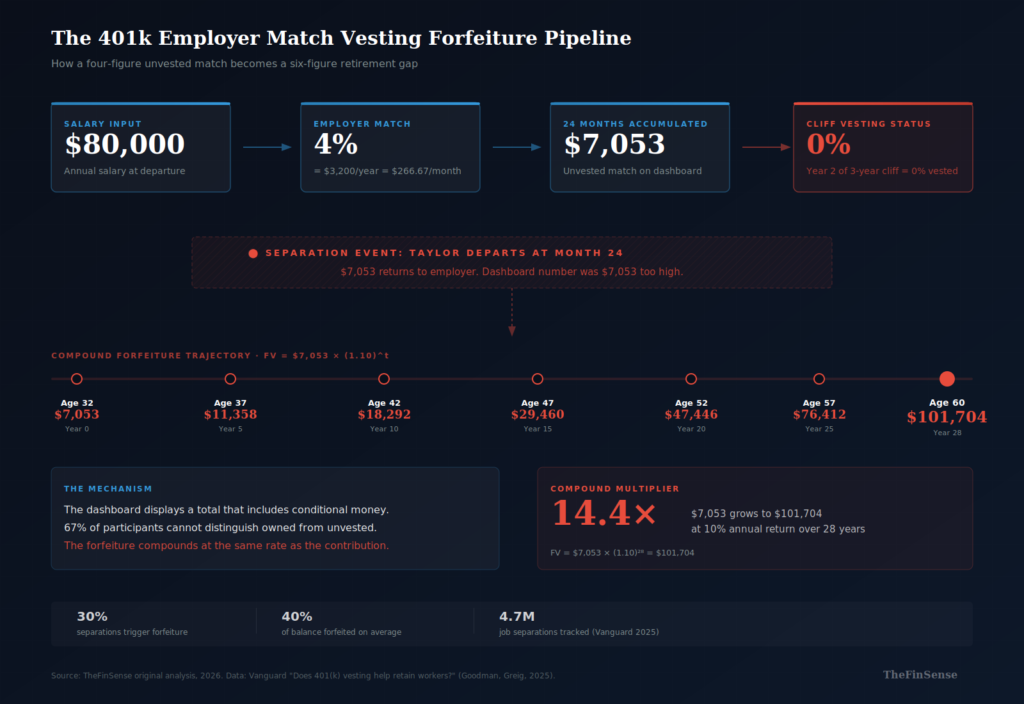
The forfeiture appears only after the participant requests a distribution. The dashboard number they used in their job-switch math was $7,053 too high.
The Compound Forfeiture Formula
The formula is compound interest. FV = P × (1 + r)t.
P equals the forfeited amount. r equals the annual return the money would have earned. t equals the years remaining to retirement.
Goodman (Vanguard) isolated the variable that makes this formula structural: 40% of the departing worker’s final balance disappears at separation. That is not a marginal cost.
James J. Choi, Professor of Finance at Yale School of Management, studied a related failure in automatic savings policies.
Co-author David Laibson, Robert I. Goldman Professor of Economics at Harvard University, analyzed nine auto-enrollment plans.
Their data: turnover, forfeiture, and cash-outs erode the net savings effect to 0.6% of income.
Goodman and Greig (Vanguard) asked a harder question: does vesting retain workers? The answer was no. The mechanism strips wealth without producing the retention benefit employers intended.
Before Choi and Laibson (2024), the field treated auto-enrollment as a solved problem for retirement savings. Their analysis of nine plans revealed that turnover, forfeiture, and cash-outs erode the savings effect to 0.6% of income. Goodman and Greig (2025) confirmed the structural failure. Vesting requirements do not retain workers but do strip wealth from the 30% who leave before the cliff.
What 0.6% Steady-State Means for Your Savings
Choi (Yale) and Laibson (Harvard) expected auto-enrollment to permanently raise savings rates. The data said otherwise. Turnover erodes the initial bump.
The 0.6% steady-state figure means the average auto-enrolled worker retains less than one percentage point of additional savings after job changes and cash-outs. For an $80,000 earner, 0.6% equals $480 per year. The plan document promised a 4% match: $3,200.
The gap between the promised match and the retained savings is where forfeiture lives. The Settlement Velocity Filter in pattern day trading reveals a similar structural cost. A hidden threshold extracts wealth from participants who do not calculate its reach.
“Approximately 30% of workers switch employers before fully vesting, forfeiting an average of 40% of their account balances, disproportionately affecting lower-income employees.”
— Fiona Greig, Global Head of Investor Research and Policy, Vanguard Investment Strategy Group
The intuition is simple. A few thousand dollars in forfeited match feels like a fraction of total retirement savings.
Vanguard tracked 4.7 million departures and found forfeitures claim 40% of the affected worker’s final balance. That figure compounds into six digits over a standard career horizon.
What does this look like in one person’s actual numbers?
Taylor Leaves 12 Months Before the Cliff
Taylor, 32, earns $80,000 and carries 40% of a matched balance that the employer can reclaim in twelve months.
The Parameters
Taylor’s employer matches 100% of the first 4% of salary. The plan uses a three-year cliff vesting schedule. Taylor leaves at month 24.
| Parameter | Value |
|---|---|
| Age at departure | 32 |
| Annual salary | $80,000 |
| Employer match | 100% on first 4% ($3,200/year) |
| Vesting schedule | 3-year cliff |
| Tenure at departure | 2 years (24 months) |
| Unvested match accumulated | $7,053 |
| Years to retirement (age 60) | 28 |
| Assumed annual return | 10% |
The Compound Cost
The $7,053 in unvested match does not disappear at face value. It disappears at compound value. FV = $7,053 × (1.10)28 = $101,704.
| Age | Years After Forfeiture | Forfeited Value |
|---|---|---|
| 32 | 0 | $7,053 |
| 37 | 5 | $11,358 |
| 42 | 10 | $18,292 |
| 47 | 15 | $29,460 |
| 52 | 20 | $47,446 |
| 57 | 25 | $76,412 |
| 60 | 28 | $101,704 |
$101,704 Lost: How One 401k Employer Match Vesting Forfeiture Compounds Over 28 Years
Taylor, age 32, $80,000 salary, 4% match, 3-year cliff vest, departs at year 2. 10% annual return assumed.
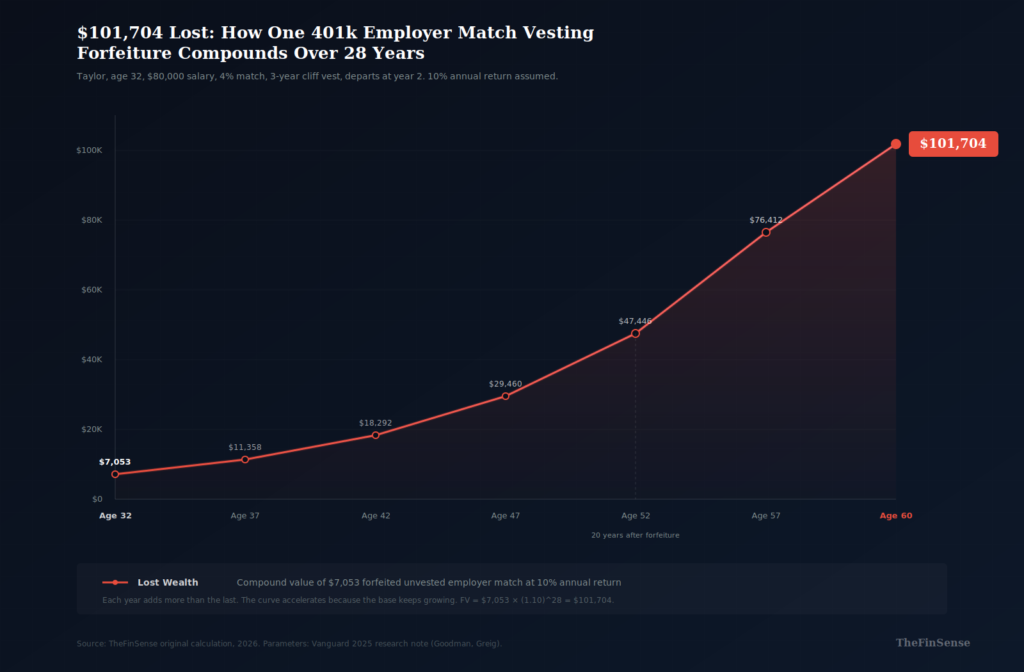
The line does not bend. Each year adds more than the last because the base keeps growing.
$7,053 sits unvested on the screen. Compounded, that becomes $101,704. The cliff is 12 months away.
One calendar year separates Taylor from full ownership. The distance on the chart between $7,053 and $101,704 is 28 years of compounding that the dashboard does not project.
That click is the tumbler. The vesting schedule just split the retirement balance into two separate accounts with two separate owners.
The name on the case study is Taylor. The salary could be yours. The match rate could be your plan’s.
The departure date could be the one you are weighing right now.
The Sensitivity Check
📐 YOUR NUMBERS MAY DIFFER
This calculation assumes 10% annual return over 28 years. Here is how the conclusion changes:
| Annual Return | Forfeiture FV at Retirement | Conclusion |
|---|---|---|
| 7% | $46,891 | Five figures, still significant |
| 10% (base case) | $101,704 | ✅ Base case |
| 12% | $168,441 | Six figures, exceeds base by 66% |
Time horizon shifts the outcome further. At 20 years to retirement, the forfeiture compounds to $47,446. At 35 years, it reaches $198,193.
Taylor’s $7,053 in forfeited match grows to $101,704 by retirement, enough to cover four years of mortgage payments from a single calendar miss.
Can I actually do something about this before my next job decision?
Three Steps Before Your Next Job Decision
The calculation that turned Taylor’s dashboard into two numbers takes three inputs and ninety seconds.
TheFinSense’s The Vesting Countdown Filter distills this into three criteria. The inputs: your vesting schedule, your unvested balance, and the dollar value of the new offer. The output: a number that sits beside the offer letter.
Step 1: Pull Your Vesting Schedule (5 Minutes)
Open your plan’s Summary Plan Description. Find the vesting section. It will state either cliff or graded and the number of years required.
If the document is not in your email, request it from HR or download it from the plan portal. The schedule is a legal disclosure; the employer must provide it.
Goodman (Vanguard) found that 67% of participants could not correctly state their vesting status. This step eliminates that gap in ninety seconds.
Step 2: Calculate the Forfeiture Cost (10 Minutes)
Multiply your annual salary by the match rate. Multiply by your tenure in years. That total is the unvested employer match at risk.
Apply the compound formula: FV = unvested match × (1 + return)years to retirement. Use 10% for a stock-heavy allocation or 7% for a conservative mix. The result is the retirement dollar cost of leaving now.
Greig (Vanguard) documented that the average forfeiture erases 40% of the affected worker’s final balance. Your calculation converts that percentage into your specific dollar figure.
Every new employer dashboard reopens the same question: how much of this number is actually mine?
Step 3: Compare Against the Raise (5 Minutes)
Subtract your current salary from the new offer. That annual difference is the raise. Multiply by the number of years you expect to stay at the new employer.
If the raise exceeds the compound forfeiture cost, the move is net positive. If it does not, the vesting cliff is worth more than the title change.
The Vesting Countdown Filter makes that comparison explicit. Approximately 60 ERISA class action lawsuits since September 2023 have challenged how employers use forfeited contributions. The legal environment is shifting, but the math has not changed. Your forfeiture cost today is the number you calculated in step two, regardless of how courts ultimately rule.
A reinvested match, once vested, compounds alongside safe investments to beat inflation in the same tax-deferred account. The forfeited match compounds for someone else.
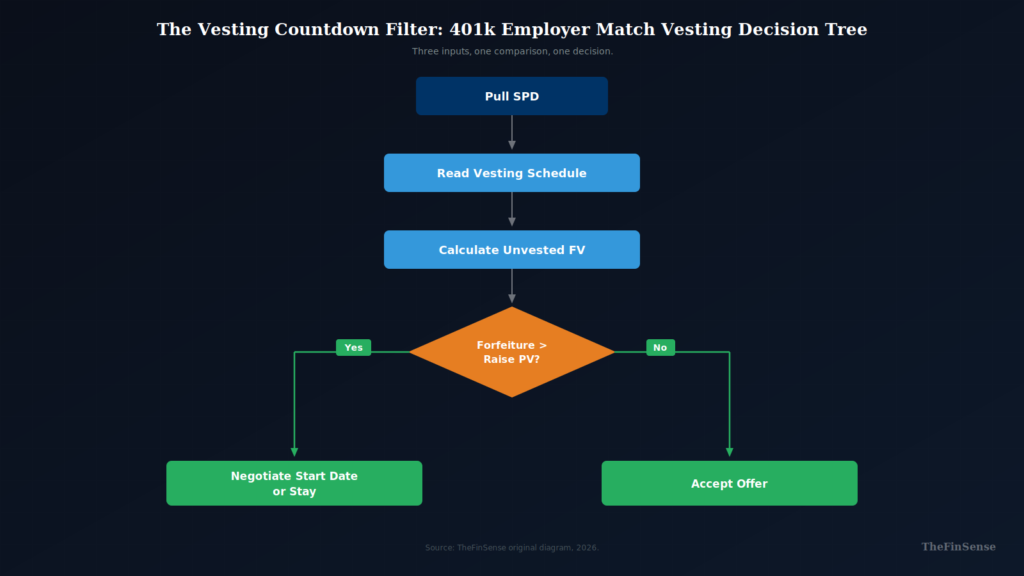
The Vesting Countdown Filter converts the vesting schedule from an HR document into a dollar comparison that sits beside the offer letter.
When This Analysis Does Not Apply
This analysis applies to the 51% of 401(k) plans that impose vesting requirements. Goodman and Greig identified that immediate-vesting plans eliminate forfeiture risk entirely. If your plan vests immediately, this calculation does not apply to you.
If your plan uses immediate vesting, confirm this on your plan’s Summary Plan Description. If it uses cliff or graded vesting, run the Vesting Countdown Filter before your next job decision.
How we calculated this: TheFinSense Methodology
401k Employer Match Vesting: Frequently Asked Questions
What happens to my unvested 401(k) match if I get laid off before the cliff
Layoff and voluntary departure follow the same vesting rules. If you leave before the cliff, unvested employer match returns to the plan regardless of the reason for separation. Some plans offer partial credit for years of service in a graded schedule, but cliff-vested plans transfer nothing until the milestone is reached. Check your Summary Plan Description for your plan’s specific forfeiture terms and any exceptions for disability or retirement-age separations.
Can my employer change the vesting schedule after I start contributing
ERISA prohibits employers from retroactively reducing vesting credit already earned. An employer can change the schedule for future contributions, but any service credit you have accumulated must be preserved under the prior terms. If your employer switches from graded to cliff vesting, your existing vested percentage cannot decrease. The transition rules are documented in the plan amendment, which the plan administrator must distribute to participants.
Does rolling over my 401(k) to an IRA preserve unvested employer match
A rollover transfers only vested funds. Unvested employer match cannot be rolled over because you do not own it. When you request a distribution, the plan custodian separates vested from unvested balances and forfeits the unvested portion back to the plan. The rollover amount reflects your actual ownership, not the total balance displayed on the dashboard. Confirm the vested amount with your plan administrator before initiating the transfer.
Does my retirement income projection include unvested funds
Most plan retirement projectors compound the full account balance into future estimates without distinguishing vested from unvested funds. The projected income figure at age 65 may include money that disappears if you leave before the cliff. The projection does not model forfeiture scenarios or job changes. Subtract your unvested match from the total balance before using the projector’s estimate in any career decision.
How do ERISA forfeiture lawsuits affect my existing 401(k) plan
Approximately 60 ERISA class actions since September 2023 have challenged employer use of forfeited funds. These lawsuits argue employers should not redirect forfeitures to offset their own future matching costs. Court outcomes may change how plans allocate forfeited money, but they do not change your vesting timeline or the compound cost of leaving early. Monitor your plan’s annual fee disclosure for any changes to forfeiture allocation policies.
The Bottom Line on 401k Employer Match Vesting
The balance that looked whole on the dashboard splits along a 40% line that no retirement projector extends to age 60
The mechanism is structural. Vesting schedules merge conditional ownership into a single total, extract wealth at separation, and compound the loss across every year the money would have grown.
The $101,704 is the visible cost of one job change. The real cost is the same mechanism repeating across a career of nine employers.
The retirement benefit designed to build worker wealth operates as a mechanism that returns it to the employer.
The nine-employer career means the same cliff appears nine times. Each forfeiture resets the compound clock to zero while the same formula runs against a shrinking horizon.
The vesting percentage on the plan document just turned into two different retirement balances.
What compounds faster than the match: the fee your fund charges on every dollar it holds.
📌 Next Read: betterment fees explained
The bolt slides. The balance splits in two.
YOUR TURN
How many months remain between your current tenure and your plan’s vesting cliff?