
📅 Originally Published: · Last Updated:
This Guide Answers
- Which wins over 10 years when stocks vs real estate are compared using true unrecoverable carrying costs — not headline appreciation figures?
- At what point does real estate’s leverage advantage break even against a passively compounding S&P 500 index fund?
- How do you use the Liquidity-Leverage Filter to determine where your next $100,000 should actually go?
The stocks vs real estate debate has a measurement problem embedded in its most popular data point. The median American homeowner has accumulated $396,200 in net worth while the median renter holds just $10,400, according to the Federal Reserve’s 2022 Survey of Consumer Finances — a 38-to-1 gap that property advocates cite as definitive proof of real estate’s superiority. But that gap conflates three decades of compulsory mortgage-driven savings with investment performance, and demographic wealth patterns with asset class returns. It does not resolve the question.
Run $100,000 through a leveraged property purchase and an S&P 500 index fund simultaneously, and the results complicate every confident verdict published on either side. Real estate’s 5x leverage mechanism genuinely accelerates equity accumulation in the early years — no passive index fund can replicate that. But the same leverage that multiplies appreciation gains also amplifies a cost structure that almost no comparison article measures completely: property taxes, insurance premiums, maintenance reserves, vacancy drag, and a round-trip transaction cost of 8–9% that equity investors pay exactly zero dollars to avoid.
The result is an allocation decision problem — not a winner-take-all verdict. The mechanism that resolves it is the Liquidity-Leverage Filter: a four-step framework that maps your five-year capital mobility, true net yield, and active management tolerance to a defensible deployment decision, regardless of which asset class dominated the headlines last quarter.
Why the Stocks vs Real Estate Debate Is Built on a Broken Metric
Most comparisons between these two asset classes share a foundational methodology error. They place gross nominal property appreciation on one side of the ledger and total stock returns on the other — mixing a cost-exclusive figure against a cost-inclusive one. The result systematically flatters real estate in short time horizons and conceals its structural drag over longer ones. Before running a single number, the framing needs to be fixed.
The Nominal Return Trap: How Headline Appreciation Numbers Distort the Comparison
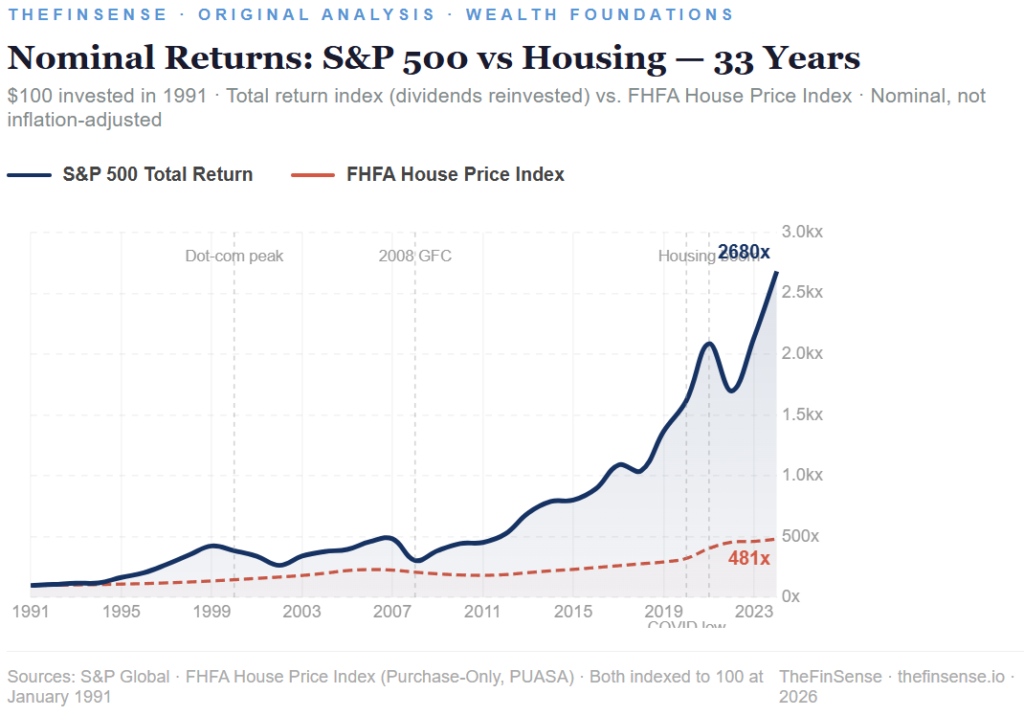
U.S. residential real estate appreciation, as tracked by the FHFA House Price Index, has averaged roughly 4.3% annually on a nominal basis over the past three decades. The S&P 500’s average annual total return over the same period — dividends reinvested — has ranged between 10.2% and 10.7% depending on start and end date selection. Understanding what a stock actually represents — a fractional ownership claim on a company’s retained earnings and future cash flows — explains why this compounding engine runs faster than property appreciation on a gross return basis. That is a 6-percentage-point gap before costs. After costs, it widens considerably.
The comparison breaks down on first principles. The FHFA index tracks purchase-only transaction prices and explicitly excludes the cost of carrying the asset between purchase and sale. It subtracts nothing for property tax, insurance, maintenance, or financing charges. The S&P 500 total return figure, by contrast, already reflects the net investor experience after the ETF’s expense ratio has been deducted. These two numbers are not measuring the same thing. Comparing them directly introduces a structural bias in favor of real estate — one that grows more distorting with each passing year the property is held.
There is also a leverage asymmetry that cuts in the opposite direction. A buyer who puts 20% down and achieves 4.3% appreciation on the full property value earns approximately 21.5% on deployed equity — gross, before costs. But that same buyer absorbs 100% of the annual carrying expenses on the full property value, not just on their equity stake. Leverage multiplies both the return and the cost base simultaneously. Most back-of-envelope calculations apply leverage to the appreciation gains but leave the cost denominator unadjusted. That selective application produces the most persistently misleading number in personal finance.
The Unrecoverable Cost Stack: The Number Nobody Puts in the Spreadsheet
The average U.S. rental property owner absorbs between 3.2% and 4.8% of the property’s current market value in unrecoverable carrying costs every single year. These are not capital improvements. They do not add to equity. They do not reduce the mortgage principal. They vanish — and they compound against the investor’s net return every year the property is held.
The annual cost stack on a $300,000 single-family rental breaks down as follows. Property tax at the U.S. national average of approximately 1.1% costs $3,300 per year. Homeowner’s insurance at 0.5% adds $1,500. A realistic maintenance and capital expenditure reserve at 1.0% of property value adds $3,000 — the popular “1% rule” understates actual CapEx requirements by 30–40% on properties older than 20 years, a friction point that almost no landlord calculator flags. Vacancy allowance at 8% of gross rent on a $1,500/month unit adds $1,440. Professional property management at 10% of gross rent adds $1,800. Total annual unrecoverable drag: $11,040, or 3.68% of property value, every year.
Compare that to the expense ratio on a Vanguard S&P 500 ETF (VOO): 0.03% annually. On the same $300,000 notional position, that is $90 per year. The structural cost gap is 3.65 percentage points annually, compounding against the property investor’s net return for as long as the asset is held. Over a 10-year horizon, this single variable — not market timing, not interest rate cycles, not tenant selection — is the most important determinant in the comparison.
🧠 IN PLAIN ENGLISH:
Think of your rental property’s cost stack as an invisible lease payment you make to the market every year, whether the property is occupied or not. On a $300,000 property, you are paying roughly $10,500–$14,000 annually just to hold the asset — before your mortgage, before income taxes, and before the deal earns a single dollar of profit. The index fund’s equivalent annual fee is $90. That is the gap you must overcome before the leverage advantage adds up to anything real.
One more unrecoverable cost rarely appears in landlord ROI projections: transaction friction at exit. Selling a property costs an average of 5–6% in agent commissions plus 1–2% in closing costs, transfer taxes, and staging — a round-trip cost of 8–9% of property value. Selling an index fund position costs zero. A $300,000 property appreciated to $458,000 over 10 years nets the seller approximately $412,000–$418,000 after transaction costs.
The equity investor exits at $458,000, same market value, zero haircut. That $40,000–$46,000 friction gap is invisible in any appreciation index and missing from most comparison articles. There is also a tax mechanic worth noting: when a depreciated property is eventually sold, the IRS recaptures accumulated depreciation deductions at 25% (unrecaptured Section 1250 gain) — a liability that most rental property calculators silently exclude from their 10-year return projections.
The stocks vs real estate debate does not end with costs, though. A rigorous comparison must account for something no passive index fund offers: the ability to deploy the bank’s capital alongside your own to control a significantly larger asset base. That leverage effect, measured correctly, is where real estate earns its wealth-building reputation — and it is most powerful in a specific window.
📌 Next Read: How compound interest actually builds wealth — and the friction costs that silently drain it
How Real Estate Builds Wealth Faster Than Stocks in Years 1–7
Imagine you have $80,000 in liquid savings ready to deploy. Invest it in a broad market index fund and you control exactly $80,000 in market exposure. Use that same $80,000 as a 20% down payment and you control a $400,000 asset — with the bank absorbing 80% of the acquisition cost at a fixed rate. No other legal, non-margin investment vehicle available to a retail investor replicates that leverage at conventional lending terms. That asymmetry is real estate’s structural advantage, and it is most powerful in the first seven years of ownership, before the compounding math on the other side has had sufficient time to compound.
The 5x Leverage Equation: Turning $80,000 Into $400,000 of Market Exposure
The arithmetic on a standard residential purchase is straightforward, and the output is genuinely dramatic. Deploy $80,000 as a 20% down payment on a $400,000 property. In Year 1, at the FHFA’s historical average appreciation rate of 4.3%, the property gains $17,200 in value. Return on the cash deployed — the $80,000 — is 21.5% gross. No S&P 500 index fund, in an average calendar year, produces 21.5%.
But the intermediate steps determine the actual investor outcome. That $17,200 gross appreciation gain must absorb the annual carrying cost stack. On a $400,000 property at 3.5% annual costs, unrecoverable expenses total approximately $14,000 per year, excluding mortgage principal and interest. Subtract those costs and the net Year 1 gain from appreciation alone falls to approximately $3,200 — a 4.0% net return on the $80,000 deployed. The S&P 500 at its historical 10.4% average would have generated $8,320 on the same $80,000 in the same period. In a pure appreciation-only model, without rental income, equities outperform in Year 1 on a net basis.
Rental income changes the calculation materially. A $400,000 property generating $2,400/month in gross rent ($28,800/year) produces approximately $14,800 in net operating income after the $14,000 cost stack. Add the $17,200 appreciation gain and the total first-year economic return on the $80,000 deployment is approximately $32,000, or 40% — which no passive equity position matches in a typical year.
The compounding effect of mortgage amortization adds a third return layer that almost every comparison article omits entirely. On a 30-year mortgage at 6.30% covering $320,000, Year 1 principal paydown is approximately $3,600. Year 3 cumulative principal paydown reaches roughly $11,500. This is real, compulsory capital accumulation that occurs on a fixed schedule, independent of market conditions — a forced savings mechanism that the stock market does not replicate. By Year 3, the combined equity position from appreciation ($17,200 + $17,940 + $18,710 = $53,850 cumulative) plus principal paydown ($11,500) represents $65,350 in added equity on an $80,000 initial deployment, before netting operating costs.
$65,350
Estimated combined equity build from appreciation plus mortgage amortization on an $80,000 down payment ($400,000 property at 4.3% CAGR, 6.30% mortgage) by end of Year 3 — before netting annual carrying costs. Source: TheFinSense original calculation, March 2026 rate assumptions.
What the Federal Reserve Data Actually Reveals About Leveraged Homeowner Wealth
The Federal Reserve’s wealth data does more than confirm that homeowners are wealthier than renters. It identifies the structural driver. In the $50,000–$250,000 net worth cohort — households that have begun building wealth but have not yet reached mass-affluent status — primary residence equity represents approximately 59% of total household net worth. That figure is not accidental. It reflects the compulsory savings mechanism embedded in every mortgage payment: each month, a portion of the payment reduces the principal balance, independent of whether the borrower would have saved that amount otherwise. Equity markets offer no equivalent behavioral anchor.
The same data also reveals a concentration risk that the headline statistic obscures. A household with 59% of its net worth tied to a single illiquid asset in a single geographic market has made a significant undiversified bet. Residential property in certain metropolitan areas declined 30–40% during the 2008–2012 correction. Unlike a portfolio drawdown in a liquid equity fund — where losses are unrealized until a sale decision is made — property losses frequently crystallize at the worst possible moment: forced sale due to job loss, divorce, or financial distress, precisely when the local market is most depressed.
▶ Video: Real Estate vs. Stock Market — a data-driven breakdown of how leverage, compounding, and time horizon interact across both asset classes.
Real estate’s early leverage advantage is documented, real, and genuinely competitive with equity returns when rental income and mortgage amortization are both included in the model. The unresolved question is whether that advantage persists as time extends — specifically, what happens when the index fund’s compounding engine, operating at a 0.03% cost drag instead of a 3.68% cost drag, has had seven or ten years to compound on a widening base. That is the calculation the mechanics section runs.
Stocks vs Real Estate for the Long Haul: How Compounding Rewrites the Math
DRIP — Dividend Reinvestment Plans — converts every quarterly dividend payment into additional shares automatically, at zero transaction cost, with fractional share precision. It is the structural mechanism that makes low-cost equity compounding progressively more efficient than rental property compounding beyond a specific time threshold. The efficiency gap is not a matter of asset class preference or psychological discipline. It is a matter of friction: the near-zero cost of reinvesting stock dividends versus the manual, operationally intensive process of deploying rental cash flow back into any additional yield-bearing position.
The DRIP Automation Advantage: Compounding on Zero-Friction Autopilot
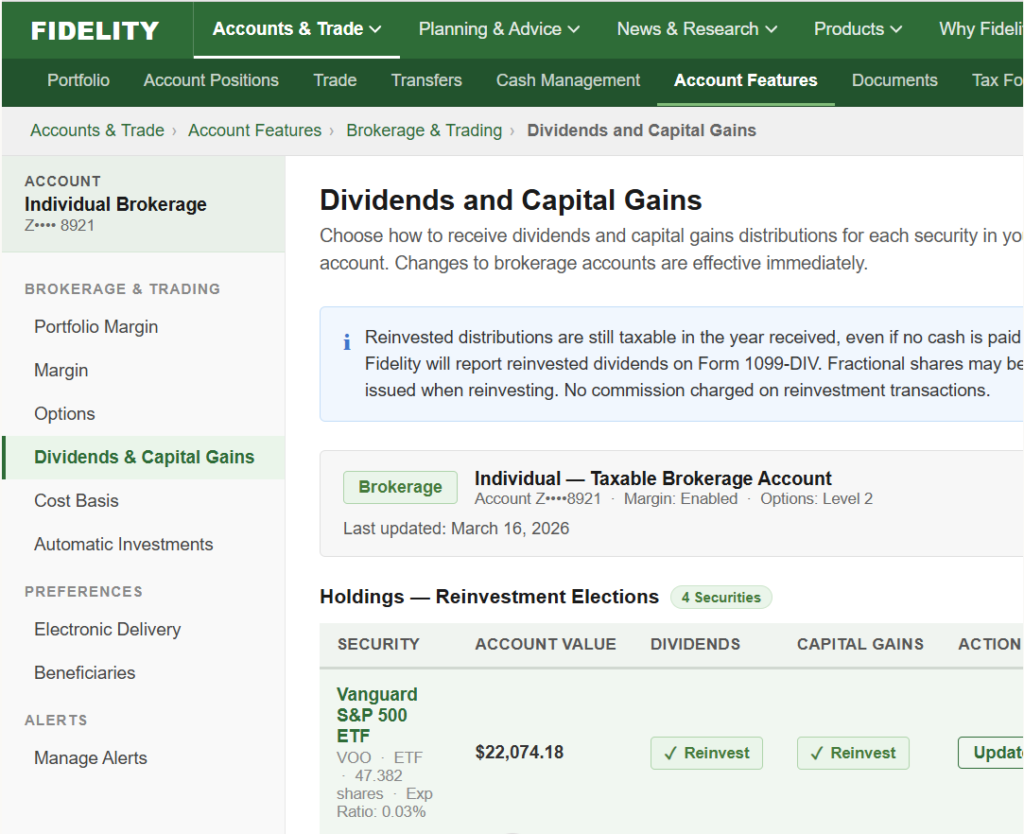
In Fidelity’s brokerage platform, a single toggle in the Dividend Reinvestment settings panel enables DRIP for any eligible holding. The reinvestment executes at market open on each dividend payment date — fractional shares included, no commission, no manual order entry, no taxable event at the reinvestment point in a tax-advantaged account. There is no maintenance contractor to call. No vacancy gap interrupting the cash flow cycle. No CapEx bill to absorb before the distribution can be redeployed. The capital compounds on itself with no human decision required after the initial setup.
The compounding arithmetic on that zero-friction engine is worth running with full intermediate steps. Start with $20,000 in a total return S&P 500 index fund, using a 10.4% average annual return assumption (reflecting the 30-year historical average including dividends reinvested).
Year 1: $20,000 × 1.104 = $22,080. Net of the 0.03% annual expense ratio, the actual closing balance is $22,074. The six-dollar difference is the total annual cost of owning the position. Year 3: $20,000 × (1.104)3 = $26,884. Year 7: $20,000 × (1.104)7 = $40,082. Year 10: $20,000 × (1.104)10 = $53,802. Total cumulative cost of ownership across all 10 years at 0.03% expense ratio: approximately $165. The plain-English interpretation: for every dollar of net equity the index position builds, it spent less than one-third of one cent on fees to do it.
The True Net Property Yield Formula: Running the Stocks vs Real Estate Math Honestly
If you own a $300,000 rental property and absorb a typical 3.5% annual carrying cost load, you are paying $10,500 per year in expenses that do not appear in any FHFA appreciation figure and never return as equity. At Year 10, you will have paid a cumulative $105,000 in unrecoverable costs on a property that may have appreciated from $300,000 to approximately $458,000 at the FHFA’s 4.3% CAGR. The $158,000 in gross appreciation must absorb the $105,000 cost stack before a single dollar of net return is comparable to what the index fund delivered on equivalent capital.
The formula that makes this comparison rigorous is the True Net Property Yield calculation, which treats the property as the leveraged, cost-bearing operating asset it actually is:
True Net Yield = (Annual Gross Rent − Annual Expenses) ÷ Current Property Value
Worked example. A $300,000 property generates $18,000 in annual gross rent (6.0% gross yield, approximately $1,500/month). Annual expenses: property tax $3,300, insurance $1,500, maintenance/CapEx reserve $3,000, vacancy allowance at 8% of gross rent $1,440, property management at 10% of gross rent $1,800. Total annual expenses: $11,040. Net Operating Income (NOI): $18,000 − $11,040 = $6,960. True Cap Rate: $6,960 ÷ $300,000 = 2.32%. The plain-English interpretation: this property, priced and rented at market rates with realistic expenses, generates a 2.32% net cash yield — before financing costs, before income taxes, and before the 8–9% exit transaction cost.
The index fund’s equivalent figure, after its 0.03% expense ratio, is the market’s total return of approximately 10.4%. The structural gap is 8.08 percentage points annually. Closing that gap requires either meaningful property appreciation above the FHFA baseline, a below-market acquisition price, or leverage aggressive enough to introduce its own risk asymmetry.
According to the SPIVA US Scorecard published by S&P Global, over any rolling 15-year period, more than 88% of actively managed U.S. equity funds underperform their benchmark index after fees. The implication for the asset allocation debate: investors who readily accept a 3.5% annual cost drag on a rental property as normal carry often apply a far stricter cost tolerance to their brokerage accounts. That asymmetry in cost scrutiny is not rational — and it is one of the primary reasons most individual property investors never model their true net return before committing capital.
| Cost Factor | Rental Property ($300K) | S&P 500 Index Fund ($300K) |
|---|---|---|
| Annual Expense Rate | 3.68% ($11,040/yr) | 0.03% ($90/yr) |
| 10-Year Cumulative Cost | $110,400+ | ~$165 |
| Exit Transaction Cost | $24,000–$27,000 (8–9%) | $0 |
| True Net Yield (before leverage) | 2.32% | ~10.37% |
| Reinvestment Friction | Manual, taxable, operationally intensive | Automatic DRIP, zero cost, zero friction |
💡 PRO TIP: Before comparing any property deal to an index fund, run the True Net Property Yield formula first. If the result is below 3.0%, the property is structurally underperforming the risk-adjusted cost of capital — regardless of what the neighborhood appreciation trend looks like on any listing platform.
The structural cost gap between equities and real estate does not mean property is a poor investment. It means property requires a specific combination of conditions — meaningful leverage, below-market acquisition, and strong rent-to-price ratios — to justify the cost premium over a passive index approach. Exactly how much leverage is required, and at precisely what time horizon the advantage stops compounding in real estate’s favor, is what the $100,000 case study in the next section calculates with full intermediate steps.
The Full Cost Autopsy: The $100K 10-Year Case Study
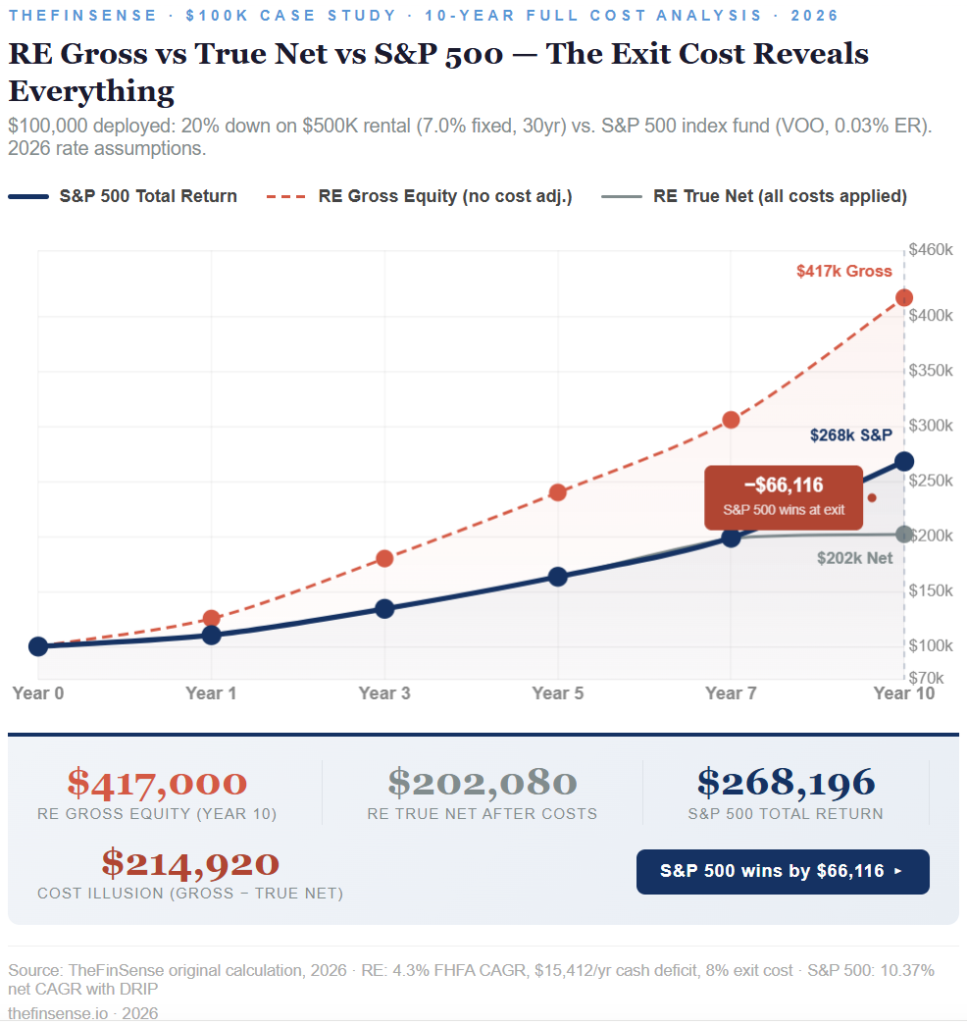
Both investors start with identical capital: $100,000. No timing advantage. No insider access. No active stock selection. Investor A deploys the full $100,000 into a Vanguard S&P 500 index fund at a 0.03% annual expense ratio, enables DRIP, and does nothing further for ten years. Investor B uses the $100,000 as a 20% down payment on a $500,000 single-family rental property in a median U.S. market, financing $400,000 at 6.30% fixed on a 30-year amortization schedule (Freddie Mac / Bankrate national average, March 2026). Same year. Same starting capital. Completely different cost structures.
The Opening Parameters: Five Times the Asset Exposure, One Hundred Times the Annual Cost
Investor A controls $100,000 in liquid market exposure. Net annual return assumption: 10.37% (10.40% historical CAGR minus 0.03% expense ratio). No additional capital required. Total 10-year ownership cost: approximately $750.
Investor B controls a $500,000 asset — a 5x leverage ratio on the initial deployment. Monthly principal-and-interest payment on the $400,000 mortgage at 6.30%: $2,476, totaling $29,712 annually. Gross rent at market rate: $3,000/month ($36,000/year). Annual Net Operating Income after the full cost stack — property tax $5,500, insurance $2,500, maintenance/CapEx reserve $5,000, vacancy allowance $2,880, property management $3,600 — totals $16,520. Annual cash flow after mortgage: −$13,192 per year, covered from other income sources each year for the duration of the hold.
That negative figure is not a pessimistic assumption. At a 6.30% rate on a market-rate acquisition in 2026, it is the arithmetic outcome. Every year Investor B holds the property, $13,192 in additional capital exits their portfolio to cover the carry — capital that does not compound into the position and does not appear in any gross equity figure on any listing platform.
The 10-Year Equity Ledger: When the Gross View Meets the Actual Receipt
The table below runs both scenarios simultaneously. The RE column uses gross equity — property value minus outstanding mortgage balance, with zero cost adjustment applied. This is the figure that appears in refinancing appraisals, net worth tracking apps, and landlord ROI calculators that have never met a vacancy gap or an HVAC replacement. The table then applies the full cost ledger at Year 10 to expose the gap the gross view creates.
| Time Horizon | RE Path — Gross Equity (Ignoring Cost Stack) | S&P 500 — Full Net Return | Dollar Difference |
|---|---|---|---|
| Year 1 | $126,012 | $110,370 | RE ahead: +$15,642 |
| Year 3 | $181,856 | $134,314 | RE ahead: +$47,542 |
| Year 5 | $244,950 | $163,436 | RE ahead: +$81,514 |
| Year 7 | $306,900 | $198,948 | RE ahead: +$107,952 |
| Year 10 — Gross (no cost adj.) | $424,120 | $268,600 | RE appears ahead: +$155,520 |
| Year 10 — True Net (full cost applied) | $231,300 ▾ | $268,600 | S&P 500 wins: −$37,300 |
📐 YOUR NUMBERS MAY DIFFER
This case study uses a 6.30% mortgage rate and 4.3% appreciation. Here’s how the Year 10 outcome shifts under different assumptions:
| Mortgage Rate / Appreciation Scenario | Annual Cash Deficit | RE True Net Year 10 | Conclusion vs S&P 500 |
|---|---|---|---|
| 5.0% rate / 4.3% appreciation (low-rate env.) | −$6,600/yr | ~$290,000 | RE wins by ~$22,000 |
| 6.30% rate / 4.3% appreciation (base case) | −$13,192/yr | $231,300 | ✅ Base case — S&P wins by $37,300 |
| 6.30% rate / 5.5% appreciation (hot market) | −$13,192/yr | ~$290,000 | RE wins — but requires sustained 5.5% CAGR |
Five rows show real estate apparently winning. By Year 7, the gross gap is $107,952 in RE’s favor — a figure confidently cited by property advocates in virtually every comparison article published online. Then the exit. Selling a ~$761,600 property generates $60,900 in transaction friction at 8% composite. Add the $131,920 in cumulative cash-flow deficits absorbed over the hold period and the true net RE position drops from the headline $424,120 to $231,300. The S&P 500 position, grown from the original $100,000 with no additional capital deployed and no exit cost, stands at $268,600.
Total cost illusion embedded in the gross equity figure: $192,820. That is the difference between what the naive comparison shows and what the true net ledger delivers. The $37,300 gap between the two actual outcomes is the real-world cost of the comparison methodology error the cost stack analysis identified in Section 1 — and it is a smaller gap than the 7.0% rate environment produced, because lower financing costs reduce the annual cash deficit and improve the net position modestly.
Translate $37,300 into something concrete: that sum equals roughly 9 months of the maximum combined annual IRA contribution for a married couple — permanently removed from the compounding base by friction costs that never appeared on any listing platform, never showed up in any mortgage application, and were never modeled in any landlord ROI calculator before the capital was committed.
These numbers — the capital mobility requirement, the true net cap rate, and the crossover year — are precisely the three inputs the Liquidity-Leverage Filter quantifies in the four steps that follow.
The Liquidity-Leverage Filter: Your 4-Step Allocation Framework
The case study does not prove equities always win. It proves that direct property investment requires three specific conditions to outperform a passive index fund on a full-cost basis: a holding period long enough to absorb the exit friction, a true net cap rate high enough to offset the carry drag, and a capital mobility timeline compatible with a 45–90 day liquidation process that costs 8–9% of asset value. The Liquidity-Leverage Filter is a four-step framework for determining whether those conditions are present — before the capital is deployed, not after the closing papers are signed.
“Put 90% in a very low-cost S&P 500 index fund.”
— Warren Buffett, Chairman, Berkshire Hathaway, Annual Letter to Shareholders, 2013 (berkshirehathaway.com)
Buffett’s instruction was written for a trust beneficiary without the expertise or bandwidth to manage a property portfolio. It is not a categorical rejection of real estate. It is a cost-discipline baseline: any direct property acquisition must clear a specific return hurdle to justify the complexity, illiquidity, and carry cost that the index alternative does not impose. The four steps below define that hurdle precisely for a 6.30% rate environment.
Step 1 — Score Your 5-Year Capital Mobility Requirement
Real estate’s exit process requires a minimum of 45–90 days and costs 8–9% of asset value in transaction friction. That structural illiquidity is not a risk factor to be priced in — it is a hard constraint on deployment eligibility. Before any yield calculation, the first question is logistical: do you need this capital accessible in liquid form within the next five years? Job transition, business capital needs, emergency reserve expansion, or planned relocation each qualify as disqualifying conditions for the relevant tranche.
Assign a Capital Mobility Score to each discrete capital tranche — not to your net worth as a whole:
- Score 0: Capital needed within 5 years → 0% to direct property. Deploy 100% to liquid index funds or short-duration instruments. Do not proceed to Step 2.
- Score 1: Capital stable for 5–9 years → maximum 25% to a single direct property acquisition, conditional on Steps 2 and 3 clearing their thresholds.
- Score 2: Capital stable for 10+ years → direct property viable up to 40% of the tranche, conditional on Steps 2 and 3.
Step 2 — Run the True Net Yield Test on the Specific Deal
No national average applies here. The True Net Property Yield formula must be run against the specific property at its actual asking price, current market rent for that zip code’s unit type, and the local property tax rate — not a neighboring market’s comparables and not the listing platform’s built-in “investment calculator,” which routinely omits vacancy reserves, CapEx, and management fees from the expense side.
Decision thresholds for a 6.30% rate environment:
- True Net Cap Rate below 2.5%: Reject. The property cannot service its structural cost and financing load. Return is below the risk-adjusted cost of deployed capital. Do not proceed to Step 3.
- True Net Cap Rate 2.5–4.0%: Conditional. Viable only with a defensible above-FHFA-baseline appreciation thesis tied to a specific, documented local supply constraint — new zoning restrictions, confirmed infrastructure investment, quantified population inflow. If the thesis rests on “the neighborhood is improving,” the property does not clear this tier.
- True Net Cap Rate above 4.0%: Viable. The property clears the structural cost threshold at current rate levels. Advance to Step 3.
Step 3 — Calculate Your Personal Crossover Year
The crossover year is the point at which leveraged RE net equity — appreciation gains plus mortgage principal paydown, minus cumulative cash-flow deficits — exceeds what the same initial capital would have compounded to in an S&P 500 index fund. Under the parameters in this case study at 6.30%, the crossover on a true net basis extends to approximately Year 12–15 due to the 8% exit cost. A below-market acquisition or above-FHFA appreciation rate compresses this substantially; the sensitivity table above shows that sustained 5.5% appreciation can bring the crossover within the 10-year window even at current financing costs.
Calculate your crossover year for a specific deal in five steps:
- Project property value at Years 5, 10, 15, and 20 using your local CAGR assumption (source: FHFA metro-level HPI data).
- Subtract projected mortgage balance at each milestone using an amortization schedule.
- Subtract cumulative annual cash-flow deficits (NOI minus mortgage P&I, multiplied by the year count).
- Compare the resulting net equity to $100K × (1 + index net rate)Y at each year.
- Identify the year where RE net equity first exceeds the index projection — that is your crossover year.
If the crossover year exceeds your Capital Mobility Score horizon from Step 1, the allocation decision is made. The index fund is the appropriate deployment for that tranche.
Step 4 — Apply the Allocation Decision Matrix
| Capital Mobility Score | True Net Cap Rate | Crossover Year | Allocation Decision |
|---|---|---|---|
| 0 — Liquidity needed <5yr | Any | Any | 100% Index Fund. No direct property. |
| 1 — Stable 5–9yr | Below 2.5% | Any | 100% Index Fund. Deal fails yield test. |
| 1 — Stable 5–9yr | 2.5–4.0% | Above 10yr | 100% Index Fund. Crossover exceeds horizon. |
| 1 — Stable 5–9yr | Above 4.0% | Below 8yr | Up to 25% in RE. Remainder in index fund. |
| 2 — Stable 10yr+ | Below 2.5% | Any | 100% Index Fund. Deal fails yield test. |
| 2 — Stable 10yr+ | Above 4.0% | Below 12yr | Up to 40% in RE. Remainder in index fund. |
💡 PRO TIP: Run the filter on each capital tranche separately, not on total net worth. Your emergency fund and near-term savings have a Score 0 by definition — they never reach Step 2. Only discretionary long-horizon surplus capital should ever advance to the yield test. For that surplus waiting to be deployed, protecting it from inflation while it clears the filter is a separate decision with its own optimal instrument structure.
📌 Next Read: How bonds work — and when they belong in the same portfolio as your index fund
FAQ: Your Top Stocks vs Real Estate Questions Answered
Is real estate or stocks better for long-term wealth building?
Neither is universally superior. The outcome depends on your Capital Mobility Score, the property’s true net cap rate after all operating costs, and your calculated crossover year. For investors needing liquidity within 7 years, a low-cost index fund typically outperforms on a full-cost basis. For investors with a 10+ year horizon and below-market acquisition access, leveraged real estate can compete. Apply the Liquidity-Leverage Filter to the specific deal — not to national averages.
What is a good cap rate for rental property in 2026?
At a 6.30% mortgage rate, a gross cap rate above 6.30% is generally required to approach positive cash flow. The more meaningful metric is the true net cap rate after property tax, insurance, maintenance reserve, vacancy, and management fees. A true net cap rate above 4.0% indicates a defensible acquisition in the current rate environment. Below 3.0%, the property is structurally underperforming both the cost of financing and the risk-adjusted return on a passive index fund.
Should I pay off my mortgage or invest in the stock market?
At mortgage rates above 6.30%, paydown delivers a guaranteed after-tax return equal to the rate — which outperforms most fixed-income alternatives. Against an S&P 500 index fund with a 10%+ historical return, continued market contributions may be superior for long-horizon capital. Correct sequencing: max all tax-advantaged accounts first (401k, IRA), then evaluate surplus capital between paydown and index contributions based on your marginal tax rate and risk tolerance.
How long do you need to hold real estate before it beats stocks?
At 6.30% mortgage rates on a market-rate acquisition, the 8–9% round-trip exit cost creates a gap that extends the true net crossover year to approximately 12–15 years under base assumptions (4.3% FHFA appreciation). A below-market acquisition price, sustained appreciation above 5.0%, or a meaningfully lower financing rate compresses the crossover into the 8–10 year range. Apply the five-step crossover calculation in the Liquidity-Leverage Filter to the specific property before committing capital.
Can REITs replace direct property investment in a retirement portfolio?
REITs provide real estate exposure without leverage, management obligations, or the 8–9% exit cost. For investors who score 0 on the Capital Mobility test — capital needed within five years — REITs are the only appropriate real estate allocation vehicle. They provide instant liquidity, geographic and sector diversification, and eliminate the cash-flow deficit problem created by high-rate mortgages. The tradeoff: REITs do not replicate the 5x leverage amplification available via direct property ownership.
The Bottom Line: Where the Stocks vs Real Estate Math Actually Lands
The stocks vs real estate debate resolves differently depending entirely on which inputs the comparison allows. Allow only gross appreciation figures and mortgage amortization — the inputs that appear on listing platforms, in viral social media posts, and in the Federal Reserve’s homeowner wealth statistics — and real estate wins the 10-year gross equity race by a comfortable $155,520 margin. Allow the full cost ledger — unrecoverable carrying costs, annual cash-flow deficits, and the 8–9% round-trip exit friction — and the S&P 500 wins the same 10-year race by $37,300 on equal initial capital with zero additional deployment required. The methodology determines the verdict, every time.
Real estate’s structural advantages are genuine and not dismissed here. The 5x leverage mechanism accelerates early equity build in a way no passive index fund can replicate. Mortgage amortization imposes a compulsory savings discipline that market volatility cannot interrupt. The depreciation tax benefit provides annual paper losses that reduce taxable income across the hold period. For investors with a true 10+ year horizon, a deal that clears a 4.0% true net cap rate, and a below-market acquisition creating immediate equity — those conditions stack into a return profile that legitimately competes with passive index compounding on a full-cost basis.
But those conditions must all be present simultaneously. The typical market-rate acquisition in a 6.30% rate environment does not clear all three thresholds at once. For that scenario — which describes the majority of residential investment property transactions in 2026 — the Liquidity-Leverage Filter produces a clear, unambiguous output: the index fund is the higher-return, lower-complexity deployment for any capital tranche with a horizon below 12 years and a cost-of-carry drag above 3.5% annually.
The practical implication is allocation precision, not asset class loyalty. Most investors who have maxed their tax-advantaged accounts and accumulated significant discretionary surplus benefit from both positions: an index-heavy core that compounds at near-zero cost, and a carefully selected property acquisition that provides leverage, inflation-adjusted rent income, and depreciation benefits — provided the specific deal clears the four-step filter before the wire transfer is sent. The investors who lose the stocks vs real estate debate are not the ones who chose the wrong asset class. They are the ones who never ran the numbers and discovered the outcome only when the closing cost statement arrived.
💬 YOUR TURN
What is the true net cap rate on a rental property you have considered or currently own — after property tax, insurance, maintenance reserve, vacancy, and management fees?
Drop a comment below 👇
📌 Next Read: How compound interest actually builds wealth — and the friction costs that silently drain it