
📝 TL;DR (Bottom Line Up Front)
- ETFs (Exchange-Traded Funds): Trade like stocks (instantly), usually cheaper, and highly tax-efficient. Best for the “Friction-Free Compounder™” strategy.
- Mutual Funds: Trade once a day, good for automated “set-it-and-forget-it” investing, but often carry hidden costs.
- The Verdict: For 95% of new investors, the ETF wins on math alone.
When deciding between ETFs vs Mutual Funds, most new investors unknowingly sign a contract that loses them money. Not through market crashes, but through the “silent killers” of investing: Expense Ratios and Tax Drag.
If you are holding the wrong vehicle, you could be bleeding 1% of your wealth annually without noticing. Over 30 years, that doesn’t just buy a nice dinner; it buys a Ferrari—for your broker, not for you.
In this guide, we aren’t just comparing definitions. We are applying “The Friction-Free Compounder™” to ensure you keep what you earn.
One Warning: There is a specific “Phantom Tax” hidden inside Mutual Funds that forces you to pay taxes even if you didn’t sell a single share. It traps millions of investors every year. I will reveal exactly how to dodge this bullet in the final section.
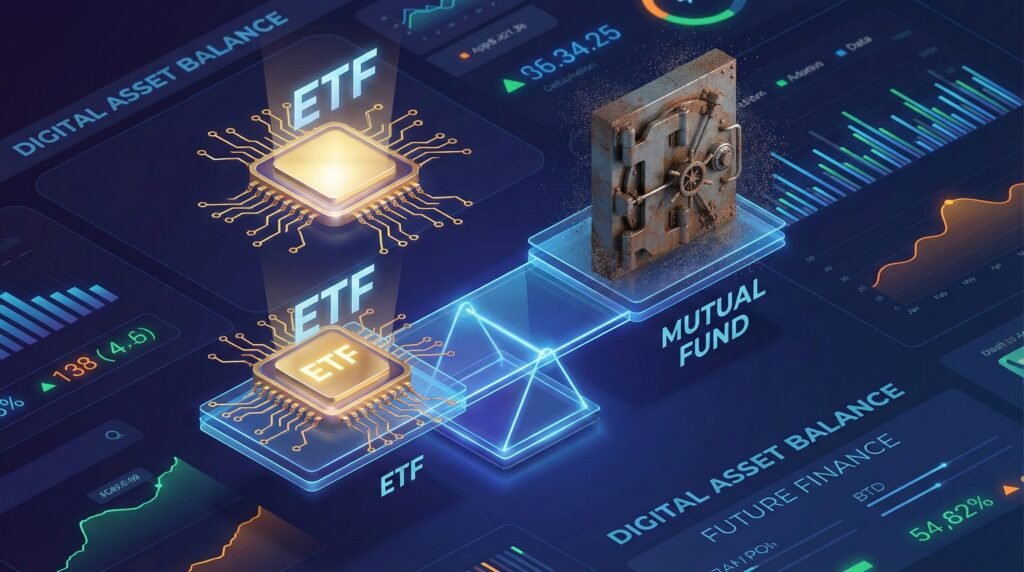
What is the Difference Between ETFs vs Mutual Funds?
Exchange-Traded Funds (ETFs) are investment baskets that trade on stock exchanges throughout the day, offering real-time pricing, high liquidity, and tax efficiency. Mutual Funds are pooled investment vehicles priced only once daily (at market close) and often involve active management with higher expense ratios. The core difference is trading flexibility.
Round 1: The Mechanics (Netflix vs. Cable TV)
To understand the mechanics, let’s use a behavioral analogy.
- ETFs are like Netflix: You have total control. You can “watch” (buy/sell) at any specific moment the market is open. You pay a low subscription fee (expense ratio) for a massive library of content (stocks).
- Mutual Funds are like Cable TV: You get what the programming director (Fund Manager) chooses. You pay a premium price for the “curation,” and everything happens on a set schedule (pricing at 4:00 PM EST).
The “Tale of the Tape” Comparison
| Feature | ETF (The Speedboat) 🚤 | Mutual Fund (The Cruise Ship) 🚢 |
| Trading Time | Any time market is open (9:30 AM – 4:00 PM) | Once per day (Market Close) |
| Minimum Investment | Price of 1 Share (or fractional shares) | Often $500 – $3,000 lump sum |
| Management Style | Mostly Passive (Tracks an Index) | Mostly Active (Human picking stocks) |
| Tax Efficiency | High (Creation/Redemption mechanism) | Low (Capital Gains distributions) |
| Avg. Expense Ratio | ~0.03% to 0.40% | ~0.50% to 1.50% |
💡 Pro Tip: Don’t be fooled by the “Active Management” sales pitch. Data consistently shows that over a 15-year period, nearly 90% of active fund managers fail to beat the market index. Why pay premium fees for sub-par performance?
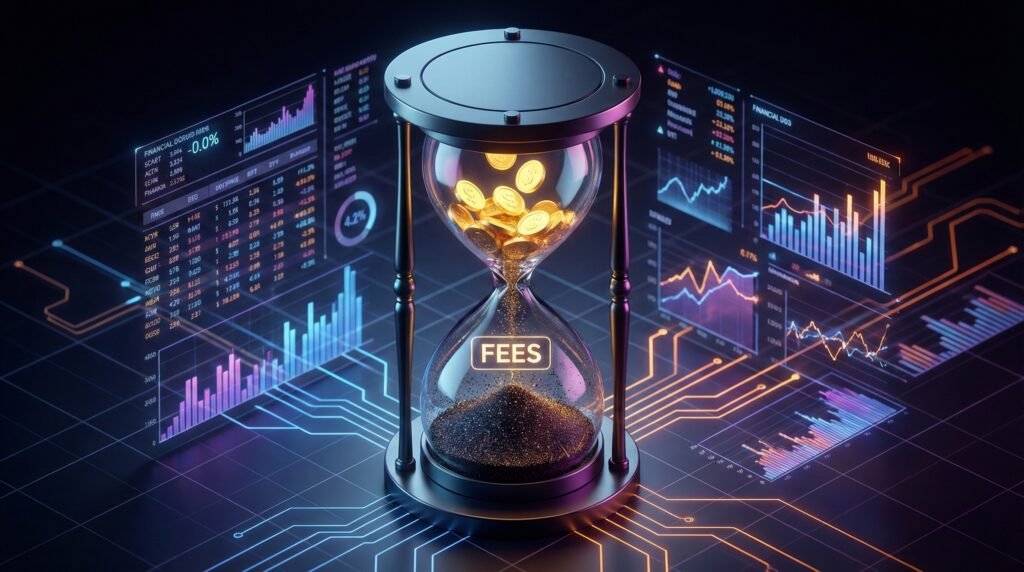
Round 2: The “Information Gain” Simulation ($158,000 Lost)
Let’s run the numbers. Most articles tell you “fees matter.” I’m going to show you how much they matter.
Imagine two investors, Sarah and Tom. Both invest $10,000 initially and add $500/month for 30 years. The market gives them both an 8% annual return.
- Sarah buys a passive ETF (Net Growth: 7.97% due to 0.03% fee)
- Tom buys an active Mutual Fund (Net Growth: 7.00% due to 1.00% fee)
Here is the result of the “Fee Drag”:
| Year | Sarah’s Portfolio (ETF) | Tom’s Portfolio (Mutual Fund) | The “Lost Wealth” Gap |
| Year 1 | $16,850 | $16,700 | **$150** |
| Year 10 | $105,600 | $99,800 | **$5,800** |
| Year 20 | $320,000 | $284,000 | **$36,000** |
| Year 30 | $848,500 | $690,600 | $157,900 💸 |
The Reality: Tom didn’t just pay 1% more. Because he lost the compound interest on that fee, Tom lost enough money to buy a small house.
⚠️ Reality Check: High fees are the only thing in finance that is a guaranteed loss. Market returns are never guaranteed; fees are. Control what you can control.
Round 3: The “Friction-Free Compounder™” Strategy
To build a portfolio that survives volatility and fees, adopt this strategy. This is how smart money operates in 2026.
1. The “Core” Defense
Use low-cost Broad Market ETFs as your “Core” (80-90% of money). This includes total stock market funds (like VTI, ITOT, or VOO). This provides the “Shield” of diversity.
2. The Expense Ratio Filter
Never buy a core fund with an expense ratio over 0.10%. There is simply no need. The biggest providers (Vanguard, BlackRock/iShares, Schwab) are in a “race to zero” on fees. Take advantage of it.
3. Check the “Bid/Ask Spread”
Because ETFs trade like stocks, there is a spread.
- Good: Spread of $0.01 (High liquidity).
- Bad: Spread of $0.20+ (Low liquidity).
- Action: Stick to ETFs with billions in Assets Under Management (AUM) to ensure you can sell when you need to.

Interactive: The “Right Choice” Quiz
Not sure which to pick? Check the box that applies to you.
Choose an ETF if:
- [ ] You want to trade intra-day or use advanced orders (Stop-Loss).
- [ ] You are investing in a taxable brokerage account (Non-IRA).
- [ ] You have a small starting amount (e.g., $50).
- [ ] You hate paying unnecessary fees.
Choose a Mutual Fund if:
- [ ] You are in an employer 401(k) where it is the only option.
- [ ] You want to invest a specific dollar amount (e.g., exactly $100.00) and your broker doesn’t support fractional ETF shares.
- [ ] You are tempted to “panic sell” during the day and want a vehicle that prevents you from trading until the market closes.
FAQ: People Also Ask
Q: Can I lose all my money in an ETF?
Yes, if the underlying assets go to zero. However, if you buy a Broad Market ETF (holding 3,000+ companies), the entire global economy would have to collapse for you to lose everything.
Q: Do ETFs pay dividends?
Absolutely. If the companies inside the ETF pay dividends, the ETF collects them and pays them out to you (usually quarterly).
Q: Are Mutual Funds safer than ETFs?
No. Safety depends on what the fund holds, not the structure. A Mutual Fund holding risky tech startups is more dangerous than an ETF holding government bonds.
Q: Can I convert my Mutual Funds to ETFs?
Sometimes. Vanguard, for example, often allows tax-free conversions from their Mutual Funds to the equivalent ETF share class. Check with your broker specifically.
Q: Why do 401(k)s mostly use Mutual Funds?
Legacy infrastructure. Mutual fund platforms were built decades ago to handle fractional shares and automated payroll deductions, which 401(k)s rely on.
Conclusion: The “Phantom Tax” Reveal
At the start, I warned you about a trap. Here it is: Capital Gains Distributions.
When other investors panic-sell out of a Mutual Fund, the Fund Manager is forced to sell stocks to pay them out. If the manager sells those stocks at a profit, the IRS requires the fund to pass that tax bill onto YOU—the remaining shareholder.
You pay taxes on profit you never pocketed.
The Solution? ETFs.
Due to a unique “In-Kind Creation/Redemption” process, ETFs rarely trigger these taxable events. They are tax shelters by design.
Your Tomorrow Morning Action Plan:
- Log into your brokerage.
- Check the “Expense Ratio” of your current holdings.
- If you are in a taxable account holding high-fee Mutual Funds, stop the bleeding. Look for the ETF equivalent.
- Switch to “The Friction-Free Compounder™” mindset.
References
Hayes, A. (2025). Expense ratio: Definition, formula, and components. Investopedia. https://www.investopedia.com/terms/e/expenseratio.asp
Internal Revenue Service. (n.d.). Topic no. 409, Capital gains and losses. U.S. Department of the Treasury. https://www.irs.gov/taxtopics/tc409
S&P Dow Jones Indices. (2025). SPIVA® U.S. scorecard. S&P Global. https://www.spglobal.com/spdji/en/research-insights/spiva/
U.S. Securities and Exchange Commission. (n.d.). Mutual funds and ETFs: A guide for investors. Investor.gov. https://www.investor.gov/introduction-investing/investing-basics/investment-products/mutual-funds-and-exchange-traded-1
Vanguard Group. (n.d.). Compare ETFs and mutual funds. Vanguard Investor Resources. https://investor.vanguard.com/investor-resources-education/etfs/etf-vs-mutual-fund
📜 DISCLAIMER: Not Financial Advice
The information provided in this article, including “The Friction-Free Compounder™” strategy and the “Fee Erosion” simulations, is for educational and informational purposes only. It does not constitute professional financial, investment, tax, or legal advice.
Hypothetical Data: The financial projections and “lost wealth” calculations (e.g., the ~$158,000 loss scenario) are hypothetical examples based on mathematical assumptions and historical market averages. They do not guarantee future results.
Risk Warning: All investments involve risk, including the potential loss of principal. Past performance of any ETF, Mutual Fund, or index is not indicative of future performance. Readers are strongly advised to consult with a qualified financial planner (CFP) or tax professional (CPA) regarding their specific financial situation before making any investment decisions.
