
📅 Originally Published: · Last Updated:
A compass left in a drawer points north just the same, waiting for someone to open it.
Executive Summary
Self-directed investors who skip a written investment policy statement sacrifice 1.50% annually in behavioral drag. That drag compounds to a $745,726 gap over 30 years on a $150,000 portfolio with $1,000 monthly contributions. A one-page IPS written in 45 minutes closes it.
Most self-directed investors manage their portfolio without a written investment policy statement. The 2025 tariff sell-off proved the cost. Portfolios without written rules froze at the worst possible moment.
That freeze costs $745,726 over 30 years. The $492,128 HSA investment gap and the $310,817 Roth conversion gap follow the same compounding path. Each traces to one unchecked default.
The mechanism is not more knowledge or better willpower. This analysis applies to US self-directed brokerage and retirement accounts only.
Why Mental Discipline Fails: The 1.50% Behavioral Penalty Research Shows
Believing that discipline alone prevents panic selling is reasonable because most investors intend to hold through volatility. Financial media, target date fund automation, and historical S&P 500 return charts all reinforce the assumption that staying invested requires willpower, not a document. If intention were sufficient, the behavior gap would not exist.
A Bogleheads community member described the freeze firsthand. The investor held a diversified index portfolio. They understood the case for staying invested through drawdowns.
When the market dropped, that understanding failed. Rebalancing into falling assets exceeded their mental threshold. They sold equities into cash and rebought weeks later at a higher price.
The investor had no written investment policy statement.
The rebalancing trigger existed only as intention. Intention without documentation produced the exact outcome the investor planned to avoid. The written rule was the only thing missing.
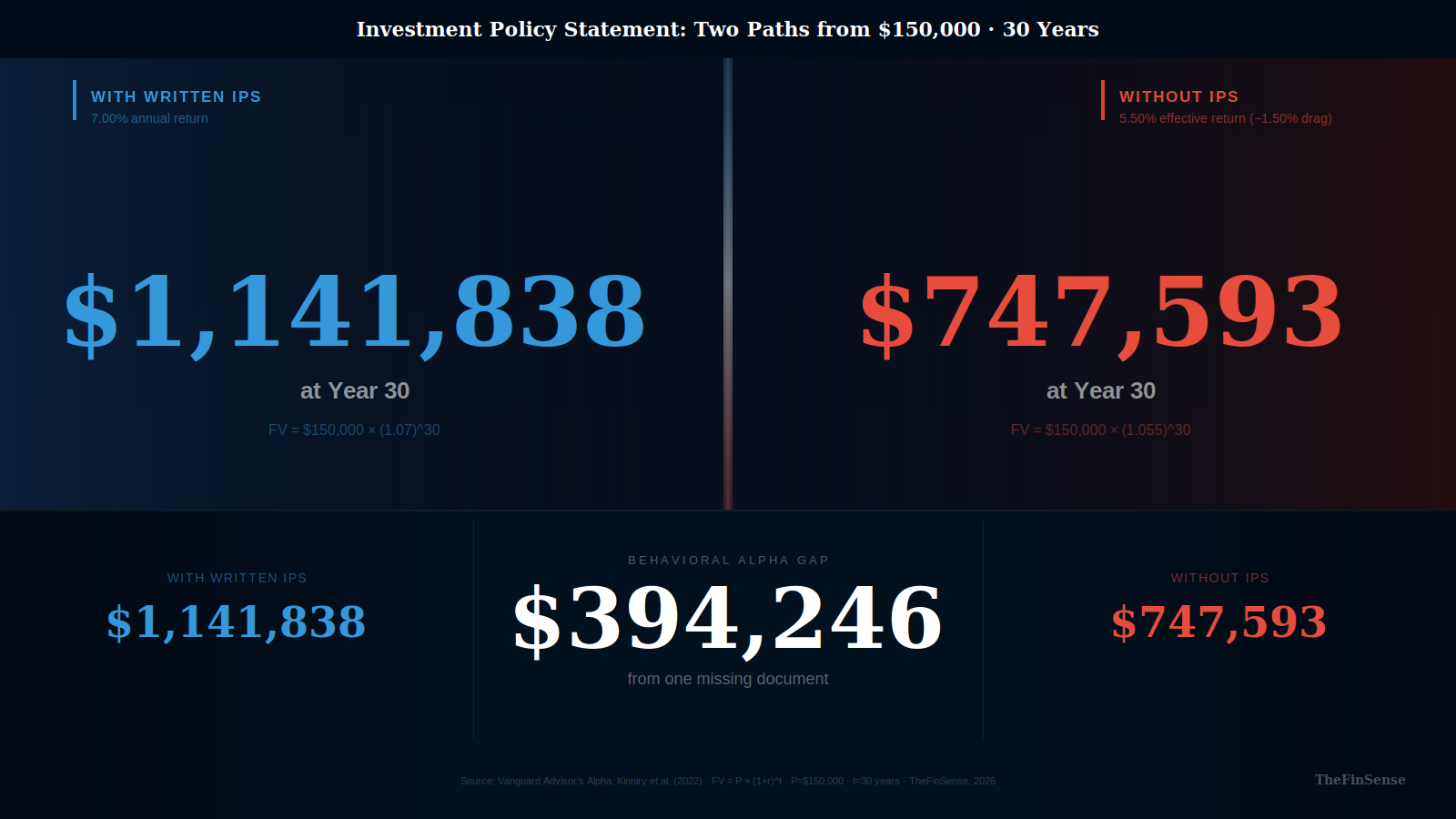
Whether your portfolio holds $80,000, $250,000, or $600,000, the 1.50% behavioral drag applies the same arithmetic to each balance. The Roth IRA holder, the split-account accumulator, and the pre-retiree face identical compounding.
Kinniry (2019) reveals that the single largest source of advisor value is not portfolio selection but preventing clients from abandoning their allocation.
If discipline were enough, why does the average investor still underperform their own investments?
What Written Investment Rules Prove: How Advisors Quantified the Behavior Gap
Every market downturn generates the same data point: investors who hold do not.
The distinction between mental resolve and a written investment policy statement reduces to five behaviors. Each row below isolates one behavioral failure and its IPS-based counterpart.
How a Written Investment Policy Statement Replaces Mental Discipline
| Behavior Type | Mental Strategy | Written IPS Rules | Impact Over 30 Years |
|---|---|---|---|
| Market Drop Response | I will hold (no pre-commitment) | If portfolio drops >15%, rebalance within 5 business days | 1.50% annual drag vs 0% |
| Rebalancing Trigger | Check quarterly when I remember | Rebalance when any asset class drifts >5% from target | 0.14% rebalancing alpha (Vanguard Module III) |
| Risk Tolerance Drift | Assume tolerance stays constant | Review risk score every 2 years or after life event | Prevents allocation mismatch |
| Performance Review | Compare to S&P 500 weekly | Compare to IPS benchmark annually | Reduces reactive trading |
| Emotional Override | Rely on willpower | Written rule: No trades within 48 hours of market headline | Prevents panic selling |
Vanguard’s Advisor’s Alpha framework estimates total advisor value at approximately 3% annually. Behavioral coaching accounts for roughly half.
Investment Policy Statement: Why Behavioral Coaching Drives Half of Advisor Alpha
Vanguard Advisor’s Alpha Module Decomposition (~3% Total Annual Value)
David Blanchett and Paul Kaplan (2013) quantified holistic financial planning at 1.59% alpha-equivalent. Their methodology covers households approaching retirement.
That behavioral alpha parallels the 1.08% alpha in tax loss harvesting rules. Both compound silently over decades.
Carl Richards, CFP and creator of the Behavior Gap, framed the problem directly.
“I am more convinced than ever that all investment mistakes are really investor mistakes.”
— Carl Richards, CFP, Creator of the Behavior Gap
DOL Interpretive Bulletin 94-2 treats a written investment policy statement as evidence of fiduciary prudence for individual investors.
Most investors assume advisor value comes from fund selection. Vanguard’s 2019 analysis found the opposite. Behavioral coaching alone accounts for half of the total 3% advisor alpha.
Vanguard found that behavioral coaching preserves 1.50% in annual returns, worth $745,726 over 30 years on a $150,000 portfolio with $1,000 monthly contributions.
The IPS does not care about the account size. It cares about whether a written rule exists before the next red screen.
Blanchett and Kaplan (2013) measure holistic planning at 1.59% alpha-equivalent, yet fewer than 10% of self-directed investors maintain a written IPS.
If the DOL treats a written investment policy as evidence of fiduciary prudence, why do individual investors treat it as optional?
How the 1.50% Behavioral Drag Compounds: The IPS Formula That Closes the Gap
A DOL standard written for pension fiduciaries and a Vanguard research module point to the same mechanism.
What the Investment Policy Statement Mechanism Actually Does
An investment policy statement converts behavioral intention into a written rule. The rule specifies exact triggers for rebalancing and drawdown response. Written triggers execute before emotion enters the calculation.
The mechanism is pre-commitment: written rules remove the decision point before emotion can override arithmetic.
Before Kinniry (2019), the field assumed behavioral coaching was a qualitative relationship benefit with no measurable return attribution.
How 1.50% Behavioral Drag Compounds Over 30 Years
Francis Kinniry, CFA, Jaconetti, DiJoseph, Walker, and Quinn (2022) quantified behavioral coaching at 1.50% annually. The range spans 0 to over 200 basis points. The midpoint anchors the formula.
That single rate deduction drives the entire gap.
Kinniry’s behavioral coaching module treats pre-commitment rules as the mechanism that preserves that 1.50% annually.
The compounding formula uses monthly compounding with contributions. Behavioral drag subtracts 1.50% from the gross return. That single deduction separates two 30-year outcomes.
Thirty years compounds the difference.
At 7.00% gross return, a $150,000 portfolio with $1,000 monthly contributions grows to $2,437,446 over 30 years. At 5.50% net return (after 1.50% behavioral drag), it reaches $1,691,720.
The gap: $745,726 from a single behavioral variable.
For a full breakdown of the compounding inputs and rate assumptions used in this analysis, see the TheFinSense calculation methodology.
The IPS target allocation governs the split between growth assets and safe investments to beat inflation. The 1.50% drag applies to the total portfolio.
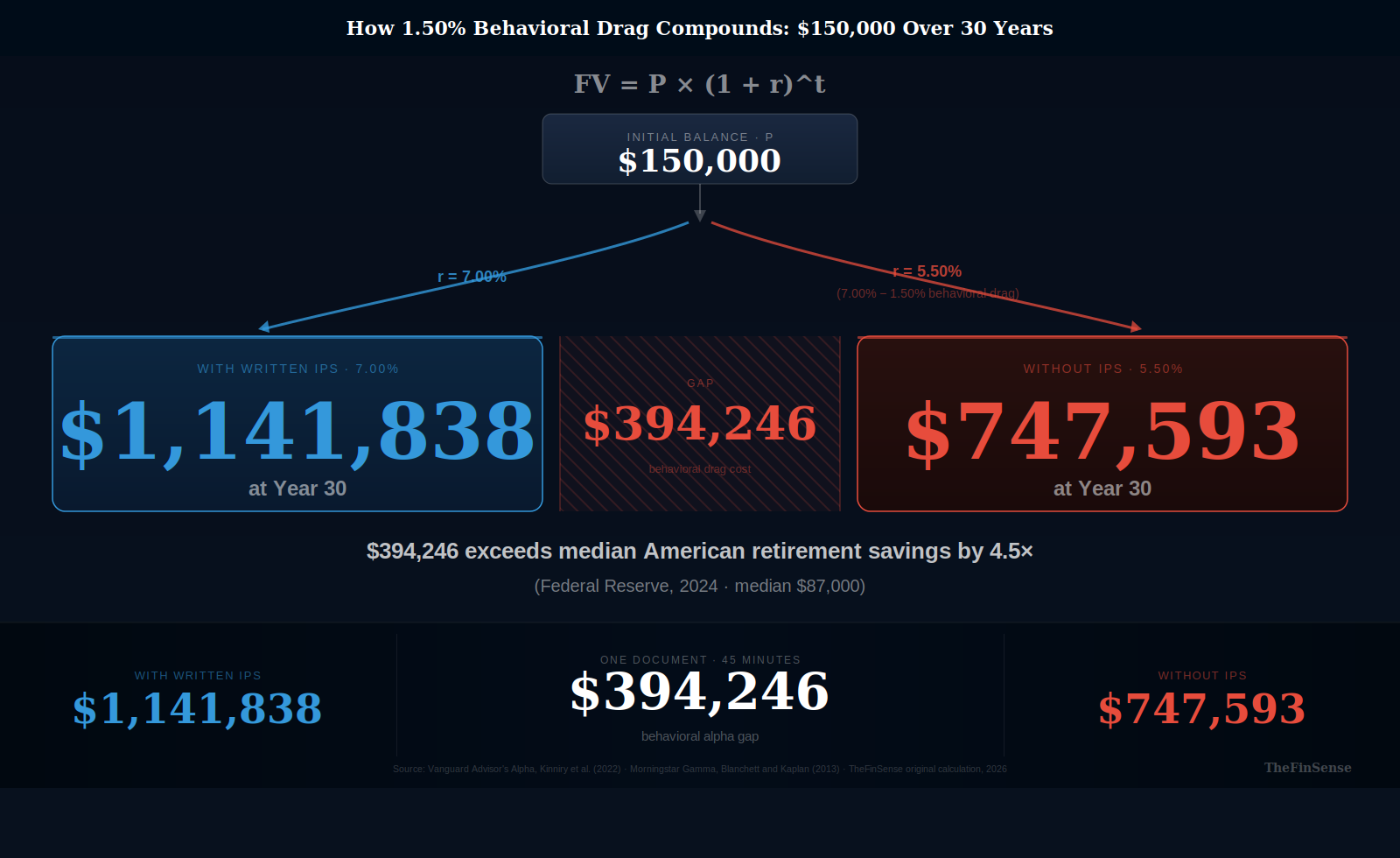
Gamma: The 1.59% Structural Planning Corroboration
Blanchett and Kaplan’s Gamma found 1.59% alpha-equivalent from five structured planning decisions.
That 1.59% translates to 22.6% more certainty-equivalent retirement income. The study population is near-retirees in decumulation. This article focuses on accumulators.
The behavioral coaching alpha, not the full Gamma, drives the formula above. Gamma serves as independent corroboration from a different research team.
The 1.59% alpha-equivalent conceals five distinct planning decisions. Removing any single one drops retirement income by 4% to 7%. Behavioral coaching is one of those five.
$745,726
The behavioral alpha gap exceeds the median American retirement savings of $87,000 by 8.6 times (Federal Reserve, 2024).
The 1.50% behavioral drag compounds silently, producing a $745,726 gap that no fund selection or rebalancing strategy can close.
If 1.50% produces a six-figure gap, what does the combined 3% Advisor’s Alpha produce?
Robin’s $745,726 Investment Policy Statement Projection: A 30-Year Two-Path Model
$745,726. Robin’s portfolio has been compounding toward that number for 30 years. One of them knows it.
Robin logs into Vanguard the Sunday after the quarterly statement arrived and opens the Holdings tab, scanning a portfolio that reads $150,000 in a three-fund index allocation. Robin has read about the importance of staying invested during downturns but has never written a single rule about what to do if the portfolio drops 20%.
When the market dropped 18% in early 2025, Robin sold $22,000 of equities into a money market fund. They rebought three weeks later at a 9% higher price.
You chose to manage your own portfolio, so here is what that math produces.
| Parameter | Value |
|---|---|
| Name | Robin |
| Age | 35 |
| Income | $130,000 |
| Filing Status | Single |
| Initial Balance | $150,000 |
| Monthly Contribution | $1,000 |
| Time Horizon | 30 years |
| Target Age | 65 |
| Invested Return Rate | 7.00% (with written IPS) |
| Alternative Return Rate | 5.50% (7.00% − 1.50% behavioral drag) |
Most investors estimate the lifetime cost of not having a written investment policy at $5,000 to $15,000.
The actual projection runs two paths from the same $150,000 starting balance. One path compounds at 7.00% with a written IPS. The other compounds at 5.50% without one.
Both begin at $150,000.
| Year | With Written IPS (7.00%) | Without IPS (5.50%) | Gap |
|---|---|---|---|
| Year 5 (Age 40) | $284,237 | $266,236 | $18,000 |
| Year 10 (Age 45) | $474,534 | $419,169 | $55,365 |
| Year 15 (Age 50) | $744,304 | $620,383 | $123,921 |
| Year 20 (Age 55) | $1,126,737 | $885,121 | $241,616 |
| Year 25 (Age 60) | $1,668,884 | $1,233,438 | $435,446 |
| Year 30 (Age 65) | $2,437,446 | $1,691,720 | $745,726 |
Investment Policy Statement: $745,726 Behavioral Alpha Gap Over 30 Years
$150,000 + $1,000/Mo — 7.00% With IPS vs 5.50% Without IPS
Robin’s projection is not unusual. Any investor holding a six-figure portfolio without a written drawdown protocol faces the same divergence. The two lines on that chart separate every self-directed account holder who relies on mental discipline from every one who put the rules on paper.
The gap is small at Year 5. It is visible at Year 15.
$2,437,446 with a written IPS. $1,691,720 without one. The difference: one page.
Robin finally opens the bearing that has been pointing toward $2,437,446 all along.
That $745,726 divided by $2,100 per month equals roughly 355 months of mortgage payments. Nearly 30 years. The cost is not abstract. It is the difference between retiring at 65 with full coverage and retiring with a gap the size of your entire mortgage.
Robin’s $150,000 portfolio reaches $2,437,446 with a written IPS and $1,691,720 without one.
YOUR NUMBERS MAY DIFFER
| Assumption Changed | Scenario | With IPS | Without IPS | Gap |
|---|---|---|---|---|
| Market Return lower | 6.00% return | $1,907,901 | $1,336,541 | $571,360 |
| Market Return higher | 8.00% return | $3,130,719 | $2,154,948 | $975,771 |
| Behavioral Drag lower | 1.00% drag | $2,437,446 | $1,907,901 | $529,544 |
| Behavioral Drag higher | 2.00% drag | $2,437,446 | $1,502,420 | $935,025 |
| Time Horizon shorter | 20 years | $1,126,737 | $885,121 | $241,616 |
| Time Horizon longer | 35 years | $3,526,977 | $2,294,683 | $1,232,294 |
Robin’s full household allocation would include both retirement and taxable accounts, including an overfunded 529 plan in the total allocation target. The IPS applies to the entire portfolio, not one account.
What would your IPS have told you to do last March?
How to Write an Investment Policy Statement: The 5-Element IPS Framework
Robin’s two-path split does not require a financial advisor to close.
You now see the math. Here is how to act on it. The following five steps produce a written investment policy statement in 45 minutes.
Step 1: Document Your Target Asset Allocation (5 Minutes)
Verify the core assumption first: that your current allocation matches your intended risk level. Open your holdings page (Vanguard: My Accounts → Holdings; Fidelity: Accounts → Positions; Schwab: Accounts → Balances) and record the exact percentage in each asset class.
Write your equity percentage and your fixed income percentage. Cash fills the remainder. Understanding how bonds work before setting the fixed income target prevents allocation errors at the source.
Start conservative.
A common starting point is 80% equity and 20% fixed income for a 30-year horizon. Adjust based on your actual risk tolerance, not the default your platform assigned.
Step 2: Set Your Rebalancing Trigger Bands (10 Minutes)
Define the drift threshold that triggers a rebalance. The standard band is 5% absolute deviation from target on any asset class.
Write the rule: if any asset class drifts more than 5 percentage points from target, rebalance within 5 business days. Calendar-based rebalancing misses drift during volatile months.
Threshold-based rules catch it.
Record the current allocation percentages next to the targets. The gap between the two columns tells you whether a rebalance is already overdue. Log the date and comparison in your IPS document.
Step 3: Write Your Drawdown Response Protocol (10 Minutes)
This step eliminates the freeze Robin experienced. Write the exact action you will take when your portfolio drops 10%, 15%, and 20% from its peak.
A sample protocol: at a 15% drawdown, rebalance to target within 5 business days. At 20%, rebalance and review risk tolerance. At 30%, execute the same protocol with no deviation.
The written rule replaces the mental calculation you will not perform during a sell-off.
Robin had no protocol. Robin sold.
Step 4: Establish Review Cadence (10 Minutes)
Set two review triggers. First, a calendar trigger: review the IPS annually at a fixed date. Second, an event trigger: review after any life event that changes income, expenses, or time horizon.
Step 5: Write the Emotional Override Rule (10 Minutes)
Add one sentence to the IPS: no portfolio trades within 48 hours of a market headline. This single line prevents the most common behavioral failure.
💡 PRO TIP: Set a recurring calendar reminder for your annual IPS review. Attach the IPS document to the calendar event so the file opens when the reminder fires. The 48-hour rule applies to trades only, not to checking your balance.
The 48-hour rule would have prevented Robin’s sell-off.
The 5-step IPS construction framework: target allocation → rebalancing bands → drawdown protocol → review cadence → emotional override rule. Source: TheFinSense, 2026.