
For 2026, the HSA annual base limit is $4,400 for self-only coverage or $8,750 for family coverage. For 2027, it is $4,500 or $9,000. Eligible people age 55 or older at year-end may add up to $1,000 in their own HSA; part-year eligibility can reduce that amount. Employer money counts toward the same limit. Your remaining room depends on your eligible months, spouse allocation and contributions already made.
Annual HSA limits for 2026 and 2027
| Tax year | Self-only coverage | Family coverage |
|---|---|---|
| 2026 | $4,400 | $8,750 |
| 2027 | $4,500 | $9,000 |
The annual base is the starting ceiling for the selected year and coverage, not an extra employee allowance. The IRS sets the 2026 amounts in Revenue Procedure 2025-19, section 2.01(1) and the 2027 amounts in Revenue Procedure 2026-24, section 3.01(1).
The catch-up and spouse rules below explain how the additional amount fits your personal limit.
The next step is to turn the annual base into your personal limit, then account for money already contributed.
From the annual ceiling to your remaining room
Having an HSA does not, by itself, let you contribute. Eligibility generally requires qualifying coverage on the first day of the month, no disqualifying other coverage, no Medicare enrollment, and that you cannot be claimed as another taxpayer’s dependent. These are person-level conditions, even when the insurance covers a family. The IRS describes them in Publication 969, “Qualifying for an HSA Contribution,” and the Form 8889 instructions, “Eligible Individual.”
If Medicare effective dates, other coverage or any month’s eligibility are unresolved, leave the result blank until they are verified. The eligibility section addresses those questions. A spouse allocation needs the family rules; a coverage change or last-month alternative needs the part-year rules.
Your personal eligible limit is the amount allowed after your monthly eligibility, family allocation and own catch-up are accounted for. Under the ordinary part-year method, the annual base for each eligible month is added and the total divided by 12; your own catch-up is kept separately. The month-by-month method is in the Form 8889 “Line 3 Limitation Chart and Worksheet.” A full-year base cannot substitute for unknown months.
Counted contributions are deposits for the same tax year across all of your HSAs: employer contributions, cafeteria-plan payroll contributions, direct deposits and contributions made by other people. A second HSA does not create a second limit. Employer contributions, including cafeteria-plan payroll contributions, are generally reported in Form W-2, box 12, code W. Do not add that payroll money a second time. Before a W-2 is available, use current payroll and custodian records. The Form 8889 instructions, line 9, “Employer Contributions,” also explain adjustments when the W-2 includes a prior year’s contributions or contributions for the selected tax year arrive the following year.
Remaining room = personal eligible limit minus counted contributions. A positive result is additional capacity only after those inputs are resolved. A negative result is an overage, not permission for a negative deposit; the excess-contribution section covers the next step.
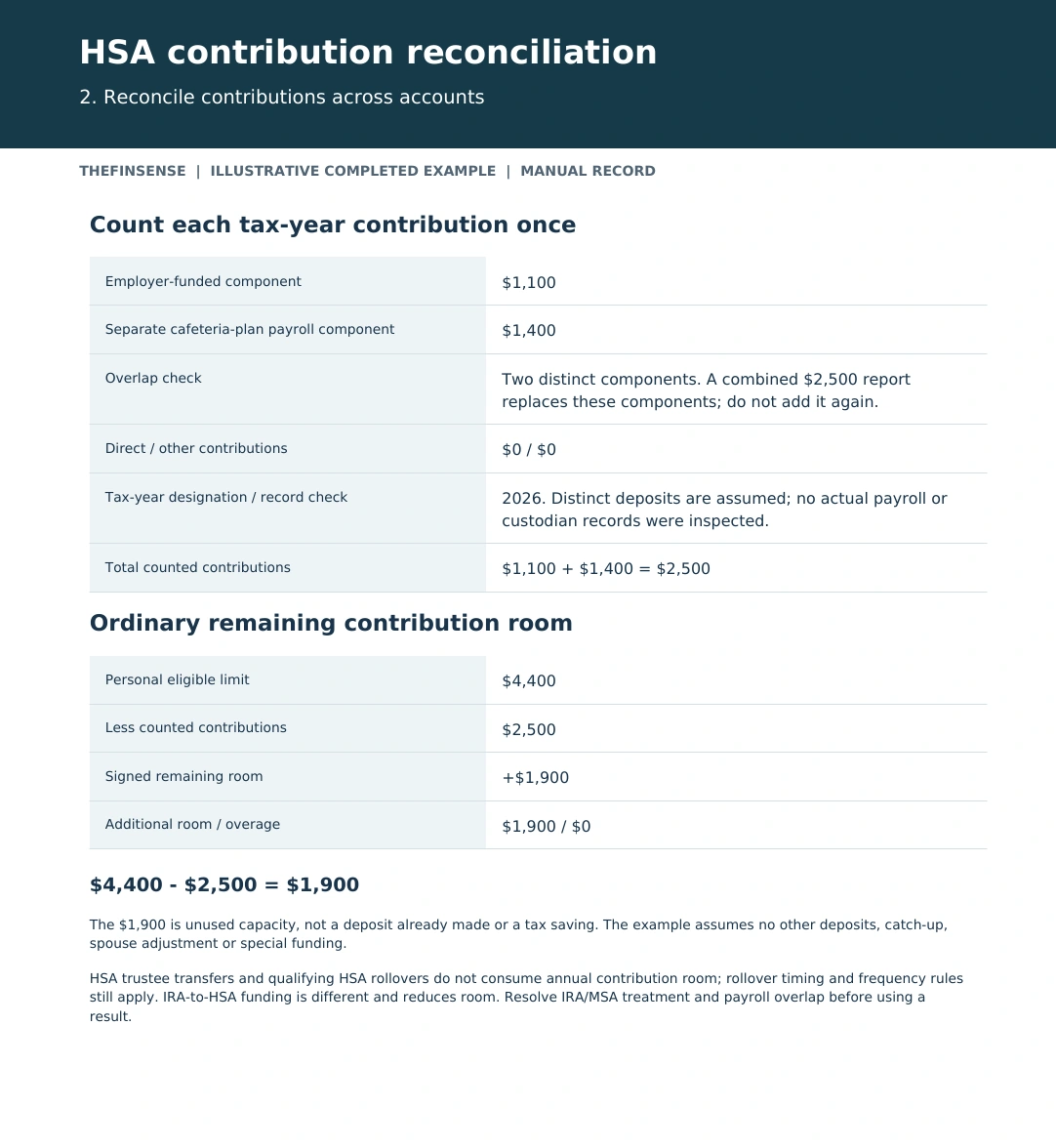
Illustrative example: take a 40-year-old with verified self-only eligibility on the first day of all twelve months in 2026. Assume no other coverage problem, catch-up, spouse adjustment or other deposits. The employer contributed $1,100 and payroll contributed a separate $1,400. Counted contributions are $2,500, leaving $4,400 − $2,500 = $1,900 of room.
The employer and payroll amounts in this example are separate components. If a payroll report already combines them into $2,500, that total replaces the two components; it is not added to them.
How much of your limit is still available?
2026 self-only example · $4,400 annual limit
- Employer deposit
- $1,100
- Separate payroll deposits
- $1,400
- Remaining contribution room
- $1,900
$4,400 − ($1,100 + $1,400) = $1,900 remaining
Download the printable HSA reconciliation record (PDF). This is a manual worksheet, with no automatic calculations. Its fields retain the evidence behind your number so a payroll or coverage change can be reconciled without rebuilding the record.
Download the completed example (PDF, 3 pages) to see how the same $1,900 result is recorded. Eligibility and deposits are illustrative assumptions, not verified personal records.
- Person, accounts and year
- Enter the tax year, your name and HSA accounts, and the IRS source edition and date you used.
- Monthly eligibility
- Record each person’s coverage and eligibility on the first day of every month, with the evidence or the question still to resolve.
- Personal limit
- Enter your base limit, your own catch-up and any agreed share of the family limit separately. Use the IRS worksheet if coverage or spouse eligibility changes during the year.
- Contributions already counted
- List employer, payroll, direct and other deposits for that tax year. Mark any reporting total that already includes payroll.
- Transfers and adjustments
- Identify transfers and rollovers. Resolve any IRA-to-HSA funding or Archer MSA adjustment before finishing the calculation.
- Room and later checks
- Keep the ordinary result, including any overage, and the last-month comparison separate. Record actual contributions relying on the last-month rule, matched payroll and custodian totals, and verified deadlines.
Update the same record when the tax year, coverage, monthly eligibility, Medicare effective date, spouse allocation or counted deposits change. Keep an unknown month distinct from an ineligible month.
Family allocation and each spouse’s catch-up
If both spouses are eligible individuals and either has family coverage, they share one family base limit. It is ordinarily split equally unless they agree to another division. Separate accounts or separate family plans do not give each spouse a full family base. This rule is in Publication 969, “Rules for married people.”
The household part of the reconciliation record therefore keeps each person’s share of the base, own catch-up and counted deposits separate. A household subtotal does not itself reallocate the shared base. Reflect any permitted allocation you both agree to in each spouse’s calculation, and keep each catch-up in its owner’s HSA. An account-specific overage still needs its own reconciliation.
The own-HSA catch-up is the eligible person’s additional amount when that person is 55 or older at tax-year end. Full-year eligibility can support $1,000; partial-year eligibility can prorate it. If both spouses qualify, each catch-up belongs in that spouse’s own HSA. One spouse cannot put both catch-ups into a single account. See the Form 8889 instructions, line 7, “Additional Contribution Amount.”
When two eligible spouses each have self-only coverage, each instead has a self-only limit. That is a different arrangement from sharing a family base. Mixed coverage or eligibility months require the applicable Form 8889 allocation rules and worksheets; a full-year household shortcut cannot resolve them.
Part-year coverage and the last-month choice
A coverage change makes the month entries in your reconciliation record matter. Under the ordinary method, add the annual base applicable to each eligible first-day month and divide by 12. An ineligible month contributes zero; an unknown month still needs verification. Keep any own catch-up and spouse allocation separate, using the Form 8889 Line 3 Limitation Chart and Worksheet for the applicable adjustments.
December coverage does not automatically replace that result. When the last-month rule applies, compare the ordinary amount with the amount based on December 1 eligibility and coverage. Retain the larger limit, as explained in IRS Notice 2008-52, “Annual HSA contribution limits for 2007 and later years.” With six eligible family-coverage months followed by six eligible self-only months in 2026, the ordinary base is $6,575 while the December self-only base is $4,400. Using December alone would discard valid ordinary room. That comparison concerns base limits before counted deposits, not two amounts available to deposit.
For the alternate-path illustration, assume a 40-year-old is not eligible January–June 2026 and has verified first-day self-only eligibility July–December, including December 1. There is no catch-up, spouse allocation, other contribution or special adjustment. The employer contributed $600 and the person made a separate $400 direct contribution.
| Quantity | Ordinary monthly method | Last-month alternative |
|---|---|---|
| Eligible limit | 6 × $4,400 ÷ 12 = $2,200 | $4,400, conditional on the last-month rules |
| Counted contributions | $600 + $400 = $1,000 | The same $1,000 |
| Remaining room | $2,200 − $1,000 = $1,200 | $4,400 − $1,000 = $3,400 |
The difference is $2,200 of conditional extra capacity. It is neither money already contributed nor automatic taxable income. Both paths use the same illustrative inputs. Any additional deposit still depends on your actual eligibility and the testing-period conditions below.
For this 2026 last-month comparison, the testing period runs from December 1, 2026, through December 31, 2027. If extra contributions rely on the rule, remaining eligible throughout that period matters. The record has a separate field for the actual contributions that rely on it, so unused capacity is not mistaken for taxable money.
Publication 969 requires income inclusion for contributions that would not have been made except for the last-month rule if eligibility fails during the testing period, other than because of death or disability. It then states:
This amount is also subject to a 10% additional tax.IRS Publication 969, “Last-month rule” and “Testing period”. The income and additional tax belong to the year eligibility fails. The rule concerns actual attributable contributions, not the entire HSA balance, all contributions or unused capacity.
After choosing the applicable path, enter its limit in the same reconciliation record. Medicare or other unresolved coverage can change the eligible months and any testing-period exposure; those inputs need the eligibility checks below before the comparison supports a deposit.
Eligibility changes that alter the calculation
Medicare enrollment changes the eligible months. Beginning with the first month of Medicare enrollment, the contribution limit is zero, including months covered by retroactive enrollment. The effective date matters; turning 65 or choosing a deposit date does not, by itself, establish the contribution answer. A later deposit may still be designated for an earlier eligible tax-year period within its applicable deadline. Publication 969, “Enrolled in Medicare” and “When To Contribute,” distinguishes these issues.
Other coverage depends on whom and what it covers. A general-purpose health flexible spending arrangement (FSA) or health reimbursement arrangement (HRA) can disqualify HSA contributions. Specified limited-purpose and post-deductible arrangements can be permitted. A spouse’s arrangement is relevant if it actually covers you; its existence alone does not settle your eligibility. Plan documents and the Publication 969 sections on other health coverage and other employee health plans help resolve that input.
| Tax year | Minimum annual deductible | Maximum annual out-of-pocket expenses |
|---|---|---|
| 2026 | $1,700 / $3,400 | $8,500 / $17,000 |
| 2027 | $1,750 / $3,500 | $8,700 / $17,400 |
These figures test the health plan under the ordinary high deductible health plan (HDHP) rules. They are not amounts you can contribute to an HSA. Out-of-pocket expenses here include deductibles and copayments, but not premiums; applicable network rules also matter. The annual source provisions are Revenue Procedure 2025-19, section 2.01(2) and Revenue Procedure 2026-24, section 3.01(3), with the network qualification explained in Publication 969, “High deductible health plan.”
Qualifying individual-market Bronze and Catastrophic plans have a separate route. For months after December 31, 2025, qualifying plans available as individual coverage through an Exchange can be treated as HDHPs even without meeting the ordinary deductible and out-of-pocket tests. Off-Exchange coverage can qualify when the same plan is available on an Exchange. The IRS also provides relief for individual-market Bronze or Catastrophic coverage when the individual has no reason to believe the coverage is not available on an Exchange. SHOP group Bronze coverage does not automatically qualify under this provision, although a plan can meet the ordinary HDHP rules. These boundaries are in Notice 2026-05, Q&A 4–9. The remaining person-level eligibility requirements still apply.
Qualifying telehealth and remote care before the deductible no longer automatically disqualify an otherwise eligible person: the permanent relief applies to plan years beginning after December 31, 2024. Qualifying direct primary care (DPC) arrangements have separate relief for months after December 31, 2025. For 2026 and 2027, the aggregate monthly DPC fee thresholds are $150 for one individual or $300 for an arrangement covering more than one individual. These are monthly qualification thresholds across arrangements, not annual HSA contribution ceilings.
The DPC fee alone is insufficient. The arrangement must provide only qualifying primary care, with fixed periodic compensation and the applicable service restrictions. The covered services and terms, rather than simply which services you use, determine that status. Notice 2026-05, sections II and III, explains the conditions; Revenue Procedure 2026-24, section 3.01(2), supplies the 2027 fees. The IRS overview of the changes also identifies their effective periods.
Once the actual coverage and effective months are resolved, update the month ledger and return to your personal-room calculation or the last-month comparison.
Records, deadlines and excess contributions
Before changing a payroll election or making another deposit, reconcile employer/payroll and custodian records across all your HSAs for the designated tax year. Payroll amounts already included in an employer reporting total are counted once. The payment date and designated contribution year may differ; the Form 8889 instructions, lines 2 and 9, distinguish personal and employer reporting.
An HSA-to-HSA direct trustee transfer does not use annual contribution room. A qualifying HSA rollover also sits outside the annual contribution limit, but has its own timing and frequency rules. A qualified IRA-to-HSA funding distribution is different: it reduces contribution room. Use the Form 8889 worksheet and instructions to resolve IRA funding or Archer MSA adjustments before calculating a final deposit amount. These distinctions are in Publication 969, “Rollovers,” “Qualified HSA funding distribution” and “Reduction of contribution limit.”
For positive remaining room, ordinary contributions generally may be made through the unextended federal return filing deadline for that tax year. An extension to file is not generally an extension to make ordinary HSA contributions. Verify the actual year’s IRS deadline and any applicable relief before scheduling the deposit. The April 15, 2026, example in Publication 969, “When To Contribute,” concerns 2025 contributions; it is not a calendar promise for a later tax year.
For an actual overage, contact the custodian about its excess-contribution return process. Excess HSA contributions generally incur a 6% excise tax for each tax year the excess remains. Timely correction generally requires withdrawing the excess and its associated earnings by the tax-return due date, including extensions. Earnings are included in income for the year they are withdrawn. The conditions are in Publication 969, “Excess contributions.” An ordinary withdrawal alone does not establish that the excess and earnings have been corrected.
The distinction between deadlines changes the next step: a filing extension can matter for excess correction without creating more time for an ordinary contribution. Keep the custodian’s completed correction and tax-year designation with the reconciliation record; earnings removal and excise-tax computations require their own applicable instructions.