📅 Originally Published: · Last Updated:
A current runs beneath every portfolio statement, steady and invisible, pulling returns in a direction the investor did not choose.
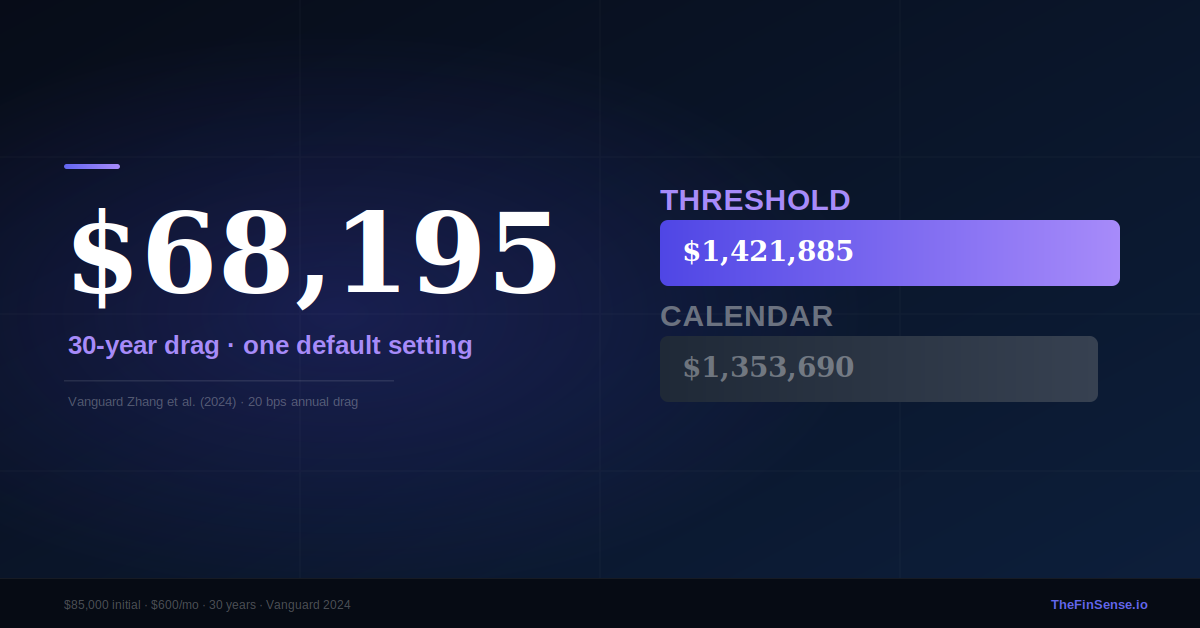
$68,195
0.20% annual drag
compounded over 30 years
What Is Your Rebalancing Drag?
Enter your current 401k or IRA balance to estimate the 30-year cost of monthly calendar rebalancing versus a 5% threshold strategy.
| Year | With Threshold | With Calendar | Gap |
|---|
Full analysis with all variables: Rebalancing Cost Calculator
Most 401k investors set their portfolio rebalancing strategy once, at enrollment, assuming the platform default is disciplined portfolio management. Yu Zhang, Ph.D., and colleagues at Vanguard demonstrated otherwise in December 2024: threshold-based rebalancing generates 15 to 22 basis points more annual return than calendar-based alternatives, compounding to a $68,195 terminal wealth gap over 30 years on a $85,000 starting balance with $600 monthly contributions. The mechanism is not market timing and it is not stock selection. It is a single account setting most investors have not reviewed.
April 2025 tariff volatility demonstrated threshold rebalancing’s advantage in real time. Vanguard’s system rebalanced at more opportune times while calendar portfolios drifted 7% between scheduled dates.
This analysis covers 401k and IRA accounts with standard 2-to-5-fund allocations, specifically the scenario where threshold rebalancing’s benefit is most directly applicable. This analysis uses institutional research applied to a retail scenario; individual results vary by portfolio complexity, account type, and tax situation.
Portfolio Rebalancing Strategy: What the Calendar Default Actually Does
The calendar trigger embedded in most managed 401k accounts executes trades on a fixed schedule (monthly or quarterly) regardless of whether the portfolio has actually drifted from its target allocation. It is the default not because it produces the best outcomes, but because it requires no monitoring infrastructure from the investor and no disclosure of proprietary thresholds from the platform.
Calendar rebalancing does not measure whether your portfolio needs a trade; it measures whether a month has passed.
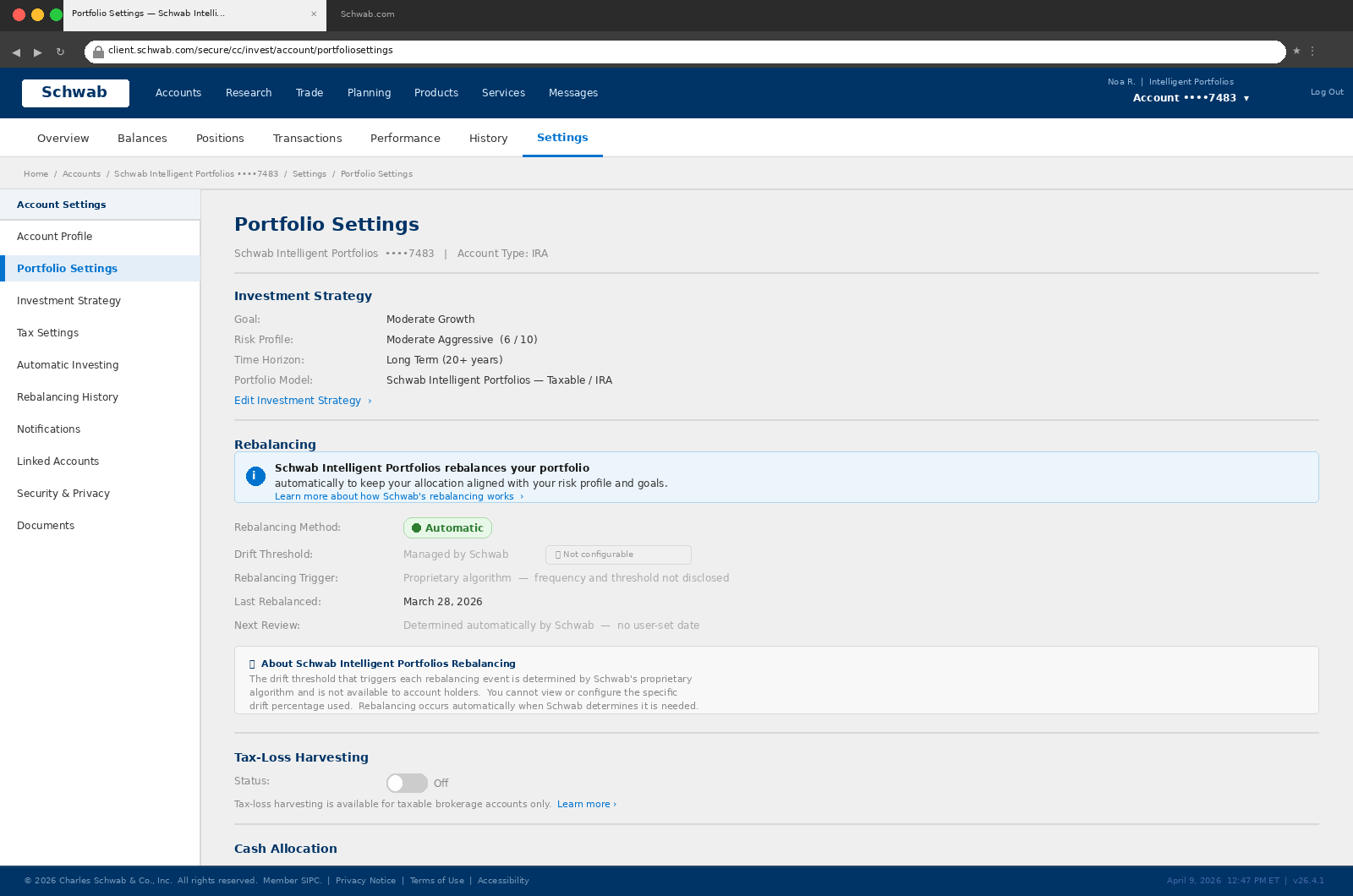
Schwab Intelligent Portfolios rebalances automatically, but the drift threshold that triggers each trade is proprietary and not disclosed to account holders.
The Default Portfolio Rebalancing Strategy Setting Most Investors Did Not Choose
A portfolio rebalancing strategy based on calendar frequency became the industry standard in the 1990s, when portfolio management software tracked time more easily than it tracked allocation drift. The infrastructure constraint drove the methodology. The methodology became the convention. The convention became the default that robo-advisors and managed 401k platforms shipped to retail investors decades later, long after the original constraint disappeared.
Threshold-based rebalancing triggers a rebalancing trade only when an asset class drifts beyond a defined percentage band from its target allocation (typically 5% absolute or 20% relative), rather than executing on a fixed calendar schedule regardless of portfolio drift.
The Bogleheads community surfaced the same finding from the practitioner side: Vanguard’s own research calls monthly and quarterly calendar methods “too frequent” for individual investors, while the platform simultaneously ships calendar rebalancing as the default in its managed accounts. The institutional finding and the retail product are pointed in opposite directions.
Why Frequency Is the Wrong Variable to Optimize
Calendar rebalancing is the approach most financial institutions recommend, and for good reason: it requires no monitoring software, eliminates the risk of forgetting to check, and ensures the portfolio is touched at least once per period. This belief is reinforced by major broker platforms that default to calendar rebalancing in their managed accounts, by financial media that frames monthly rebalancing as disciplined investing, and by the observable fact that any rebalancing outperforms no rebalancing at all. The argument has a real foundation, and the question is not whether to rebalance but whether a calendar is the right trigger.
Whether you let your 401k rebalance on autopilot, manage a three-fund portfolio yourself on a quarterly calendar, or trust a robo-advisor to handle drift, the same 20 basis point drag compounds identically against your terminal wealth.
The $16 Billion Cost of Trading on a Calendar
Calendar trades cost $16 billion annually because the schedule is too predictable.
Portfolio Rebalancing Drag by Method: Monthly Calendar vs. Threshold Strategy (Annual Basis Points)
A 5% threshold strategy eliminates calendar-driven unnecessary drag. Sources: Vanguard Zhang et al. 2024; Harvey, Mazzoleni, Melone 2026.
How Predictable Calendar Trades Create a $16 Billion Annual Cost
Campbell R. Harvey, Ph.D., is a Duke University economist, NBER research associate, and former editor of the Journal of Finance. In a 2026 NBER working paper, Harvey and co-authors Michele G. Mazzoleni and Alessandro Melone measured the aggregate cost of calendar-based institutional rebalancing. Harvey, Mazzoleni, and Melone (2026) estimated that calendar-based institutional rebalancing costs investors approximately $16 billion annually. The cost is structural.
The mechanism Harvey et al. identified is front-running: when institutions must rebalance on a predictable calendar date, other market participants price the anticipated order flow into the following trading session. Every calendar date becomes a trading opportunity for others. Harvey et al. (2026) estimated calendar-based rebalancing costs institutional investors approximately $16 billion annually, roughly $200 per US household.
In tax-advantaged accounts, the calendar drag compounds without the additional friction of capital gains; our HSA investment strategy analysis covers the drag-free growth advantage those accounts carry.
Harvey et al. found calendar rebalancing costs institutional investors $16 billion annually because the trades are predictable enough to front-run.
Harvey et al. (2026) trace the $16 billion annual cost to one structural property: calendar trades are predictable. For a retail investor, the mechanism is different, but the direction is the same: the calendar creates unnecessary trades that interrupt momentum.
From $16 Billion to $200 Per Household
The $200-per-household estimate Harvey et al. derived represents a system-wide average that smooths across all US investor types, account sizes, and rebalancing frequencies. At the individual account level, Harvey et al. traced the mechanism to a 17-basis-point next-day equity decrease following predictable institutional calendar trades. Discipline is not how often you trade but whether you trade for a reason. The calendar does not ask that question.
The transaction cost line on a statement captures commissions but not the 17 basis points of equity return the market extracted the day after every predictable calendar trade.
Whether the trigger is the platform’s autopilot, your quarterly calendar, or an algorithm, the same switch eliminates the same drag.
❌ Calendar Default
Your 401k executes rebalancing trades on a fixed monthly or quarterly schedule, regardless of whether your allocation has actually drifted from its target. Each predictable trade carries a 17-basis-point market impact cost that does not appear on any account statement.
✅ Threshold Alternative
A 5% drift threshold triggers rebalancing only when your allocation has moved beyond its target band, eliminating the calendar drag entirely without changing a single investment holding.
Why 15 to 22 Basis Points Becomes $68,195 Over 30 Years
At $16 billion institutionally, the drag on a single account is the question.
Daryanani’s 2008 Paradigm Shift: The Trigger Beats the Frequency
Before Daryanani (2008), the field assumed calendar frequency was the primary variable in rebalancing optimization. Wealth managers debated whether to rebalance quarterly or annually, treating the calendar as the only available trigger mechanism. Daryanani demonstrated that the trigger itself matters more than the frequency, shifting the paradigm from how often to trade to when drift justifies a trade.
Gobind Daryanani, CFP, Ph.D., published the foundational threshold rebalancing study in the FPA Journal in January 2008, examining a five-asset-class portfolio across multiple market cycles. His findings established the mechanism: threshold-based rebalancing outperformed annual calendar rebalancing by 30 basis points annually and outperformed no rebalancing at all by 0.45%. The driver was not increased trading activity but the opposite: threshold triggers eliminated trades that calendar schedules forced when no drift existed, allowing momentum to compound uninterrupted between genuine rebalancing events.
Vanguard’s 2024 Quantification: 15 to 22 Basis Points in Accumulation
Yu Zhang, Ph.D., lead researcher at Vanguard, and co-authors Harshdeep Ahluwalia, Ankul Daga, CFA, and Yiran Zi published the institutional quantification in December 2024. Vanguard rebalancing edge research documented 15 to 22 basis points of annual return improvement in the accumulation phase, 22 to 25 basis points in decumulation, and 43 basis points less allocation deviation from target using absolute bands of 200 basis points. The automation removed human judgment about when drift was sufficient to justify a trade, and that turned out to be the error the calendar schedule had been perpetuating.
All projections in this analysis use the monthly-compounded annuity FV formula: FV = P·(1+r/12)^n + PMT·[((1+r/12)^n − 1)/(r/12)]. See TheFinSense calculation methodology for full derivation details.
The Arnott Confirmation: Annual Has Risk Edge, Threshold Has Return Edge
Amy C. Arnott, CFA, portfolio strategist at Morningstar and co-host of “The Long View” podcast, confirmed the directional finding:
“Annual rebalancing has a slight edge for risk reduction, while a threshold rebalancing strategy pulls out ahead when it comes to upside returns.”
The Daryanani mechanism and the Vanguard quantification converge on the same conclusion from independent datasets spanning 16 years.
Fifteen basis points is invisible on a single trade but separates $68,195 from a retirement account across 360 monthly periods.
The 20 basis points of drag from calendar rebalancing never appears as a line item on any account statement.
The mechanism compounds at the portfolio level through two channels: unnecessary transaction volume when the calendar triggers a trade despite minimal drift, and momentum interruption when assets that would have continued compounding are rebalanced back to target prematurely. Zhang et al. (2024) documented both effects in the VCMM simulation, finding that threshold strategies generated 43 basis points less allocation deviation, meaning the portfolio stayed closer to target allocation precisely because it traded less, not more.
⚠️ TAXABLE ACCOUNT CAVEAT: Capital Gains Tax Drag: Taxable accounts carry an additive cost layer on top of the $68,195 base-case gap. A taxable portfolio running monthly calendar rebalancing generates approximately $1,200 per year in unnecessary long-term capital gains per $100,000 invested, adding roughly $36,000 in cumulative tax friction over 30 years, equivalent to 53% of the base-case gap. The full cost of monthly calendar rebalancing in a taxable account compounds across both mechanisms simultaneously.
Noa’s Statement: Twelve Trades, One Setting, $68,195
What the Statement Revealed
Noa assumed the 401k’s monthly rebalancing was a feature.
Most readers will estimate the 30 year cost of monthly rebalancing between $5,000 and $15,000.
Three weeks after April 2025 tariff headlines shook the S&P 500, Noa opens a quarterly 401k statement on a Saturday morning. The statement shows twelve calendar-triggered rebalancing events for the prior year, each executing on schedule whether the portfolio had drifted 1% or 7% from target.
The parameters below define the 30-year projection. The drag rate comes directly from Vanguard Zhang et al. (2024).
| Parameter | Value |
|---|---|
| Name / Age | Noa, 35 (target: 65) |
| Income | $95,000 |
| Initial Balance | $85,000 |
| Monthly Contribution | $600 ($7,200/year) |
| Time Horizon | 30 years |
| Threshold Return Rate | 7.00% gross annual |
| Calendar Return Rate | 6.80% (20 bps drag applied) |
| Drag Source | Monthly calendar rebalancing trigger |
| Formula | FV = P·(1+r/12)^360 + PMT·[((1+r/12)^360−1)/(r/12)] |
Running both rates through the formula produces a gap that grows nonlinearly. The difference is imperceptible in year five and unavoidable at year thirty.
| Year | Threshold Portfolio (7.00%) | Calendar Portfolio (6.80%) | Gap |
|---|---|---|---|
| 5 | $163,454 | $162,040 | $1,414 |
| 10 | $274,672 | $270,174 | $4,499 |
| 15 | $432,338 | $421,950 | $10,388 |
| 20 | $655,849 | $634,983 | $20,866 |
| 25 | $972,704 | $933,996 | $38,708 |
| 30 | $1,421,885 | $1,353,690 | $68,195 |
Running the 30-Year Calculation
A $1,414 gap at year five is rounding error on an $85,000 portfolio. By year twenty, the same portfolio rebalancing strategy default produces a $20,866 gap. By year thirty, it produces $68,195 from the same unreviewed account setting. The only variable that changed was the compounding period.
Noa’s $85,000 account is not institutional, but the 0.20% drag compounding over 30 years does not care about the starting balance.
Every calendar trade that executed without measured drift taxed Noa’s momentum. The account displayed no threshold field. The $68,195 difference appears only when the formula runs both paths side by side.
$1,421,885 in Noa’s threshold account. $1,353,690 in the calendar account. The gap bought 45 months of childcare. A setting Noa did not choose.
That drag is 1 of every 20 dollars at retirement.
Every calendar date, Noa’s account drifted — but the clock, not the drift, scheduled the trade.
The confusion was not the return figures. Noa had assumed disciplined rebalancing meant frequent rebalancing; the 0.20% drag had not appeared on any statement as a cost. Twelve trades. One setting. $68,195.
What the Gap Actually Buys
Portfolio Rebalancing Strategy Gap: Threshold Account Grows $68,195 Larger Than Calendar Over 30 Years
Noa’s 401k: $85,000 initial + $600/month. Threshold (7.00%) vs. Calendar (6.80%). Drag: 20 bps per Vanguard Zhang et al. (2024).
At $1,500 per month median childcare costs, the $68,195 gap funds 45 months of that expense alone. The same figure covers 3.4 years of in-state tuition at a public university. Calendar rebalancing spent each of those months generating trades on schedule for drift Noa had not measured.
How to Switch to Threshold Rebalancing in One Afternoon
The mechanism is identified; the change takes one afternoon.
Investors who lack discipline to monitor drift regularly may still benefit more from any automated calendar schedule than from no rebalancing at all.
📐 YOUR NUMBERS MAY DIFFER
Base case assumes 20 bps drag, 7.00% gross return, $85,000 initial balance, $600/month contributions, and 30-year horizon. Here is how the gap changes when each assumption shifts.
| Assumption Changed | Scenario | Threshold FV | Calendar FV | Gap |
|---|---|---|---|---|
| Base case ✅ | 20 bps / 7.00% / 30yr / $85K | $1,421,885 | $1,353,690 | $68,195 |
| Drag ↓ | 15 bps | $1,421,885 | $1,370,398 | $51,487 |
| Drag ↑ | 22 bps | $1,421,885 | $1,347,070 | $74,815 |
| Return ↓ | 6.00% | $1,114,628 | $1,062,409 | $52,219 |
| Return ↑ | 8.00% | $1,823,753 | $1,734,480 | $89,273 |
| HORIZON ↓ | 20 years | $655,849 | $634,983 | $20,866 |
| HORIZON ↑ | 40 years | $2,961,358 | $2,769,611 | $191,747 |
| Balance ↓ | $50,000 initial | $1,137,807 | $1,086,065 | $51,743 |
| Balance ↑ | $150,000 initial | $1,949,457 | $1,850,710 | $98,747 |
| Band 3% (tighter) | ~10 bps drag | $1,421,885 | $1,387,330 | $34,554 |
| Band 10% (wider) | ~5 bps drag | $1,421,885 | $1,404,492 | $17,393 |
Every monthly contribution is already a monitoring event; the only change is checking drift before directing the deposit.
Setting a drift threshold alert in Vanguard or Fidelity requires four account-settings clicks; Schwab SIP provides no equivalent user control.
Step 1: Identify Your Current Rebalancing Method
Time required: 5 minutes. Log into your primary retirement or brokerage account and navigate to the rebalancing or automatic investing section. Confirm whether the monthly calendar rebalancing trigger is active: a calendar frequency dropdown set to monthly or quarterly indicates calendar default; a percentage band input field indicates threshold rebalancing is already configured. Most platforms reach this section within two clicks from the main menu or settings panel.
If no rebalancing setting is visible, locate the Plan Documents or contact your 401k administrator; many employer plans enforce a platform default without surfacing it to the account holder.
Step 2: Choose Your Threshold Band
Time required: 10 minutes. A 5% absolute band is the standard starting point for a standard retirement portfolio. It requires no daily monitoring and is supported by both Daryanani (2008) and Vanguard Zhang et al. (2024) for retail accumulation scenarios.
The research translates to retail thresholds differently by source. Daryanani’s 20% relative threshold means a 60% equity allocation triggers rebalancing when equity reaches 48% or 72%. Vanguard’s 200-basis-point absolute band triggers at 58% or 62% on that same target. A 5% absolute band sits between the two and captures most of the documented advantage without requiring institutional-level monitoring infrastructure.
| Band Width | Best For | Est. Annual Events | Drag Eliminated |
|---|---|---|---|
| 3% absolute | Complex multi-asset / daily monitoring | 6–9 | ~10 bps |
| 5% absolute ✅ | Standard 2–4 fund 401k or IRA | 4–6 | ~15–20 bps |
| 10% absolute | Simple 2-fund / quarterly check | 2–4 | ~5 bps |
| 20% relative | Multi-asset-class (Daryanani 2008) | Moderate | ~30 bps vs. annual |
Step 3: Set the Drift Alert in Your Account
Time required: 10 minutes. Vanguard and Fidelity each require approximately four clicks: Account Settings (or Planning) → Rebalancing → Select threshold-based → enter band percentage. Schwab Intelligent Portfolios does not expose a configurable threshold; the rebalancing trigger is proprietary and undisclosed to account holders. If your 401k platform has no threshold option, document the current calendar setting and contact plan administration about available alternatives.
Setting the alert is not the rebalancing action; it is the trigger. Once configured, the platform compares current allocation against target at each check and trades only when the band is breached.
Step 4: Use Each Contribution as a Monitoring Event
Time required: 5 minutes per contribution. Before directing each monthly deposit, open the allocation screen and check whether any asset class has breached the threshold. If drift exceeds 5%, rebalance before adding new money. If drift is within the band, deposit normally. This converts an existing behavior into a monitoring discipline without adding a separate calendar reminder.
The March 2020 COVID drawdown is the documented real-money case for this approach. A Bogleheads investor using a 5/25 threshold band triggered rebalancing at the market bottom, directing contributions into small-cap value positions that gained 95% within months. A monthly calendar portfolio waited for its next scheduled date.
Threshold Rebalancing Decision Tree: How to Switch from Calendar in One Afternoon
4 steps · 30 minutes total · No new tools required.
The Rebalancing Cost Calculator below runs your specific balance, contribution rate, and return assumption against the 20-basis-point drag to compute your personal 30-year gap.
Rebalancing Cost Calculator
Calculate the 30-year cost of monthly calendar rebalancing versus a 5% drift threshold strategy for your account parameters.
| Year | With Threshold | Without Threshold | Gap |
|---|
Download the Rebalancing Cost Reference Guide
Formula, 3 drag scenarios (15/20/22 bps), threshold selection matrix, and platform paths. One page, print-ready.
When This Analysis Does Not Apply
Vanguard’s 2024 participant data shows that 79% of 401k participants hold managed or target-date portfolios where threshold rebalancing applies most directly.
Vanguard’s finding applies to institutional target-date funds with daily monitoring; simpler retail portfolios may capture less of this benefit.
Investors with simple portfolios can check drift at each contribution event and rebalance only when allocation exceeds 5% from target.
Switching from calendar to a 5% threshold portfolio rebalancing strategy takes one afternoon and protects $68,195 over 30 years without changing a single investment.
Rebalancing is not about frequency but about whether the trigger matches the drift; the calendar measures time, the threshold measures risk.
Noa’s $68,195 rebalancing drag stacks on top of the $334,814 expense ratio impact and the advisory fee drag quantified in our Betterment fee analysis. Together, the two invisible costs can exceed $130,000 over a career. Asset allocation strategy decisions amplify both cost types simultaneously. This is exactly the compounding cost pattern an investment policy statement is designed to document and prevent.
We update the drag rate and sensitivity table when Vanguard or comparable institutions publish new threshold rebalancing data.
Portfolio Rebalancing Strategy FAQ
Does threshold rebalancing actually improve returns over calendar rebalancing?
Yes, and the finding is consistent across independent datasets. Vanguard Zhang et al. (2024) documented 15 to 22 basis points of annual return improvement in the accumulation phase using threshold strategies versus calendar alternatives. Daryanani (2008) found a 0.45% improvement over no rebalancing and 30 basis points over annual calendar rebalancing. The mechanism is the same in both studies: threshold triggers eliminate trades that calendar schedules execute without measured drift.
What are the tax implications of switching from calendar to threshold rebalancing?
In tax-deferred accounts such as 401k and IRA, switching rebalancing methods carries no direct tax consequence. In taxable accounts, the benefit is additive: threshold rebalancing generates fewer capital gains events than calendar rebalancing, reducing unnecessary long-term capital gains by approximately $1,200 per year per $100,000 invested, roughly $36,000 cumulative over 30 years. That represents 53% of the $68,195 base-case gap as an additional drag in taxable scenarios.
Is it true that the same 5% threshold works for every portfolio type?
The optimal threshold varies by portfolio complexity. Five percent absolute is the standard starting point for simple 2-to-4-fund portfolios. Daryanani’s 20% relative threshold translates to a 60% equity allocation triggering at 48% or 72%. Vanguard’s 200-basis-point band triggers at 58% or 62% on the same target. A 5% band captures most of the documented advantage. Complex multi-asset portfolios with daily monitoring may benefit from a 3% band; simple 2-fund portfolios can use 10%.
What happens if I set my rebalancing threshold too wide or too narrow?
A threshold set too wide (10%+) allows excessive drift and captures only 5 basis points of the calendar drag benefit, reducing the $68,195 advantage to roughly $17,000 over 30 years per the sensitivity table. A threshold set too narrow (under 3%) generates near-calendar-frequency trading, which reintroduces transaction drag and momentum interruption. The 5% sweet spot triggers 4 to 6 events per year versus 12 under monthly calendar rebalancing; fewer trades, each with a clear rationale.
Does the 29% of investors who have not yet rebalanced affect this analysis?
A GOBankingRates survey from November 2024 found 29% of US investors aged 55 to 64 have never rebalanced their 401k or IRA. That population sits outside this analysis: the $68,195 gap compares calendar rebalancing to threshold rebalancing, not rebalancing to no rebalancing at all. For the 29% who have not yet rebalanced, any systematic trigger represents a meaningful improvement. Daryanani (2008) documented roughly half a percent of annual improvement from threshold rebalancing versus no rebalancing at all.
Portfolio Rebalancing Strategy: The Algorithm That Trades on a Calendar Does Not Know Your Drift
The $68,195 gap closed with one account setting Noa did not know to change.
The calendar is the wrong rebalancing trigger because it measures time, not risk. Monthly trades executed on schedule regardless of drift interrupt momentum that would otherwise compound undisturbed. The arithmetic does not adjust for sentiment; the instinct to rebalance on a schedule was the only variable the data consistently found wanting. Vanguard, Daryanani, and Harvey arrive at the same conclusion from independent datasets spanning nearly two decades: threshold strategies outperform calendar strategies because they trade on evidence rather than on the clock.
Calendar rebalancing in taxable accounts triggers capital gains events that threshold rebalancing avoids entirely.
Thirty years of compounding a 0.20% drag, undone by a single afternoon of changing one account setting.
The most expensive portfolio trades are the ones your platform made on schedule instead of on evidence.
Three decades of research converge on one finding: the calendar is the wrong trigger for rebalancing. A 5% drift threshold reduces unnecessary trades, avoids interrupted momentum, and compounds 15 to 22 basis points back into the portfolio annually. Threshold rebalancing recovers this drag by matching the rebalancing trigger to the signal that actually matters: drift, not the date.
The investor who checks drift before acting outperforms the algorithm that trades on a calendar.
The threshold you set for rebalancing is the first line of your investment policy statement.
📌 Next Read: How to Build an Investment Policy Statement That Prevents Panic Decisions
Noa at 65 remembers the terminal balance, not the rebalancing dates.
The tide compounds in silence.
YOUR TURN
Which rebalancing method does your 401k use right now?