
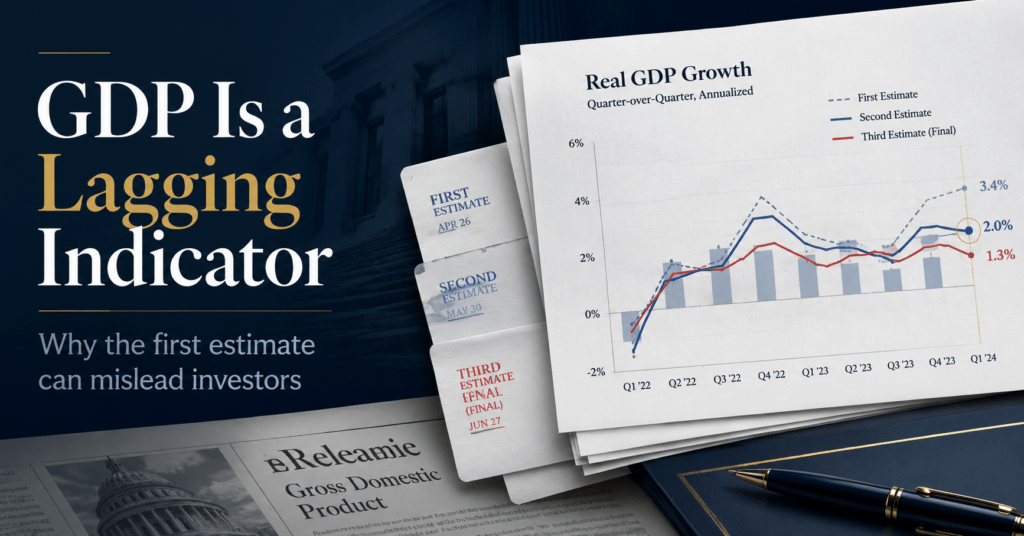
GDP is a lagging indicator because it measures activity that has already happened and is revised as fuller data arrives. The BEA publishes advance, second, and third estimates, so the same quarter can look different over time.
The first quarter of 2015 moved from slight growth to contraction and then back to growth. Long-term investors should treat each GDP release as context, not a stand-alone trading signal.
Which GDP Estimate Are You Reading?
The phrase “GDP report” hides four different levels of maturity for a GDP estimate. The advance estimate arrives fastest, but it uses source data that are incomplete or still subject to revision. The second and third estimates incorporate additional information. Annual and comprehensive updates can change the historical record again.
| Estimate | Typical timing | What changes | Reasonable investor use |
|---|---|---|---|
| Advance | Near the end of the first month after the quarter | Built with incomplete source data and assumptions for missing inputs | Early macro context; avoid treating it as a stand-alone allocation trigger |
| Second | About one month later | Adds more complete monthly and quarterly source data | Check whether the initial story strengthened, weakened, or changed direction |
| Third | About two months after the advance estimate | Incorporates another round of revised and newly available data | Better for reviewing the quarter, though it is still not final |
| Latest vintage | After annual and comprehensive updates | Uses annual surveys, benchmark data, and methodological improvements | Best for historical analysis; unavailable in real time when the trade decision occurs |
BEA’s October 2024 revision summary reports an average absolute revision of 0.5 percentage point from the advance to the second estimate, 0.7 percentage point from the advance to the third estimate, and 1.2 percentage points from the advance to the latest estimate. Those figures cover quarterly real GDP growth from 1999 through 2023. BEA also reports that the advance and latest estimates point in the same direction 97% of the time, which is a useful reality check: sign flips are important, but they are unusual rather than normal.
📚 Source: U.S. Bureau of Economic Analysis, Comparisons of Revisions to Real GDP, updated October 2024.
Who this matters to
Most relevant: investors who feel pressure to change their portfolio after an economic release.
Less relevant: investors who review GDP only as background and rebalance on a fixed schedule.
How the 2015 GDP Estimate Changed Sign
The first quarter of 2015 is a clean example because the reported growth rate crossed zero twice within three months. Each figure below was official when released, but each belonged to a different data vintage.
GDP is a lagging indicator: four estimates for 2015 Q1
| Release | Reported growth |
|---|---|
| Advance estimate, April 29 | +0.2% |
| Second estimate, May 29 | -0.7% |
| Third estimate, June 24 | -0.2% |
| Annual update, July 30 | +0.6% |
The April advance estimate showed slight growth. The May second estimate reported a contraction. The June third estimate reduced the size of that contraction. The July annual update returned the quarter to positive growth. The useful takeaway is limited but important: a near-zero advance estimate can move enough to change sign as better data arrives.
It does not prove that GDP reports are useless, nor does it prove that markets will reverse when BEA revises a quarter. Markets respond to many inputs at once, including inflation, interest-rate expectations, earnings, credit conditions, and information that may already be reflected in prices. The revision example is evidence about measurement uncertainty, not a formula for stock returns.
📚 Official releases: BEA advance estimate, second estimate, third estimate, and July 2015 annual update.
Why GDP Estimates Change
GDP combines large amounts of information about consumer spending, investment, government activity, exports, and imports. BEA must publish the advance GDP estimate before every underlying series is complete. Missing or preliminary inputs are estimated, then replaced or revised when fuller data arrives.
That process was visible again in 2026. Real GDP growth for the first quarter was reported at 2.0% in the advance estimate, revised down to 1.6% in the second estimate, and revised up to 2.1% in the third estimate. BEA said the third-estimate revision mainly reflected a downward revision to imports, partly offset by a downward revision to consumer spending. Because imports are subtracted in the expenditure calculation of GDP, a lower estimate of imports raised measured GDP growth.
| Estimate | Release date | Annualized real GDP growth |
|---|---|---|
| Advance | April 30, 2026 | 2.0% |
| Second | May 28, 2026 | 1.6% |
| Third | June 25, 2026 | 2.1% |
The sequence also shows why “final GDP” is a misleading phrase. The third estimate ends the quarter’s initial release cycle, but annual and comprehensive updates can still revise it later. A GDP figure should therefore be read with both a quarter and a vintage date.
📚 Official releases: BEA advance estimate, second estimate, and third estimate.
What Research Says About GDP Revisions
Two academic results help place the release sequence in context, but neither supports a mechanical “sell after weak GDP” or “buy after a revision” rule.
Mankiw and Shapiro: early estimates contain real news and large uncertainty
Mankiw and Shapiro’s 1986 paper studied preliminary GNP data, the headline output measure used at the time. They found that early estimates were efficient in a statistical sense, meaning later revisions could not be predicted easily from information already embedded in the initial estimate. Efficiency did not mean precision. Their abstract gives a striking example: when the preliminary estimate showed no quarterly change, the authors could be only 80% confident that the later annualized estimate would fall between -2.8% and +2.8%.
That historical interval should not be transplanted directly into a modern forecast. BEA methods and source data have changed, and the paper analyzed GNP vintages from an earlier period. The point that still holds is simple: the best estimate available today can carry enough uncertainty to make a near-zero reading fragile.
📚 Source: N. Gregory Mankiw and Matthew D. Shapiro, News or Noise? An Analysis of GNP Revisions, NBER Working Paper 1939, 1986.
Dynan and Elmendorf: provisional estimates partly miss turning points
Dynan and Elmendorf examined real-time output data from the late 1960s through 2000. They found that provisional estimates tended to understate acceleration and overstate activity during deceleration, so early releases did not fully capture turning points. They also found that adding contemporaneous financial-market, sentiment, and macro data improved forecast quality only modestly, reducing the forecast standard error by about 5%.
That finding argues for humility rather than dismissal. Policymakers and investors can combine GDP with other evidence, but no small set of extra indicators turns a provisional output estimate into a precise real-time map of the economy.
📚 Source: Karen E. Dynan and Douglas W. Elmendorf, Do Provisional Estimates of Output Miss Economic Turning Points?, Federal Reserve FEDS 2001-52.
Should Investors Trade on GDP?
For most long-horizon investors, the practical question is not whether GDP matters. It is whether one release should override an existing portfolio rule. Usually it should not.
| Situation | Better response | Why |
|---|---|---|
| Your written plan has no GDP trigger | Do not trade on the release | A surprising data point is not a reason to invent a new rule in real time |
| You rebalance on a calendar or allocation band | Keep the scheduled rule | The portfolio decision already has a repeatable trigger |
| You run a tactical macro strategy | Use the correct data vintage, predefined thresholds, and several indicators | The advance estimate is provisional and may not capture turning points fully |
| You need cash for a known expense | Follow the withdrawal plan | The cash need, not GDP, is the relevant decision variable |
A written investment policy statement is useful here because it separates a genuine portfolio trigger from an emotionally loud headline. The same discipline applies when reading the jobs report or comparing CPI with PCE inflation. Each release adds information, but none should silently replace the decision process you chose before the news arrived.
GDP is still valuable. It helps describe the economy, compare growth across periods, and test whether a broader macro story is strengthening or weakening. The mistake is asking a revised measure of past activity to do the job of a forward-looking investment rule.
Practical check: Before acting on a GDP headline, identify the quarter, the estimate vintage, the size of the revision, and the portfolio rule that authorizes a trade. If one of those four items is missing, pause.
GDP Revision FAQ
Why is GDP called a lagging indicator?
GDP is called a lagging indicator because it measures production that occurred during a quarter and is first released after that quarter has ended. The advance estimate usually appears near the end of the following month, so it describes the recent past rather than forecasting the next quarter. It also changes as more complete source data arrives. GDP can confirm that economic growth strengthened or weakened, but it cannot by itself tell an investor what markets will do next.
How many times is a GDP quarter revised?
BEA publishes three scheduled estimates for each quarter: advance, second, and third. The quarter can then change again during annual updates and comprehensive updates. Annual updates generally cover at least the five most recent calendar years, while comprehensive updates occur at roughly five-year intervals and can incorporate benchmark data and methodological changes. The third estimate is therefore the end of the initial release cycle, not the final historical value.
Can a GDP revision change from growth to contraction?
Yes, especially when the initial estimate is close to zero. The first quarter of 2015 was reported at +0.2% in the advance estimate, -0.7% in the second estimate, -0.2% in the third estimate, and +0.6% in the July annual update. BEA’s broader record shows that the direction of the advance and latest estimates matches most of the time, so this sign flip is a useful warning case rather than the typical outcome.
Is the third GDP estimate final?
No. The third estimate is based on more complete information than the advance and second estimates, but BEA can revise it during later annual and comprehensive updates. Historical research should therefore identify the data vintage being used. For an investor reading the release in real time, the practical takeaway is simple: later estimates improve the picture, but no single vintage converts past economic growth into a reliable forecast of stock returns.
Should a long-term investor sell after a weak GDP report?
A weak GDP report alone is not a sound reason for a long-term investor to sell. The release measures past activity, the advance estimate is incomplete, and market prices reflect many inputs beyond GDP. A trade may still be appropriate when a written allocation, rebalancing, liquidity, or risk-management rule calls for it. The key distinction is whether the action comes from a preexisting rule or from a reaction to one provisional headline.
The Bottom Line
GDP is a lagging indicator in two practical senses. It reports activity after the quarter has ended, and its early readings are revised as better information arrives. The 2015 sign flip shows how unstable a near-zero estimate can be. The 2026 sequence shows that meaningful revisions still occur during the normal three-release cycle.
Read GDP as a dated estimate of recent economic activity. Check the vintage, compare it with other evidence, and let a written portfolio rule decide whether any action is warranted. For most long-term investors, the correct response to one surprising GDP print is observation, not improvisation.
Keep reading: how Federal Reserve decisions reach a portfolio, how to write an investment policy statement, and why timing the business cycle is harder than it looks.
Your turn
When an economic headline surprises you, do you check the release vintage before deciding whether it matters?
- FOUNDATIONAL BEA release vintages: the 2015 Q1 sequence was checked against the four original releases; the 2026 Q1 sequence was checked against the three original releases.
- FOUNDATIONAL BEA revision statistics: average absolute revisions of 0.5, 0.7, and 1.2 percentage points were taken from BEA’s October 2024 comparison covering 1999 through 2023.
- SUPPORTING Mankiw and Shapiro (1986): used for the historical uncertainty of preliminary GNP estimates, with an explicit warning that the paper is not a modern GDP forecast interval.
- SUPPORTING Dynan and Elmendorf (2001): used for evidence that provisional output estimates partly miss accelerations and decelerations.
- METHOD No market-return backtest was used. The article makes no claim that GDP revisions mechanically cause stock returns. Its evidence concerns release timing, measurement revision, and decision discipline.
📋 Update History
- July 26, 2026: Updated the first-quarter 2026 sequence through the third estimate; removed the unsupported hypothetical dollar-loss framing; clarified that the 2015 sign flip was not an official recession declaration; reorganized the article around estimate vintages and investor decisions.
- June 18, 2026: Original publication.